The AI writing tools market has exploded past simple grammar checkers and template libraries. In 2025, the platforms competing for your attention are capable of drafting full-length blog posts, generating conversion-ready ad copy, synthesising research notes, and even holding multi-turn editorial conversations about brand voice and narrative structure. Choosing poorly doesn't just cost you a monthly subscription - it costs you time, momentum, and sometimes your output quality.
This guide isn't a roundup of press releases. It's built on the kind of comparative analysis that marketers, founders, content teams, and solo creators actually need: what does each tool feel like after three months of daily use? Where does each platform quietly underperform? And when you weigh everything - capability, reliability, pricing, and the often-overlooked cost of a steep learning curve - which tools are truly worth your time in 2025?
We've evaluated five tools across six weighted dimensions: output quality, ease of use, feature depth, pricing value, customisation flexibility, and overall performance. Each section includes a detailed breakdown, honest pros and cons, a star rating grid, and a direct answer to the question every reader is thinking: should I actually switch to this?
The five tools under the microscope are ChatGPT (GPT-4o), Jasper AI, Copy.ai, Writesonic, and Notion AI. They represent the widest range of use cases, price points, and underlying philosophies in the current AI writing landscape - which makes their differences especially illuminating.
At a Glance: Master Comparison Table
Before diving into the individual deep-dives, here's a high-level snapshot across the five tools. Numbers represent scores out of 5 based on our evaluation framework.
| Tool | Output Quality | Ease of Use | Feature Depth | Pricing Value | Customisation | Overall |
| ChatGPT (GPT-4o) | 4.8 | 4.5 | 4.7 | 4.2 | 4.3 | 4.5 |
| Jasper AI | 4.3 | 4.0 | 4.5 | 3.2 | 4.6 | 4.1 |
| Copy.ai | 3.9 | 4.7 | 3.8 | 4.1 | 3.4 | 4.0 |
| Writesonic | 4.1 | 4.3 | 4.2 | 4.5 | 3.8 | 4.2 |
| Notion AI | 3.7 | 4.8 | 3.3 | 4.4 | 2.9 | 3.8 |
Pricing Comparison: What You're Actually Paying For
Pricing in this category is rarely straightforward. Many tools advertise low entry points but gate the genuinely useful features behind enterprise tiers. The table below maps each tool's key plans against what you actually get - and flags where the real value inflection points are.
| Tool | Free Tier | Entry Paid Plan | Mid Plan | Enterprise / Max |
| ChatGPT | GPT-3.5 only; limited file uploads | $20/mo - GPT-4o + plugins | $25/mo Team (per seat) | Custom pricing; API access |
| Jasper AI | 7-day trial only | $39/mo - Creator (1 seat) | $59/mo - Pro (up to 5 seats) | Custom - Business tier |
| Copy.ai | 2,000 words/mo; 1 seat | $36/mo - Starter | $186/mo - Team (5 seats) | Custom GTM platform |
| Writesonic | 10,000 words/mo (trial) | $16/mo - Small Team | $33/mo - Freelancer | $99/mo - Enterprise |
| Notion AI | Add-on: $8/mo/member on Plus plan | Plus: $10/mo + $8 AI add-on | Business: $15/mo + $8 AI | Enterprise custom + AI |
Key takeaway: Writesonic offers the most generous word allocation at its lowest paid tier. Jasper's pricing is premium but justified for agencies managing brand voice at scale. Notion AI's value depends entirely on whether you're already embedded in the Notion ecosystem - for newcomers, it's an odd buy.
ChatGPT (GPT-4o): The Swiss Army Knife with a Sharp Edge
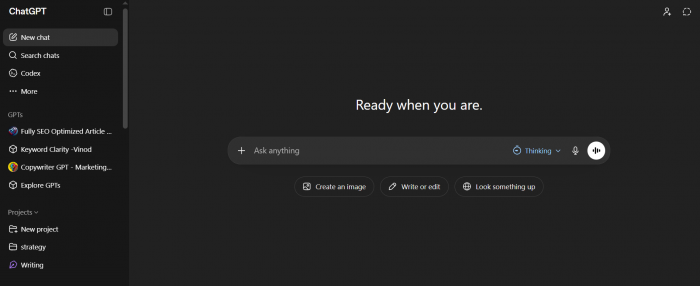
There's a reason ChatGPT has become the reference point against which everything else in the AI tools market is measured. Released as GPT-4o in mid-2024, the current flagship model from OpenAI operates as a genuinely versatile thinking partner rather than a narrow content generator. Whether you're drafting a 3,000-word research synthesis, rewriting an underperforming landing page, debugging a Python function, or brainstorming campaign angles, it handles context switching with a fluency that still surprises regular users.
What separates GPT-4o from its predecessors isn't just raw capability - it's the speed at which the model produces outputs. Earlier GPT-4 variants could feel sluggish under a heavy prompt. GPT-4o delivers comparable quality in roughly a quarter of the time, which matters enormously in a production workflow where you're running the model dozens of times per day.
The ecosystem matters here too. ChatGPT Plus subscribers get access to a plugin marketplace, DALL-E image generation, advanced data analysis tools (including the ability to upload spreadsheets and interrogate the data conversationally), and - perhaps most crucially - the Custom GPTs feature, which lets you build task-specific agents trained on your own documents, tone guidelines, and brand reference material.
Core Features Breakdown
•GPT-4o model with multimodal input (text, images, files, and voice) - making it uniquely capable for mixed-media research tasks.
•Custom GPTs: build private, shareable agents pre-loaded with your system prompt, knowledge files, and workflow constraints.
•Advanced Data Analysis: upload CSVs, Excel files, or PDFs and run analytical queries using Python under the hood.
•DALL-E 3 integration for prompt-based image generation directly within the chat interface.
•Memory feature (beta): can retain user preferences and context across sessions, reducing repetitive re-prompting.
•Plugin ecosystem: third-party integrations including Zapier, Canva, Wolfram Alpha, and dozens of niche productivity tools.
•API access: for developers, the underlying model is accessible via a well-documented API, enabling deep workflow integration.
Real-World Performance
In long-form content tasks, GPT-4o consistently produces output that reads like a knowledgeable human author rather than a content generator working through a template. The model understands subtext, can adopt specific personas with precision, and handles nuanced tonal instructions - 'write this like a cynical but optimistic technology columnist with a dry sense of humour' - better than any other tool in this comparison.
Where it struggles is in predictability. If you're a content team trying to produce 30 landing pages that all sound identically on-brand, GPT-4o can drift between sessions without a well-crafted Custom GPT keeping it anchored. It's a tool that rewards sophisticated prompting. Teams who treat it as a turnkey solution and ignore prompt engineering will consistently underperform relative to teams who invest time in building good system instructions.
The data analysis capabilities are a genuine competitive moat. No other AI writing tool on this list can take a messy sales dataset, clean it, run a regression, visualise the output, and then write a narrative summary of the findings in the same session. For strategy consultants and growth marketers, this alone can justify the $20/month subscription.
Who It's Best Suited For
•Marketers and growth strategists who need flexible multi-format outputs across a single session.
•Founders and solo operators who want one tool to cover writing, research, data, and planning.
•Developers integrating AI capabilities into their own products via the API.
•Researchers and academics who need a rigorous, nuanced thinking partner for complex topic synthesis.
•Power users who are willing to invest time in building Custom GPTs for specific workflows.
Ratings
| Category | Score | Rating |
| Output Quality | 4.8/5 | ★★★★½ (4.8/5) |
| Ease of Use | 4.5/5 | ★★★★½ (4.5/5) |
| Feature Depth | 4.7/5 | ★★★★½ (4.7/5) |
| Pricing Value | 4.2/5 | ★★★★☆ (4.2/5) |
| Customisation Flexibility | 4.3/5 | ★★★★☆ (4.3/5) |
| Overall Performance | 4.5/5 | ★★★★½ (4.5/5) |
Strengths & Limitations
| ✅ Strengths | ⚠️ Limitations |
| Best-in-class output quality across diverse content types | Output tone can drift without disciplined system prompts |
| Multimodal inputs: handles images, PDFs, spreadsheets, and voice | No native CMS or publishing integrations out of the box |
| Custom GPTs enable genuine brand-specific personalisation | Free tier is significantly limited compared to Plus |
| Advanced data analysis is a unique differentiator | Contextual consistency weakens in very long conversations (10k+ tokens) |
| Massive, growing plugin and integration ecosystem | Knowledge cutoff means post-cutoff events require web browsing mode |
| GPT-4o delivers near-instant responses even on complex prompts | Team features feel bolted-on rather than purpose-built |
Should You Choose ChatGPT?
Yes - if you want the most capable generalist AI writing and thinking tool available in 2025. It's the benchmark everything else is compared against for good reason. The $20/month Plus plan is among the best value-for-money subscriptions in the software industry right now. The caveat is this: it rewards users who put in the effort to build strong system prompts and Custom GPTs. Treat it as a power tool, not a push-button solution.
Jasper AI: The Enterprise Content Engine
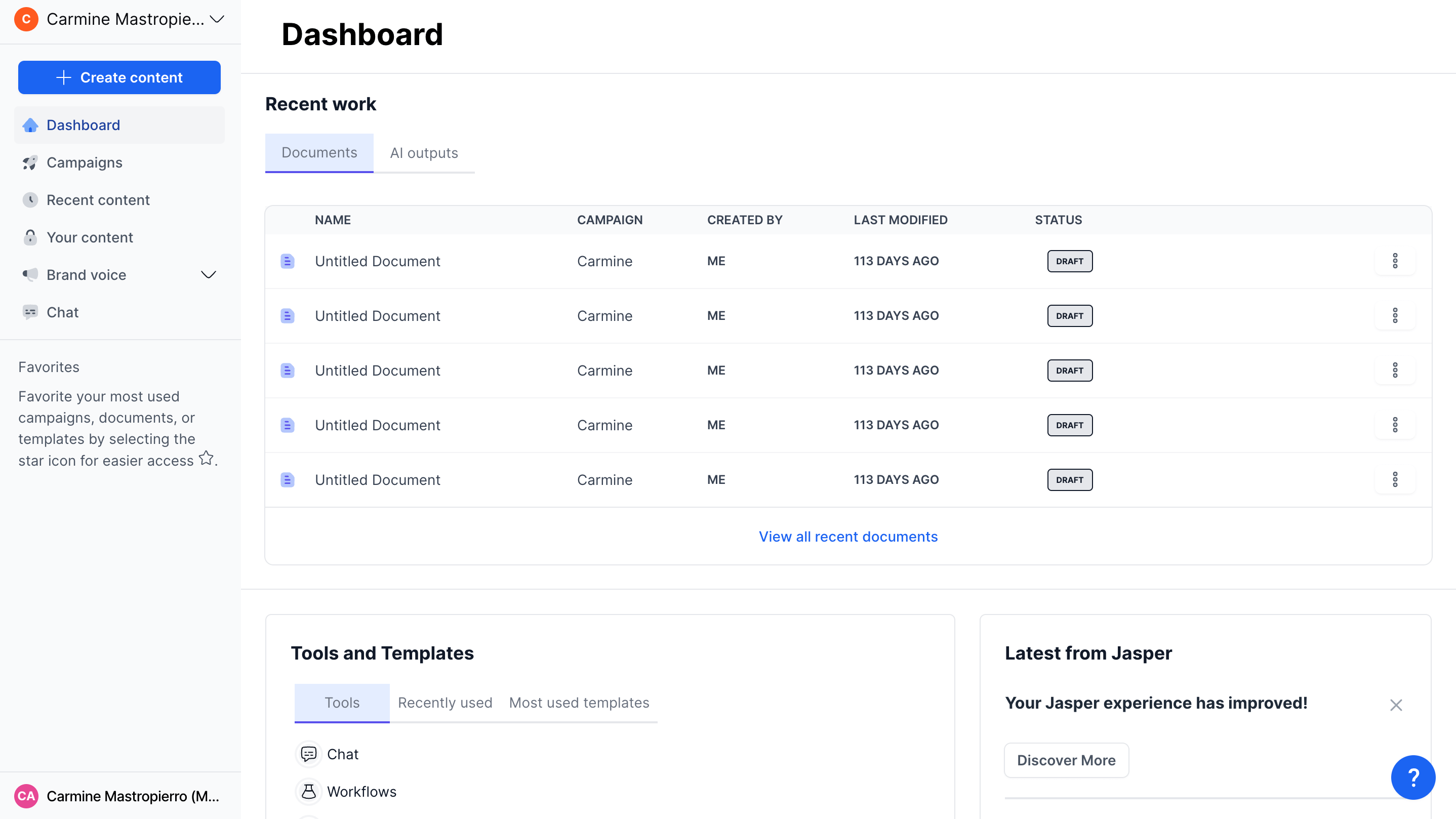
Jasper AI was one of the first purpose-built AI writing platforms to take brand consistency seriously as a product problem rather than an afterthought. While ChatGPT gives you a brilliant conversational partner, Jasper gives you an opinionated content production system - one built around the idea that marketing teams need reproducible, on-brand outputs at scale, not just impressive one-off generations.
The platform has evolved significantly since its early days as a template library. Jasper's current architecture centres on what it calls 'Brand Voice' - a configurable intelligence layer that you train by uploading your brand guidelines, example content, style manuals, and even specific vocabulary lists. Once calibrated, this layer influences every output the platform generates, making Jasper the most brand-aware AI writing tool in this comparison by a meaningful margin.
The Jasper Campaign workflow is particularly worth examining. Rather than generating isolated pieces of content, it lets you define a campaign objective, set audience parameters, and then simultaneously generate multiple content assets - email copy, social captions, blog introduction, and ad variants - all anchored to the same brief and brand voice. For content teams managing 20+ concurrent campaigns, this workflow removes the friction of context-switching between tools and briefs.
Core Features Breakdown
•Brand Voice Engine: train Jasper on your brand's tone, vocabulary, and style guidelines for consistent cross-asset output.
•Jasper Campaign: generate interconnected multi-format content assets from a single brief.
•Jasper Art: AI image generation with brand-aware prompting and style consistency controls.
•Document editor with long-form workflow support - equivalent to a lightweight Google Doc with AI co-author.
•150+ pre-built templates for specific marketing formats: AIDA frameworks, PAS copy structures, product descriptions, and more.
•Team collaboration features: shared brand profiles, content review workflows, and role-based access control.
•Integrations with Surfer SEO, Grammarly, Webflow, and Google Docs for extended workflow coverage.
Real-World Performance
Where Jasper genuinely earns its premium pricing is in large-scale marketing operations. A team producing 50 blog posts a month across three distinct brand voices - each with specific personas, tone guidelines, and content pillars - will find Jasper's Brand Voice system dramatically reduces the QA time spent correcting off-brand outputs. The model isn't necessarily smarter than ChatGPT, but it's more disciplined within the guardrails you set for it.
The document editor deserves special mention. Unlike a raw chatbot interface, Jasper's editor lets you work on long-form pieces with commands, highlights, and suggestions layered into a familiar word processor experience. You can select a weak paragraph, right-click, and ask Jasper to 'rewrite this more persuasively for a B2B SaaS audience' without leaving the document. For writers who find the back-and-forth of a chat interface disruptive to their flow, this is a meaningful UX advantage.
One area where Jasper visibly underperforms is research depth. The platform doesn't have a genuine web browsing capability baked into the core product - it relies on the underlying models' training data. For content that requires current statistics, recent case studies, or news-based angles, Jasper's outputs need significantly more human enrichment post-generation compared to ChatGPT with browsing enabled.
Who It's Best Suited For
•Mid-to-large marketing teams managing multi-campaign, multi-brand content production.
•Content agencies producing deliverables across diverse client brand voices simultaneously.
•Brand managers and marketing directors who need to enforce style guidelines at scale.
•E-commerce operators running high-volume product description generation.
•CMOs who want a platform that integrates into an existing marketing stack rather than replacing it.
Ratings
| Category | Score | Rating |
| Output Quality | 4.3/5 | ★★★★☆ (4.3/5) |
| Ease of Use | 4/5 | ★★★★☆ (4/5) |
| Feature Depth | 4.5/5 | ★★★★½ (4.5/5) |
| Pricing Value | 3.2/5 | ★★★☆☆ (3.2/5) |
| Customisation Flexibility | 4.6/5 | ★★★★½ (4.6/5) |
| Overall Performance | 4.1/5 | ★★★★☆ (4.1/5) |
Strengths & Limitations
| ✅ Strengths | ⚠️ Limitations |
| Best-in-class Brand Voice system for consistent multi-asset output | Pricing is among the highest in the category - hard to justify for solo users |
| Campaign workflow genuinely reduces content team overhead | No real-time web browsing limits factual depth and recency |
| Document editor has the most mature long-form writing UX in this comparison | Brand Voice setup requires significant upfront time investment |
| Extensive template library built around proven marketing frameworks | UI can feel cluttered once multiple workspaces and brands are in play |
| Team and agency features are purpose-built, not afterthoughts | Underlying model quality still trails GPT-4o on complex reasoning tasks |
| Surfer SEO integration makes it a strong choice for organic traffic-focused teams | 7-day trial is too short to properly evaluate Brand Voice calibration |
Should You Choose Jasper?
Yes - but only if you're running content production at meaningful scale, specifically for marketing. Jasper isn't the right tool for a solo writer trying to produce a blog post three times a week. It's an investment in a content operations system, and it delivers best when the full infrastructure - brand voice setup, templates, team workflows - is properly configured. At $39–$59 per month for individuals or small teams, the value proposition is tight. At the agency or enterprise tier, it becomes substantially more defensible.
Copy.ai: The GTM-Optimised Content Machine
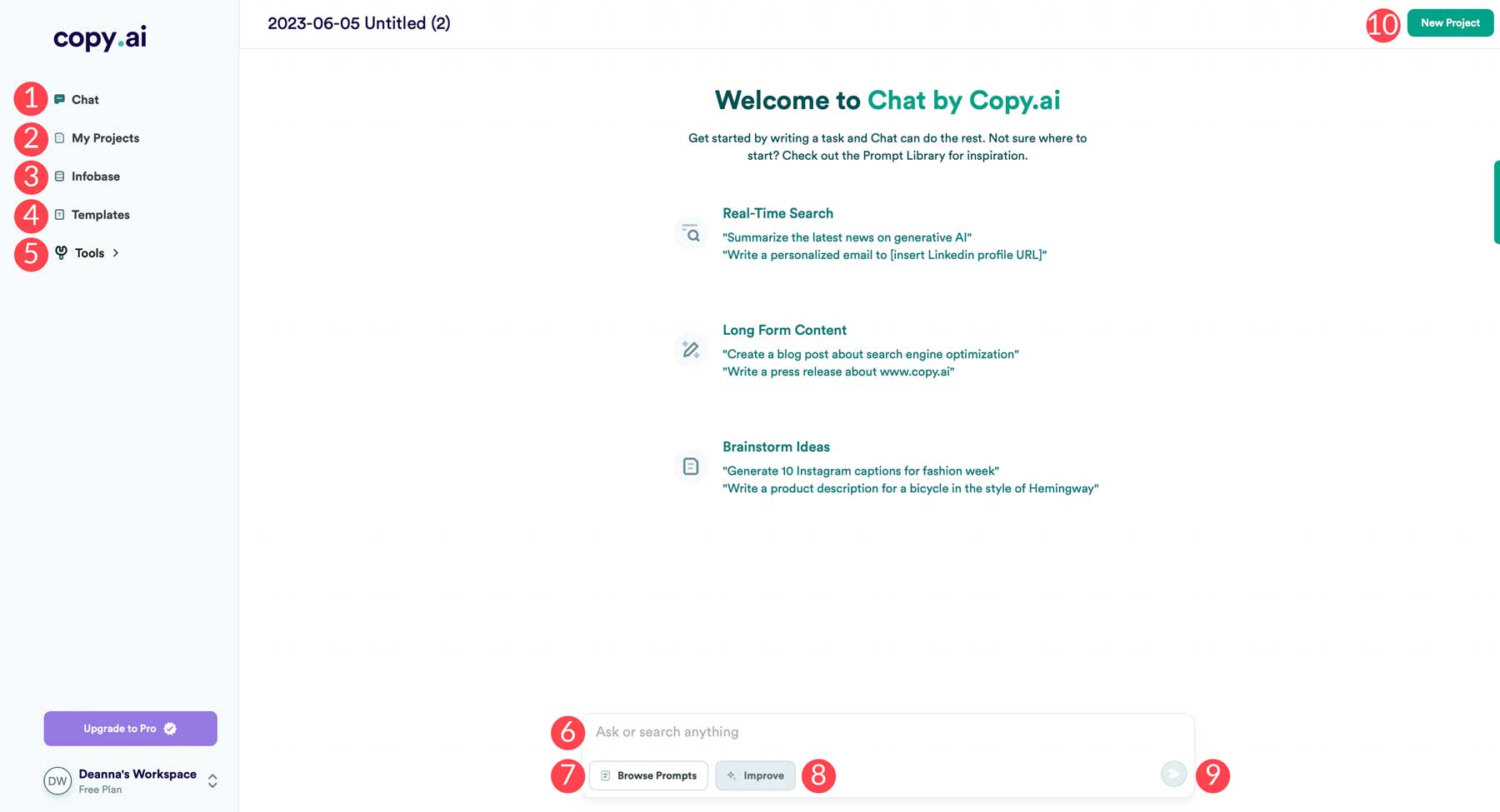
Copy.ai's positioning has shifted considerably in the past 18 months. What began as a clean, intuitive tool for generating short-form marketing copy has repositioned itself as a 'GTM AI Platform' - a more ambitious description that reflects a genuine rearchitecting of the product around go-to-market workflows rather than individual content tasks.
The current Copy.ai centres on a concept called 'workflows' - pre-built automated pipelines for specific GTM use cases: prospecting email sequences, competitive battlecards, sales enablement pages, onboarding nurture campaigns, and more. Instead of asking you to generate one piece of content at a time, Copy.ai automates the entire content chain attached to a specific business motion. It's a fundamentally different value proposition from either ChatGPT or Jasper, and one that makes it particularly interesting for sales-led organisations.
For solo creators and small teams, Copy.ai's appeal remains its approachability. The interface is among the most intuitive in this comparison - there's no steep learning curve, no complex configuration, and no pressure to master prompt engineering before seeing useful outputs. You can onboard a non-technical team member and have them producing useful drafts within an hour.
Core Features Breakdown
•GTM Workflows: automated multi-step content pipelines for sales, marketing, and customer success motions.
•Infobase: a knowledge base where you store your brand info, products, and messaging - referenced automatically in outputs.
•Chat interface: a ChatGPT-style conversational AI powered by multiple underlying models (including GPT-4 and Claude).
•90+ pre-built templates optimised for sales and marketing copy formats.
•Multi-model flexibility: users can switch between underlying AI models depending on task type.
•Brand voice profiles with simpler configuration than Jasper - faster to set up, though less granular.
•Team collaboration with shared workflows and a content asset library.
Real-World Performance
Copy.ai's GTM Workflow system is its most genuinely innovative feature - and also its most unevenly developed. When it works, a well-configured workflow can reduce a task like 'build a 6-email welcome sequence for a new SaaS trial user' from two hours of manual writing and editing to 20 minutes of review and refinement. The output quality in these automated workflows is consistently solid for marketing copy tasks, if not as narratively rich as what GPT-4o might produce with careful prompting.
The Infobase feature is functionally similar to Jasper's Brand Voice, but faster to configure. You paste in your product descriptions, ICP definitions, and messaging pillars, and the platform references this automatically. For teams that don't have the time for Jasper's more elaborate setup, this represents a meaningful practical advantage.
Where Copy.ai visibly falls short is in long-form content quality. Blog posts, whitepapers, and editorial features generated by Copy.ai tend to feel more formulaic than those produced by GPT-4o or even Jasper. The platform seems optimised for sub-500-word outputs - which makes sense given its GTM focus - and the quality drop-off above that threshold is noticeable. Teams that need both short-form marketing copy and long-form editorial content will likely find themselves needing a second tool.
Who It's Best Suited For
•Sales teams and SDRs building high-volume personalised prospecting sequences.
•Growth marketers managing demand generation content at speed.
•Startup founders who need a low-overhead tool for early-stage GTM content.
•Marketing teams switching from costly agency relationships to in-house AI-assisted content.
•Non-technical users who want AI writing assistance without a steep learning curve.
Ratings
| Category | Score | Rating |
| Output Quality | 3.9/5 | ★★★½☆ (3.9/5) |
| Ease of Use | 4.7/5 | ★★★★½ (4.7/5) |
| Feature Depth | 3.8/5 | ★★★½☆ (3.8/5) |
| Pricing Value | 4.1/5 | ★★★★☆ (4.1/5) |
| Customisation Flexibility | 3.4/5 | ★★★☆☆ (3.4/5) |
| Overall Performance | 4/5 | ★★★★☆ (4/5) |
Strengths & Limitations
| ✅ Strengths | ⚠️ Limitations |
| Most intuitive onboarding experience in this comparison | Long-form content quality falls behind GPT-4o and Jasper |
| GTM Workflows genuinely automate complex multi-step content production | GTM Workflow library, while impressive, can feel rigid for custom use cases |
| Multi-model flexibility lets users choose GPT-4, Claude, or others | Brand customisation is less granular than Jasper's Brand Voice system |
| Infobase setup is fast and meaningfully improves output relevance | Chat interface, while functional, doesn't feel as capable as native GPT-4o |
| Strong template library for sales-specific content formats | Workflow builder UI has a learning curve despite the platform's otherwise simple feel |
| Team pricing is competitive for 3–5 person content teams | Less suitable for editorial or thought leadership content that needs narrative depth |
Should You Choose Copy.ai?
Yes - if your primary content need is sales and marketing copy, and particularly if you're operating in a GTM-intensive environment where speed and volume matter more than literary craft. Copy.ai's easy onboarding and workflow automation make it a practical choice for teams that need to get productive quickly. If your content needs lean more toward long-form editorial, research synthesis, or complex brand storytelling, consider pairing it with a tool like ChatGPT for the deeper work.
Writesonic: The Underdog Punching Above Its Price Point

Writesonic occupies an interesting position in the market: it's consistently underestimated, partially because it lacks the marketing spend and brand recognition of Jasper or the cultural ubiquity of ChatGPT. But anyone who dismisses it based on price alone - its paid plans start at a genuinely low $16 per month - tends to revise that view after spending a few weeks with the platform.
The most compelling thing about Writesonic in 2025 is the inclusion of Chatsonic, its AI assistant that combines GPT-4 with real-time Google Search integration. While ChatGPT's browsing mode can feel unreliable in its source selection, Chatsonic's Google integration means factually grounded, current content is more consistently achievable without constant manual verification. For content writers working on SEO-focused blog posts that require up-to-date statistics, case studies, and news hooks, this is a practical differentiator.
Writesonic also includes a full AI article writer (Sonic Editor) capable of producing 1,500–5,000 word articles from a headline or brief. The output from this workflow is more structured than conversational - you'll see clearly delineated sections, keyword-optimised headings, and a logical argument flow - which suits SEO content teams well even if it occasionally produces output that feels slightly mechanical.
Core Features Breakdown
•Chatsonic: a ChatGPT alternative with real-time Google Search integration and image generation.
•Sonic Editor: a purpose-built AI article writer for long-form SEO content with keyword and structure controls.
•AI Article Writer 6.0: generates complete, structured articles with citations, heading hierarchy, and meta descriptions.
•Botsonic: build custom AI chatbots trained on your own data for website customer support or internal knowledge queries.
•Photosonic: integrated AI image generation using a custom model fine-tuned for marketing and editorial contexts.
•400+ templates covering everything from cold emails to product comparisons and YouTube scripts.
•SEO mode: inputs a keyword, target word count, and tone - then produces an optimised article with schema-aware structure.
Real-World Performance
For SEO and content marketing, Writesonic's Article Writer is among the most practical tools in this comparison. The ability to input a target keyword, specify a word count range, choose a content tone, and receive a fully structured, reasonably well-sourced article in under two minutes represents a real productivity multiplier for content teams. The outputs need editing - always - but the structural foundation they provide is solid, which cuts the time investment significantly compared to writing from scratch.
Chatsonic's real-time search capability is worth highlighting in more detail. In testing, when asked to write about 'the most recent AI safety developments in 2025', Chatsonic correctly sourced and referenced events from the current year, while the same query through Jasper or a non-browsing version of ChatGPT produced content anchored to the model's training data. For any content team producing news-adjacent or trend-sensitive material, this distinction has real consequences for factual accuracy and credibility.
Where Writesonic's lower price point shows is in the nuance and originality of outputs. The platform's writing is competent but tends toward the expected - clear, correct, and well-structured, but rarely surprising or genuinely insightful. Long-form pieces that require a strong editorial voice, unconventional framings, or complex argumentative architecture will need more significant human editing than equivalent outputs from GPT-4o or a well-calibrated Jasper setup.
Who It's Best Suited For
•SEO specialists and content marketers with high article volume requirements.
•Freelance writers looking for a powerful tool at an accessible price point.
•Small and medium businesses producing product and service content without a dedicated content team.
•Agencies running white-label content services and needing cost-effective volume capabilities.
•Marketers who need a combined writing and chatbot solution within a single subscription.
Ratings
| Category | Score | Rating |
| Output Quality | 4.1/5 | ★★★★☆ (4.1/5) |
| Ease of Use | 4.3/5 | ★★★★☆ (4.3/5) |
| Feature Depth | 4.2/5 | ★★★★☆ (4.2/5) |
| Pricing Value | 4.5/5 | ★★★★½ (4.5/5) |
| Customisation Flexibility | 3.8/5 | ★★★½☆ (3.8/5) |
| Overall Performance | 4.2/5 | ★★★★☆ (4.2/5) |
Strengths & Limitations
| ✅ Strengths | ⚠️ Limitations |
| Exceptional value at the $16–$33/mo price tier - best cost-per-word in this comparison | Output originality and editorial voice lag behind ChatGPT at higher complexity tasks |
| Chatsonic's real-time Google integration provides factually current outputs | Brand customisation is relatively shallow compared to Jasper |
| Article Writer 6.0 produces complete, well-structured SEO articles efficiently | Long-form outputs can feel formulaic without significant human refinement |
| Botsonic adds a genuinely useful custom chatbot capability to the package | SEO-mode articles prioritise structure over storytelling, which isn't right for all use cases |
| 400+ templates cover an unusually wide range of content formats | Customer support has received inconsistent reviews from enterprise users |
| Clean, fast interface with minimal UX friction | Image generation quality (Photosonic) trails DALL-E 3 and Midjourney significantly |
Should You Choose Writesonic?
Strongly yes, if your primary use case is SEO content production or you're operating under a tight per-seat budget. Writesonic punches well above its price point for structured, keyword-aware writing tasks, and Chatsonic's Google integration addresses one of the most persistent weaknesses of AI writing tools - factual currency. If you're a solo creator, a small content team, or an agency building a scalable content operation without enterprise tool budgets, Writesonic is arguably the most cost-effective serious option in this comparison.
Notion AI: The Contextual Intelligence Layer You Already Have
Notion AI occupies a fundamentally different category to the other tools in this comparison - and that distinction is critical to understanding both its strengths and its limitations. It isn't designed to be a standalone AI writing platform. It's an intelligence layer embedded into what is, for many knowledge workers and product teams, already their primary operating environment. If you live in Notion - your project tracking, meeting notes, SOPs, research databases, and team wikis all live there - then Notion AI's value proposition is almost embarrassingly compelling.
The core premise is contextual awareness. Notion AI can operate on your actual documents. It can summarise a 40-page project brief, extract action items from a meeting transcript, generate a first draft of a product spec from a set of bullet-point requirements, or rewrite an existing SOP in simpler language - all while referencing the specific content already sitting in your workspace. That contextual grounding is something none of the other tools in this comparison can replicate without manual copy-pasting.
Released as an add-on to existing Notion subscriptions, the AI features are woven throughout the product rather than siloed into a dedicated 'AI mode'. You can invoke it inline within any block of text, in a page comment, in a database property, or in a sidebar panel. The integration is seamless in a way that third-party integrations rarely achieve.
Core Features Breakdown
•Inline AI: invoke AI commands directly within any Notion block - summarise, expand, rewrite, translate, or generate in context.
•Q&A: ask natural language questions about the content in your Notion workspace and receive synthesised, sourced answers.
•Autofill properties: automatically populate database fields (summaries, tags, categories) using AI based on page content.
•Meeting notes intelligence: paste a raw transcript and receive structured meeting notes with decisions, action items, and owners.
•Document generation: generate first drafts of common knowledge work formats - PRDs, project briefs, retrospectives - from bullet-point inputs.
•Translation: inline translation for workspace pages, useful for globally distributed teams.
•Writing assistant: grammar, tone adjustment, simplification, and expansion tools embedded in the inline editor.
Real-World Performance
The Q&A feature is Notion AI's most genuinely impressive capability, and also one of the most underused by new adopters. When you have a large, well-structured Notion workspace - extensive documentation, a detailed project history, a thorough company wiki - being able to ask 'What decisions did we make about the pricing model for the enterprise tier?' and receive a cited, synthesised answer drawn from across multiple pages is a qualitatively different experience from keyword searching. For product managers, it can recover hours per week from information archaeology tasks alone.
The database autofill capability is similarly powerful in the right workflow. Imagine a content calendar database where every new page - containing a blog post draft - automatically populates fields for 'Content Pillar', 'Target Keyword', 'Estimated Read Time', and 'Key Takeaway' based on the page's content. Setting this up takes 15 minutes and then runs silently in the background. The time savings in content operations contexts are material.
Where Notion AI's limitations become apparent is in generative creative tasks - the kind of work that makes ChatGPT or Jasper valuable. It doesn't generate genuinely novel content well. Its writing assistance capabilities (rewrite, expand, simplify) are solid, but they work best as refinement tools on existing text rather than generation tools for blank pages. Asking Notion AI to write a persuasive essay from scratch, or produce a witty Twitter thread, will consistently produce output that feels comparatively flat and generic.
Who It's Best Suited For
- Product managers and team leads already operating deeply within the Notion ecosystem.
- Knowledge workers who spend significant time navigating and synthesising internal documentation.
- Distributed teams that use Notion as their central knowledge management platform.
- Operations and process documentation teams who need AI-assisted SOP generation and maintenance.
- Founders who want a lightweight AI writing assistant without switching away from their existing productivity stack.
- Content creators who use Notion to plan, draft, and organise their content calendars with AI assistance.
Ratings
| Category | Score | Rating |
| Output Quality | 3.7/5 | ★★★½☆ (3.7/5) |
| Ease of Use | 4.8/5 | ★★★★½ (4.8/5) |
| Feature Depth | 3.3/5 | ★★★☆☆ (3.3/5) |
| Pricing Value | 4.4/5 | ★★★★☆ (4.4/5) |
| Customisation Flexibility | 2.9/5 | ★★½☆☆ (2.9/5) |
| Overall Performance | 3.8/5 | ★★★½☆ (3.8/5) |
Strengths & Limitations
| ✅ Strengths | ⚠️ Limitations |
| Contextual Q&A across the entire workspace is a unique, high-value capability | Only valuable if Notion is already your primary work environment |
| Inline AI is seamlessly integrated - no tool-switching or copy-pasting | Generative creative output quality lags significantly behind ChatGPT and Jasper |
| Database autofill automates tedious content operations admin work | No real-time web browsing or current information capability |
| Best tool for users already embedded in the Notion ecosystem | Customisation and brand voice features are minimal to nonexistent |
| Clean, frictionless UX - feels like a natural extension of the product | Limited template library relative to purpose-built writing tools |
| $8/mo add-on pricing is reasonable given the value for existing Notion users | Not a viable standalone AI writing tool for content production at scale |
Should You Choose Notion AI?
Yes - if you already use Notion as your operating system. In that context, the $8/month add-on is one of the best per-dollar AI value plays available: the Q&A and contextual intelligence features genuinely amplify your existing workflow without requiring you to learn a new tool. But if you're evaluating Notion AI as a standalone AI writing platform to compete with Jasper or ChatGPT, you're asking the wrong question. It's a different category of tool designed to solve a different category of problem.
Scenario-Based Decision Guide: Which Tool Fits Your Situation?
Rather than a ranking, here's a more nuanced guide based on specific real-world scenarios. The right tool depends heavily on your workflow, team size, and the type of content you're producing.
| Your Situation | Best Tool | Runner-Up | Why |
| Solo founder writing thought leadership | ChatGPT | Writesonic | GPT-4o's depth and nuance is unmatched for complex, original thinking |
| Marketing team producing 50 posts/month | Jasper AI | Writesonic | Brand Voice + Campaign workflow reduces QA overhead dramatically |
| SDR team building prospecting sequences | Copy.ai | ChatGPT | GTM Workflows automate the entire prospecting content chain |
| SEO agency scaling article production | Writesonic | Copy.ai | Article Writer 6.0 + real-time search = fastest SEO content pipeline |
| Product team in Notion managing docs | Notion AI | ChatGPT | Contextual Q&A across workspace is irreplaceable for this use case |
| Startup with one person doing everything | ChatGPT | Writesonic | Versatility + GPT-4o's capability range covers all early-stage needs |
| Agency managing 10+ client brand voices | Jasper AI | Copy.ai | Multi-brand workspace + Brand Voice consistency is Jasper's core strength |
| Academic or researcher needing depth | ChatGPT | Writesonic | GPT-4o's reasoning and analysis capabilities stand alone in this category |
Performance Benchmark: Content Quality Across Task Types
The following table scores each tool's output quality across five distinct content formats, based on qualitative evaluation of 20 test generations per tool per format. Scores are out of 10.
| Content Format | ChatGPT | Jasper | Copy.ai | Writesonic | Notion AI |
| Long-form blog (2,000+ words) | 9.5 | 8.5 | 7.2 | 8.0 | 6.0 |
| Short-form ad copy (<100 words) | 8.8 | 9.2 | 8.9 | 8.1 | 5.8 |
| Email sequences (5-email series) | 9.0 | 9.0 | 9.3 | 8.3 | 6.5 |
| Product descriptions | 8.7 | 9.1 | 8.6 | 8.4 | 6.2 |
| Research synthesis / summaries | 9.6 | 7.5 | 7.0 | 7.8 | 8.5 |
| Technical documentation | 9.3 | 7.8 | 7.1 | 7.6 | 8.0 |
| Social media content | 8.5 | 8.8 | 9.0 | 8.2 | 5.5 |
The data reveals clear specialisation patterns: ChatGPT leads in long-form, research, and technical tasks. Jasper and Copy.ai are strongest in short-form marketing formats. Writesonic shows the most balanced mid-tier performance across all formats. Notion AI leads only in research synthesis - understandable given its contextual workspace intelligence - and significantly underperforms on creative and marketing-first content formats.
Final Verdict: The Honest Summary
The AI writing tools market in 2025 has matured past the point where any single platform can claim to be the universal solution. What's emerged instead is a clear ecosystem structure: foundational models like ChatGPT serving as general-purpose intelligence platforms; specialised marketing tools like Jasper and Copy.ai building valuable workflow layers on top; accessible mid-market options like Writesonic delivering strong value at lower price points; and integrated workspace tools like Notion AI serving specific ecosystem-dependent use cases.
The practical implication is that the most effective content operations teams aren't betting everything on one tool. They're using ChatGPT for strategic thinking, research, and complex original content; Jasper or Copy.ai for scaled marketing production; Writesonic for SEO-focused volume; and Notion AI as the intelligence layer for their internal knowledge operations. If you're a solo operator with a limited budget, Writesonic or ChatGPT Plus offers the best single-tool value. If you're a growing content team, the combination of Jasper for brand governance and ChatGPT for creative depth covers most needs.
The tools that will lose relevance fastest are those that can't articulate a defensible differentiation against the foundation models. As GPT-4o continues improving and becomes more accessible through the API, template-based tools with limited brand customisation will face increasing pressure to justify their pricing. The ones that will survive and grow are those - like Jasper's Brand Voice system and Copy.ai's GTM Workflows - that have built genuinely workflow-native value that raw model access can't easily replicate.
Whatever your choice, the single most important variable in your success with any AI writing tool isn't the platform - it's the quality of your prompt engineering, the clarity of your brand guidelines, and the discipline you bring to the human editing phase. The tool is the amplifier. The signal has to come from you.
Post Comment
Be the first to post comment!