~67% Reported true-match rate in independent testing | ~23% False-positive rate, roughly 1 in 4 matches | $6+ Entry price, crypto-only, about $0.69 per search |
Romance scams alone cost consumers roughly $1.14 billion in 2023, and most of them begin the same way: a stolen photo and a fake name. That single problem explains why reverse face search tools have exploded in popularity, and why FaceCheck ID keeps surfacing in the conversation.
Upload one photo, and it tries to find every public place that same face appears: social profiles, news stories, blogs, even mugshot databases. But a tool that promises to identify almost anyone from a single image deserves scrutiny, not hype.
The reality sits between the breathless demos and the privacy panic. FaceCheck is more capable than the free tools most people reach for first, yet less reliable and less convenient than its paid reputation suggests. This review pulls together pricing, independent accuracy testing, and head-to-head comparisons so you can decide whether it belongs in your toolkit.
What Is FaceCheck ID?
FaceCheck ID is a facial recognition search engine built for one job: finding where a specific person appears online using nothing but a photo. It launched in 2022 under a company listed as Tech Solutions.

Unlike general-purpose tools such as Google Lens or TinEye, which match images by color, shape, and composition, FaceCheck is purpose-built to match faces. Rather than hunting for copies of the same picture, it reads the geometry of a face (the spacing of the eyes, the shape of the nose, the contour of the jaw) and looks for that same face across entirely different photos, angles, and lighting. That’s why it can connect a blurry group shot to a polished headshot when a pixel-matching tool simply can’t.
A few limits are worth fixing in your mind before you start. FaceCheck won’t:
• Reach private or locked accounts. It only sees publicly indexed pages.
• Hand you a name, phone number, or address. It returns image matches and source URLs, nothing more.
• Do the verification for you. Identifying the person from those links is your job.
Table 1 · FaceCheck ID at a glance
| Attribute | Detail |
|---|---|
| Tool type | Facial recognition / reverse face search engine |
| Launched | 2022 (operated by Tech Solutions) |
| What it searches | Public social media, news, blogs, video thumbnails, mugshot & offender databases |
| Result speed | About 15 to 30 seconds per search |
| Confidence scoring | 50 to 100% per match |
| Free tier | Yes, blurred previews; paid credits to unlock |
| Payment | Cryptocurrency only (since late 2024) |
| Platform | Web only, no app, no public API |
| Returns personal data? | No, image matches and source links only |
How FaceCheck ID Works
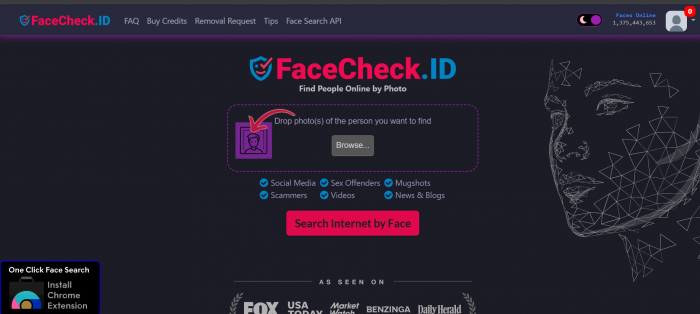
Under the hood, FaceCheck follows the same broad pipeline as most modern face search engines. When you upload a photo, it detects the face and converts its measurable features into a numerical fingerprint, often called a facial embedding. That fingerprint is compared against millions of pre-indexed faces, and the closest matches come back with a confidence score, usually within 15 to 30 seconds. Free users see results immediately, but the previews are blurred until you spend credits to unlock the clear images and source links.
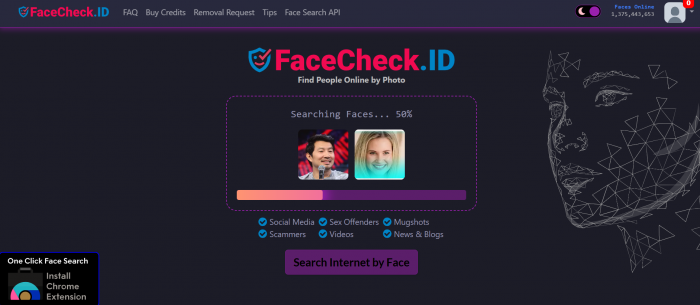
The confidence score is the part most people misread. It runs from 50% to 100%, and it is a probability estimate, not a verdict. A high score means the facial geometry is a close statistical match; it does not prove the two photos are the same person. Here’s a practical way to read the scores:
• 90 to 100%: near-certain match. Still worth confirming against a second source.
• 83 to 89%: high confidence. Usually the same person, but verify.
• 70 to 82%: possible match. Treat it as a lead, not a conclusion.
• Below 70%: weak. Often a look-alike or false positive, so don’t rely on it.
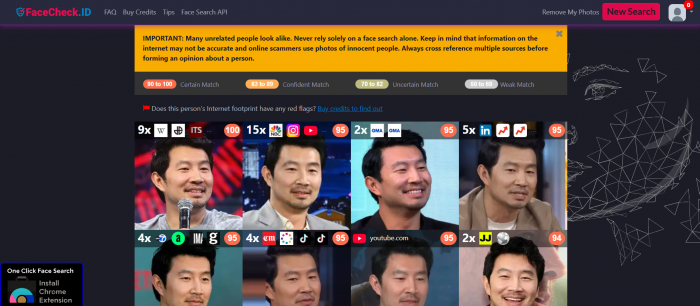
Because many unrelated people genuinely look alike, treating any single score as proof is the most common, and most dangerous, mistake users make. FaceCheck is a starting point for investigation, not the final word, and every credible guide on the tool stresses cross-referencing before you draw a conclusion.
Does FaceCheck ID Actually Work?
This is where the marketing and the measurements diverge. FaceCheck advertises its algorithm as “scary good,” and on difficult photos it genuinely outperforms most rivals. But independent testing reported across multiple review analyses places its real-world accuracy in more sober territory.
Its true-positive rate, how often it correctly finds a real match, lands around 67%, and it swings hard with photo quality. Just as important, the false-positive rate sits near 23%, meaning roughly one in four “matches” can be wrong, and even results labelled near-certain are sometimes incorrect.
Table 2 · Reported accuracy by photo type
| Photo type | Approx. accuracy | What it means for you |
|---|---|---|
| Professional / front-facing | ~78% | Best case; most reliable results |
| Standard social media photo | ~60 to 67% | Workable, but verify every match |
| Low-light image | ~38 to 42% | Unreliable; expect misses |
| Steep side-angle / partial | ~38 to 42% | Unreliable; expect misses |
| Overall true-positive rate | ~67% | Treat strong matches as leads |
| Overall false-positive rate | ~23% | About 1 in 4 matches may be wrong |
Figures reflect independent testing aggregated across published reviews; results vary by image and are not vendor-certified.
What the numbers don’t capture is FaceCheck’s real edge: it tolerates imperfect inputs better than most competitors, surfacing usable matches from blurry, masked, or odd-angle photos that defeat other engines. The honest summary is that it works well enough to be useful, and clearly better than free alternatives on hard photos, yet its error rate is high enough that no result should ever stand as confirmation on its own.
The deepfake blind spot Like every reverse face search tool, FaceCheck only matches images that already exist online. It can tell you where a face has appeared, but not whether the photo is authentic. With AI-generated faces now cheap to produce, a scammer can use a synthetic image with no web history at all, returning zero matches and a false sense of safety. A clean search isn’t proof that someone is real; it may just mean their fake has never been posted. |
How Much Does FaceCheck ID Cost?
FaceCheck lets you search for free, but free only buys blurred previews. To see clear matches and their source links, you purchase credits, and the pricing rewards heavier users with a much lower per-search cost.
Table 3 · FaceCheck ID pricing (credit-based, one-time)
| Plan | Price | Searches | Validity | Per search |
|---|---|---|---|---|
| Just a Peek | $6 | 12 | 2 days | ~$0.69 |
| Rookie Sleuth | $19 | 50 | 14 days | ~$0.55 |
| Private Eye | $47 | 133 | 2 months | ~$0.51 |
| Deep Investigator | $197 | 666 | 6 months | ~$0.43 |
| Professional | $597 | 3,333 | 1 year | ~$0.26 |
Pricing sourced from vendor and review data; confirm current rates before purchase.
On paper that’s reasonable, well under a dollar a search and far cheaper than subscription rivals for occasional use. The catch is how you pay: since late 2024, FaceCheck accepts cryptocurrency only, with no credit-card option. Before you buy, weigh what that really costs and what you’re not getting:
• Crypto-only adds hidden fees. Exchange fees (around 1 to 3%), wallet transaction fees (roughly $2 to $15), and conversion markups quietly inflate the sticker price.
• Credits expire. The cheapest tiers lapse in days, so buying small “just to try” can mean paying again sooner than expected.
• No support, no practical refunds. There’s no help channel to dispute a bad charge or a wrong match.
For anyone without a crypto wallet, that payment wall is the single biggest reason to consider an alternative.
FaceCheck ID vs the Alternatives
FaceCheck doesn’t operate in a vacuum. The reverse-image-search market was estimated at around $1.2 billion in 2024 and growing roughly 12.5% a year, and several mature competitors now compete on accuracy, payment flexibility, and legal compliance.
PimEyes leads on coverage and posts the highest tested accuracy, but it’s subscription-based and pricier. Social Catfish pairs face search with name, email, and phone lookups for dating-scam verification. Spokeo is FCRA-compliant, which matters for any formal screening. Google Lens and TinEye are genuinely free but use pixel matching, not facial recognition, so they can’t track a person across different photos.
Table 4 · FaceCheck ID vs top alternatives
| Tool | Reported accuracy | Pricing model | Payment | Best for |
|---|---|---|---|---|
| FaceCheck ID | ~67% | Pay-per-credit, from $6 | Crypto only | Hard photos; social + news; casual checks |
| PimEyes | ~84% | Subscription, ~$30+/mo | Card | Deep, web-wide image audits |
| Social Catfish | ~82% | ~$19.95/mo | Card | Dating-scam & identity verification |
| Spokeo | ~79% | Subscription | Card | FCRA-compliant background checks |
| TinEye | Pixel match | Free / API bundles | Card | Finding exact image copies |
| Google Lens | Pixel match | Free | Free | Quick, casual image lookups |
The pattern is clear: FaceCheck wins on price-per-search and on difficult images, but trails the leaders on raw accuracy, payment convenience, and legal protections. If you need the highest hit rate or compliant results, a rival is the safer pick.
Who Should (and Shouldn't) Use FaceCheck ID
FaceCheck fits a specific user: someone who needs to verify a face quickly, accepts that results are leads rather than proof, and is comfortable paying in crypto. It’s a strong fit for:
• Online daters checking whether a match’s photos are genuine or lifted from someone else (classic catfish detection).
• Journalists and OSINT investigators verifying sources, subjects, or the origin of a viral image.
• Parents screening unknown adults who interact with their children online.
• People monitoring their own footprint to see where their face appears across the public web.
• Small businesses running an informal sanity check on a potential partner (emphasis on informal).
It’s the wrong tool when stakes are high or formal. Because FaceCheck is not FCRA-compliant, it should never drive hiring, tenant screening, lending, or any decision with legal consequences; those need compliant services with dispute processes. It’s also a poor choice if you can’t use cryptocurrency, or if you need the single most accurate result, where PimEyes or Social Catfish pull ahead.
Is FaceCheck ID Safe and Legal?
Using a face search engine on publicly available images is generally legal in most regions. What you do with the results is where the law turns serious: using matches to harass, stalk, intimidate, or discriminate is illegal, and FaceCheck’s terms put that responsibility squarely on the user.
Privacy is the thornier issue. FaceCheck says the photos you upload are deleted within 24 hours and never added to its index, but independent audits haven’t verified that claim, and the company is notably opaque about its sources, describing them only as public, readily available web pages. It also uses tracking cookies, and its crypto-only, support-free setup leaves users little recourse if something goes wrong.
There’s a useful flip side. If your own face turns up in results you’d rather keep private, there’s a removal route:
1. Verify your identity through FaceCheck’s photo-removal request process.
2. Submit the exact URLs where your image appears.
3. Contact the original host too. Delisting from FaceCheck doesn’t delete the photo at its source, so it can reappear if the page stays live.
| The responsible rule of thumb: treat any match as a lead, confirm it against independent sources, respect people’s privacy, and never make a consequential decision about someone based on a face search alone. Many unrelated people look alike, and the error rates above are real. |
The Verdict
FaceCheck ID earns its reputation in one specific way. Its matching algorithm handles bad photos better than almost anything at its price, and per-search costs are low, so for fast, casual identity checks on social media and news content, it delivers. Weighed up, though, it’s a tool of clear strengths and equally clear limits.
Strengths • Best-in-class matching on blurry, angled, or partially hidden photos • Fast results (15 to 30 seconds) with direct source links • Low per-search cost, well under a dollar • Photo-removal option for your own images | Weaknesses • About 1 in 4 matches can be wrong, so nothing is proof • Cryptocurrency-only payment, plus hidden exchange and wallet fees • No customer support, no API, no FCRA compliance • Lower raw accuracy than PimEyes and Social Catfish |
3.5 / 5 Useful, with real caveats FaceCheck ID is a capable, focused tool that works best as one verification step among several, never as the final word on anyone’s identity. If you’re comfortable with crypto and you treat a “match” as a starting point, it’s worth the few dollars. If you need top accuracy, mainstream payment, or compliant results, spend your money on a rival instead. |
Post Comment
Be the first to post comment!