Two hours of testing both platforms back to back reveals the divide. Poppop AI feels like a free browser toy that punches above its weight on voice covers, sound effects and karaoke tracks. Suno feels like a full studio that happens to live online, with v5 vocals that pass blind-listening tests on r/SunoAI more often than not. They get lumped together in every AI music roundup, but they barely compete for the same creator.
The 2026 comparison really turns on one question: is the project commercial music or content audio? Suno owns the first lane with full commercial rights, v5-grade output and Suno Studio for serious editing. Poppop AI owns the second with no-signup browser access, multilingual TTS and a sound effect generator that runs on text prompts alone. Pricing tells the same story, with Poppop's Basic plan costing roughly the same as Suno Pro but selling completely different value. This breakdown covers spec sheets, three comparison tables, real user reviews and the market context behind both platforms.
Inside Poppop AI: What Sets It Apart
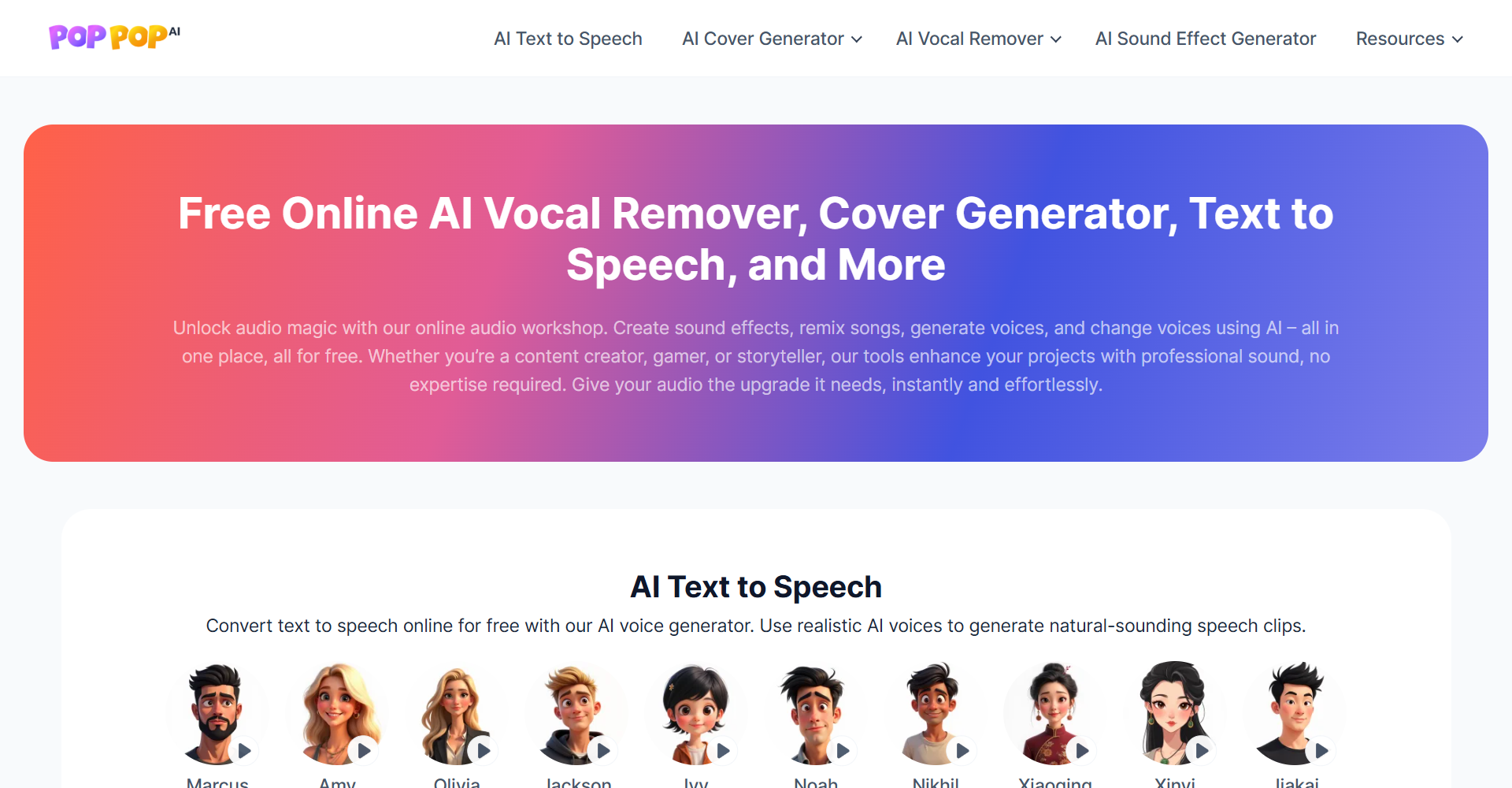
Built by Nabla Mind, Poppop AI runs entirely in the browser with no signup required for most tools. The platform pulled roughly 360,900 visits in July 2025 per AIPure traffic data, though that figure dipped 17.6 percent month-over-month after earlier highs. The positioning is honest: this is not a competitor to studio-grade production. It exists to give creators, streamers and casual experimenters a fast way to make voice covers and audio assets without learning software or paying upfront.
The toolkit is wide rather than deep. Core features include a vocal remover and karaoke maker that strip vocals from any uploaded track, an acapella extractor for producers needing isolated stems, and an AI cover song generator with celebrity, cartoon and custom voice models. Text-to-speech covers 29 languages with over 200 AI voices. The sound effect generator converts descriptive prompts into usable audio, and AI voice cloning creates a custom voice model from a short sample on the paid plan. Output formats include MP3, FLAC, WAV and M4A for audio, with MP4, MKV and MOV supported for video uploads.
Poppop AI at a Glance
| Specification | Detail |
|---|---|
| Developer | Nabla Mind |
| Platform access | Browser only, no signup needed for free tools |
| Free tier limits | 15 conversions/day at 500 characters each, 20 song covers/day |
| Paid plan starting | 9.95 USD/month or 79 USD/year (6.58 USD/month effective) |
| Voice library | 200+ AI voices across 29 languages |
| Voice cloning | 2 clones/month on Basic plan |
| Cloud storage | 1 GB free, 5 GB on Basic |
| Trustpilot rating | ~3.5 / 5 |
| Best fit | Hobbyists, content creators, TikTok and YouTube voiceovers |
Key Strengths of Poppop AI
•Zero-friction setup. Loading the page and generating a sound effect or AI cover in under a minute without signup is rare in this category.
•Sound effect generator. Prompts like "rain on a tin roof at midnight" produce usable audio, replacing time spent combing stock libraries.
•Multilingual TTS. Native support for Hindi, Spanish, Japanese, Arabic and Korean serves creators in regions where most AI tools default to English-only.
•Generous free tier. The free plan covers most casual workflows indefinitely, with no daily login or watermark penalties.
Where Poppop AI Falls Short
•Output inconsistency. Vocal removal on complex mixes leaves faint echoes or distortion. Independent reviews repeatedly describe output as "hit or miss."
•Browser dependency. No offline mode and slow connections noticeably degrade the experience.
•Commercial grey zone. Voice cloning and cover generation raise copyright concerns that the platform flags only in fine print, creating risk for commercial release.
Suno AI in the v5 Era
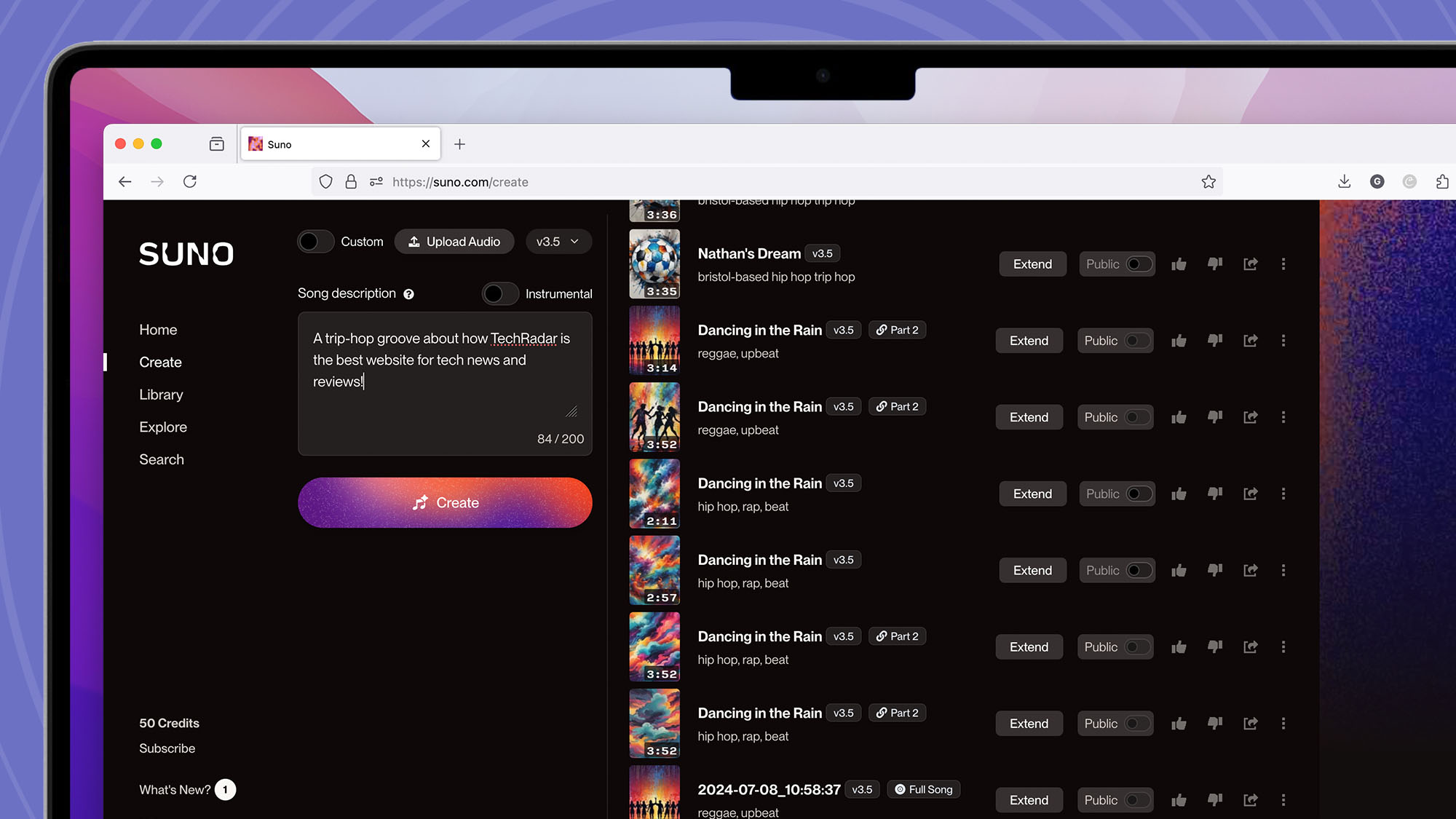
Suno occupies a different category entirely. As of February 2026, the platform sits at roughly 300 million dollars in annual recurring revenue with 2 million paid subscribers, marking 404 percent year-over-year growth. That makes it one of the fastest consumer SaaS companies to reach the 300 million ARR mark, outpacing the early growth curves of Spotify, Canva and Notion per the AI Video Bootcamp generative AI media report. The v5 model, launched September 2025, pushed Suno into territory where casual listeners often cannot distinguish AI tracks from human-produced ones.
Beyond raw generation, Suno launched Suno Studio in September 2025, billed as the first generative audio workstation. The Studio 1.2 update in February 2026 added warp markers, granular timing edits and stem-level controls that bring the platform closer to a traditional DAW workflow. Studio is locked to the Premier tier. Other notable features include Personas (saved vocal styles across generations), hum-to-song input where a melody or rhythm becomes the seed for a full arrangement, stem splitting into up to 12 separate tracks, MIDI export and batch generation. Both Pro and Premier plans grant full commercial rights for any track generated while the subscription stays active
Suno AI at a Glance
| Specification | Detail |
|---|---|
| Developer | Suno Inc. (Cambridge, MA) |
| Platform access | Browser, iOS and Android |
| Free tier limits | 50 daily credits (~10 songs/day), non-commercial only, v4.5-all |
| Paid plans | Pro at 10 USD/month, Premier at 30 USD/month |
| Annual discount | 20 percent off (Pro 8 USD/month, Premier 24 USD/month effective) |
| Latest model | v5 (Sept 2025) plus Suno Studio 1.2 (Feb 2026) |
| Stem extraction | Up to 12 separate stems on paid plans |
| G2 rating | ~3.9 / 5 |
| Best fit | Musicians, producers and commercial creators needing licensed output |
Key Strengths of Suno AI
•v5 vocal realism. Tracks produce clean transients, natural pitch transitions and intelligible lyrics. Blind-listening posts on r/SunoAI routinely fool commenters.
•Suno Studio (Premier). Warp markers, stem-level edits and MIDI export turn the platform into a near-DAW that integrates with Ableton or Logic Pro workflows.
•Full commercial rights. Both Pro and Premier grant perpetual commercial licensing for any track generated during an active subscription, covering Spotify, sync and monetized YouTube.
•Personas and hum-to-song. Save consistent vocal identities across generations, or hum a melody and let the model build a full arrangement around it.
Where Suno AI Falls Short
•Free tier misleads. Free output runs on v4.5-all and lags noticeably behind v5, leaving first-time users with the wrong impression of the platform ceiling.
•Vocal artifacts persist. Roughly 25 percent of generations still show robotic edges or pronunciation glitches, especially on aggressive prompts.
•Billing complaints. G2 and Trustpilot reviews flag difficulty canceling subscriptions and slow support response during disputes.
•Tighter creative guardrails. After settling a Warner Music Group lawsuit in 2025, certain prompt styles and artist references are restricted, and download caps tightened in 2026.
Direct Feature Comparison
The clearest way to weigh the gap is to lay both tools next to each other across the dimensions that actually move workflow decisions.
| Feature | Poppop AI | Suno AI |
|---|---|---|
| Core function | Voice covers, TTS, sound effects, stems | Full song generation with lyrics and vocals |
| Latest model | Proprietary (unversioned) | v5 (Sept 2025) plus Studio 1.2 |
| Free tier output | 15 conversions/day, 20 covers/day | 50 daily credits (~10 songs/day) |
| Commercial rights | Terms-dependent, restricted | Yes on Pro and Premier tiers |
| Stem extraction | Vocal and instrumental split only | Up to 12 separate stems on paid plans |
| Voice cloning | 2 clones/month on Basic | Personas feature on Pro and Premier |
| Music composition | Cover-style only (no original songs) | Original composition across 30+ genres |
| DAW features | None | Suno Studio (Premier only) |
| Platform reach | Browser only | Browser, iOS and Android |
| Best suited for | Hobbyists, content creators | Musicians, producers, commercial creators |
Pricing at a Glance
Pricing is where the philosophical gap shows up most clearly. Poppop AI is built around a generous free tier with a single low-cost paid plan. Suno is built around credit-based tiers designed for users who treat AI music as a serious creative or commercial workflow.
| Plan tier | Poppop AI | Suno AI |
|---|---|---|
| Free | 15 conversions/day, 20 songs/day, 1 GB storage | 50 daily credits, v4.5-all only, non-commercial |
| Entry paid (monthly) | 9.95 USD/month | 10 USD/month (Pro) |
| Entry paid (annual) | 6.58 USD/month effective | 8 USD/month effective |
| Entry paid quota | 1,000 conversions, 1,000 songs, 2 clones, 5 GB | 2,500 credits (~500 songs), v5, commercial rights |
| Top tier (monthly) | Custom (Enterprise on request) | 30 USD/month (Premier) |
| Top tier perks | Custom limits and SLA | 10,000 credits, Suno Studio, MIDI, batch generation |
| Cost per output | Effectively unlimited per quota | ~0.015 USD per song on Premier annual |
Poppop AI Basic and Suno Pro sit at near-identical monthly prices but solve fundamentally different problems. Poppop hands over voice cloning, cover generation and TTS in volume. Suno hands over commercial rights and v5-quality original composition. Neither plan replaces the other, and treating them as substitutes leads to frustration on both sides. The smarter framing is to ask which problem the project actually needs solved before reaching for a credit card.
Which Tool Wins for Each Use Case
A side-by-side feature list rarely surfaces the practical answer. The verdict matrix below maps real creator scenarios to the tool that genuinely fits.
| Use Case | Poppop AI | Suno AI | Winner |
|---|---|---|---|
| YouTube voiceovers and intros | Strong fit | Overkill | Poppop AI |
| Trending TikTok voice covers | Best in class | Not built for it | Poppop AI |
| Spotify release / commercial music | Risky licensing | Full rights on paid | Suno AI |
| Sound effects for indie games | Direct prompt-to-audio | Not in feature set | Poppop AI |
| Album or mixtape production | Lacks composition | v5 plus Studio | Suno AI |
| Client jingles with brand voice | Voice cloning works | Personas more consistent | Suno AI |
| Multilingual TTS narration | 29 languages supported | Lyrics only in 50+ | Poppop AI |
| Sync licensing for film and TV | Not licensed | Permitted on Pro/Premier | Suno AI |
| Karaoke version of existing track | Vocal remover handles it | Not built for it | Poppop AI |
| Podcast intros and stings | Quick and free | Higher polish | Tie |
The pattern is clear once mapped this way: Poppop AI wins for content production work where speed, accessibility and multilingual coverage matter. Suno AI wins for music creation work where output quality, commercial licensing and production-grade editing matter. A creator doing both can reasonably subscribe to both for under 20 dollars combined per month.
The Market Context Behind Both Platforms
The competitive backdrop matters because both platforms are riding the same generative-AI wave. According to The Business Research Company, the AI-in-music market climbed from 4.48 billion dollars in 2025 to a projected 5.55 billion dollars in 2026, with a 23.4 percent CAGR taking it to 12.86 billion dollars by 2030. The narrower AI music generation segment specifically sits at roughly 1.07 billion dollars in 2026 and is projected to reach 5.87 billion dollars by 2035 per Market Reports World.
Suno's individual trajectory inside that market is what makes the comparison interesting. The chart below tracks ARR climb across the last 24 months, with key product milestones annotated.
Final Verdict
A few weekends of bouncing between Poppop AI and Suno AI lands on the same conclusion: the right tool depends entirely on the project sitting on the desk. There is no universal winner here.
Poppop AI feels like a Swiss Army knife. For YouTube videos, TikTok edits and podcasts that need voice covers, sound effects and multilingual TTS, the free tier handles most casual workflows and the 9.95 dollar Basic plan covers serious volume without breaking a budget.
Suno AI feels like a recording studio. For music made to release, license or monetize, the v5 model produces tracks that cross into Spotify-quality output, and Pro and Premier plans remove the legal grey zone that haunts cover-style platforms. Suno Studio is where the toolkit stops being an AI toy and starts being a real production environment.
These are not competing tools so much as adjacent ones. A creator running both a TikTok channel and a paid music project would reasonably subscribe to both for under 20 dollars combined per month. Both have earned their place. Knowing which one belongs on which project is the only question that still actually matters
Post Comment
Be the first to post comment!