Quick Overview
Both products belong to the same category: AI-powered study apps that convert source material into active-recall practice. Gizmo AI launched earlier and has grown into a mass-market habit app with a very large public deck library. Jungle AI, previously known as Wisdolia, leans toward rigorous academic fields and stands out for visual and case-based question types. The table below summarizes the headline differences.
Table 1. Side-by-side snapshot of Gizmo AI and Jungle AI
| Attribute | Gizmo AI | Jungle AI |
|---|---|---|
| Category | AI flashcards, quizzes, and tutor | AI flashcards, quizzes, and case practice |
| Launched | 2021 (Cambridge alumni team) | Rebranded from Wisdolia |
| Best known for | Gamified daily practice and a huge public deck library | Image occlusion and case questions for technical fields |
| Platforms | iOS, Android, web | iOS, Android, web |
| Core method | Spaced repetition and active recall | Spaced repetition and deliberate practice loop |
| Standout extra | AI tutor and Quizlet or Anki imports | AI image occlusion and Anki export |
| Audience | General students and lifelong learners | Medicine, nursing, law, and science students |
What Is Gizmo AI
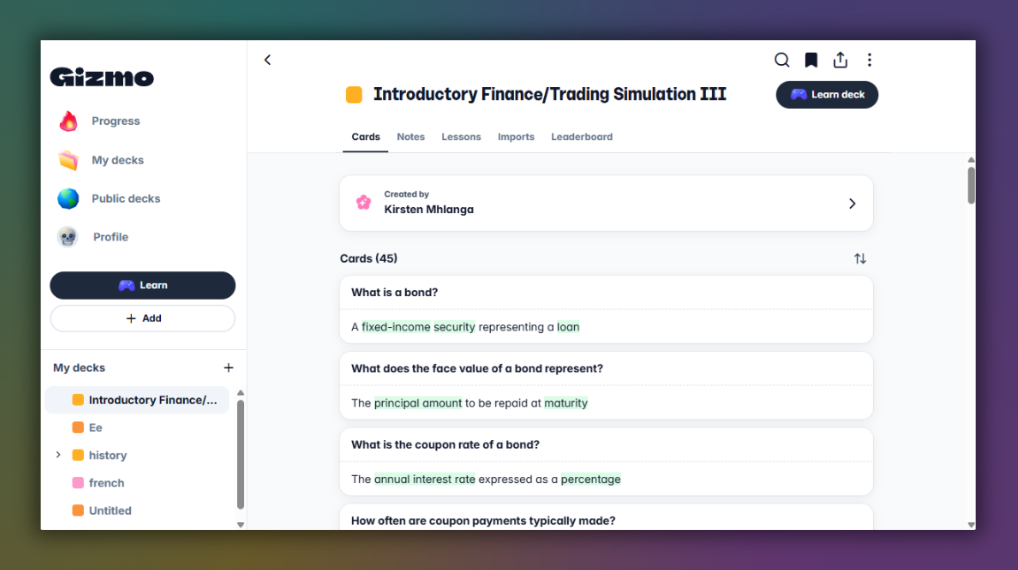
Think of Gizmo AI as the study app that refuses to let anyone make excuses. Drop in a PDF, a lecture recording, a YouTube link, or a wall of messy notes, and seconds later it hands back clean flashcards and quizzes ready to drill. Built in 2021 by a team of Cambridge alumni, it has grown from a simple card maker into a full learning assistant on iOS, Android, and the web.
Its real trick is psychology, not just generation. A daily system of practice lives, streaks, and rewards turns revision into something closer to a mobile game, and reviewers keep saying the same thing: it actually gets them to open the app every day. Pair that with a built-in tutor that explains tricky answers and a library of over a million ready-made public decks, and the appeal of a low-effort start becomes obvious.
Table 2. Gizmo AI at a glance
| Detail | Gizmo AI |
|---|---|
| Developer and launch | Cambridge alumni team, launched 2021 |
| Platforms | iOS, Android, and web |
| Free tier | Unlimited basic flashcards, daily lives, capped AI quizzes per day |
| Premium | From about 8.80 USD per month; higher Ultra tier reported near 19.99 USD |
| Signature feature | AI tutor plus a million-deck public library |
| Best suited to | General students and anyone fighting to stay consistent |
| Typical rating | About 4.7 out of 5 |
WHERE GIZMO SHINES
✓Turns almost any source into flashcards and quizzes in seconds
✓Gamified streaks and lives build a genuine daily study habit
✓Over one million shared public decks, so studying can start instantly
✓One-tap imports from Quizlet and Anki ease the switch
✓Step-by-step AI tutor explains concepts on demand
WATCH OUT FOR
⚠The free-tier lives can lock out cramming sessions until they refill
⚠No image occlusion, so diagram-heavy subjects are underserved
⚠The top Ultra tier feels pricey for an app marketed as free
What Is Jungle AI
If Gizmo is the friendly habit-builder, Jungle AI is the heavyweight that walks into a medical or law lecture and keeps up. It takes the same raw materials, slides, PDFs, textbooks, and videos, then spins them into a far richer mix of practice: multiple-choice, free response, and the case-style questions that mirror real professional exams. It carries the DNA of an earlier tool called Wisdolia, rebuilt for students who need precision over novelty.
The standout feature that turns heads is AI image occlusion. Upload a labeled diagram and Jungle automatically hides the labels to create fill-in-the-blank visual cards, a task that used to eat hours of manual work in anatomy or biology. Add a chat that answers follow-up questions about any uploaded file, a slide-reference tool that points back to the exact source of every answer, and Anki export on paid plans, and the picture is of a tool engineered for serious revision rather than casual review.
Table 3. Jungle AI at a glance
| Detail | Jungle AI |
|---|---|
| Heritage | Rebuilt and rebranded from Wisdolia |
| Platforms | iOS, Android, and web |
| Free tier | Around 10 generations per month with page and video caps |
| Premium | Mega Mind from about 5 USD; Super Learner around 12 USD per month |
| Signature feature | AI image occlusion and case-based questions |
| Best suited to | Medicine, nursing, law, and science students |
| Typical rating | About 4.6 out of 5 |
WHY JUNGLE STANDS OUT
✓AI image occlusion converts diagrams into visual recall cards automatically
✓Generates case questions and free response, not just flat flashcards
✓Slide referencing traces every answer back to its exact source
✓Chat with any document or video to clear up confusion fast
✓Exports to Anki on paid plans for power users
WATCH OUT FOR
⚠The free tier monthly generation limit disappears during busy weeks
⚠A feature-rich interface can feel busy for a simple deck
⚠Some auto-generated questions still need a quick manual edit
Feature Comparison
The two platforms overlap on the fundamentals and diverge on the extras. Both generate cards from multiple sources, both run spaced repetition, and both gamify the experience. The differences that matter sit in question variety, visual learning, tutoring, and community content.
Table 4. Feature-by-feature comparison
| Feature | Gizmo AI | Jungle AI |
|---|---|---|
| AI flashcard generation | Yes | Yes |
| Multiple-choice questions | Yes | Yes |
| Free-response questions | Limited | Yes |
| Case-based questions | No | Yes |
| AI image occlusion | No | Yes |
| AI tutor or explanations | Yes, step-by-step tutor | Yes, analogies and feedback |
| Chat with document or video | Limited | Yes |
| Spaced repetition | Yes | Yes |
| Public or shared deck library | Yes, very large | Limited |
| Quizlet and Anki import | Yes | Partial |
| Anki export | Limited | Yes, on paid tiers |
| Source or slide referencing | Limited | Yes |
| Multi-language support | Yes | Yes |
| Progress analytics | Yes | Yes |
The pattern is clear. Gizmo wins on ecosystem breadth, import flexibility, and a ready-made deck library, while Jungle wins on question depth and visual learning tools. A student who values a large bank of pre-built material and a friendly tutor will gravitate toward Gizmo. A student preparing for an exam full of labeled diagrams and applied scenarios will value what Jungle uniquely offers.
Supported Content and Inputs
Generation quality starts with what each app can read. Both accept a wide spread of formats, which is one reason they have displaced manual card creation so quickly. The table below maps supported inputs.
Table 5. Supported content and input formats
| Input type | Gizmo AI | Jungle AI |
|---|---|---|
| PDF documents | Yes | Yes |
| PowerPoint and lecture slides | Yes | Yes |
| Word documents | Yes | Yes |
| Typed or pasted notes | Yes | Yes |
| Handwritten notes (scan) | Yes | Partial |
| YouTube videos | Yes | Yes |
| Web pages and URLs | Yes | Yes |
| Audio recordings | Yes | Yes |
| Diagrams and images | Basic | Yes, with occlusion |
| Google Drive links | Yes | Yes, on iOS |
For most learners the input lists are close enough that neither app is disqualified on format alone. The meaningful gap is diagrams. Jungle treats images as first-class study material and turns them into occlusion cards, whereas Gizmo handles images in a more basic way. Anyone studying a visual subject should weigh that difference heavily.
Study Methods and Learning Science
Both apps rest on the same two pillars of evidence-based study: active recall and spaced repetition. Recall forces retrieval instead of passive rereading, while spaced repetition times reviews to the moment information starts to fade. Both methods are well supported by research, and each platform automates the scheduling so learners never have to manage it by hand.
Where the philosophies part ways is in how practice is structured. Gizmo emphasizes frequent, bite-sized quiz sessions reinforced by its tutor, which suits learners who benefit from steady daily contact with the material. Jungle frames study as a deliberate practice loop of action, feedback, and integration, with question types that escalate from recall toward application. Case questions and free-response prompts push learners past memorization into reasoning, which is the level most professional exams test.
Table 6. Learning approach at a glance
| Dimension | Gizmo AI | Jungle AI |
|---|---|---|
| Primary focus | Consistent recall through short sessions | Depth of understanding through applied practice |
| Question progression | Recall to quiz | Recall to application and reasoning |
| Feedback style | Tutor explanations on demand | Immediate per-question feedback and analogies |
| Best for | Building a daily study habit | Mastering complex, exam-heavy subjects |
Gamification and Motivation
Motivation design is where the two apps feel most different in daily use. Gizmo uses a system of lives that learners spend as they answer, replenishing over time, alongside streaks and rewards that nudge consistent practice. Reviewers credit this loop with making studying feel like a game and keeping reluctant students coming back, though some power users find the life limits frustrating during intense cramming sessions.
Jungle takes a gentler, nature-themed approach. As learners answer questions, they grow a virtual tree, and a character canoes farther down a river after each session. The progression is calmer and less interruptive, designed to reward sustained effort rather than ration access. Both systems work; the right choice depends on whether a learner responds better to playful pressure or to quiet, cumulative progress.
Practical note: Long, focused study blocks suit Jungle's calm progression, while short daily bursts suit Gizmo's streak-driven loop.
Pricing Comparison
Both apps follow a freemium model: a usable free tier with caps, then paid plans that lift limits and unlock advanced features. Pricing shifts by region, platform, and seasonal promotions, so the figures below should be treated as representative rather than fixed. Always confirm the current price inside the app store before subscribing.
Table 7. Representative pricing tiers (subject to change by region and platform)
| Plan | Gizmo AI | Jungle AI |
|---|---|---|
| Free tier | Daily lives plus a capped number of AI quizzes; unlimited basic flashcards | Roughly 10 generations per month with page and video caps |
| Entry paid plan | Around 8.80 USD per month | Mega Mind, around 5 to 8 USD per month |
| Top paid plan | Ultra tier reported up to about 19.99 USD per month | Super Learner, around 12 USD per month |
| Annual option | Around 52.80 USD per year | Super Learner yearly, around 72 USD per year |
| Student discount | Yes, reported on premium plans | Lower-cost entry tier serves a similar role |
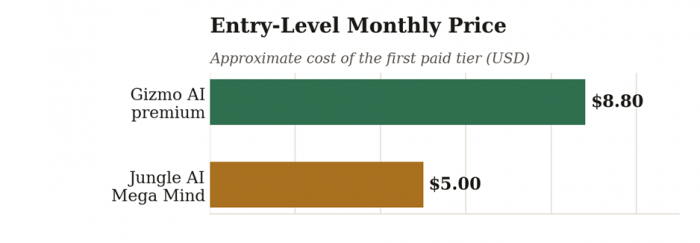
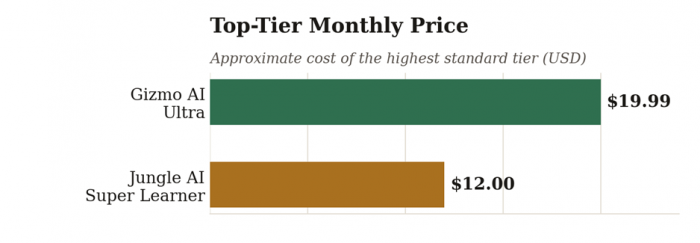
On headline numbers, Jungle's paid plans tend to undercut Gizmo's higher tiers, and its entry plan ranks among the cheapest around. Gizmo answers with a notably generous free tier and a deep public deck library that softens the pressure to upgrade. The smarter buy comes down to usage: heavy uploaders lean toward Jungle's Super Learner plan, while light users can stretch Gizmo's free tier a long way.
User Base and Ratings
Reception is strong for both apps, which is rare in a crowded category. Gizmo reports a user base in the millions and holds high store ratings, with one Android listing showing 4.73 out of 5 across roughly 95,000 ratings. A large share of returning visitors points to real habit formation, and the Philippines, the UK, and the US rank among its biggest markets.
Jungle reports a community above one million students and keeps consistently high ratings, with reviewers praising the accuracy of its questions and the usefulness of slide referencing. The main gripe is that some auto-generated questions read awkwardly, a quirk of AI generation across the whole category rather than Jungle alone.
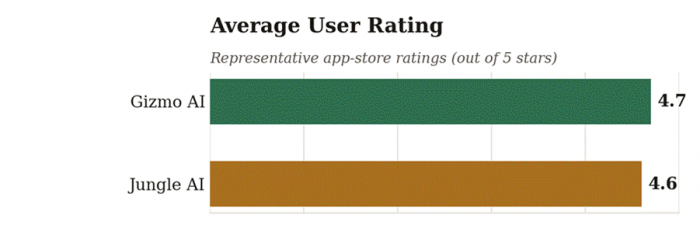
Table 8. Reception and reach indicators
| Indicator | Gizmo AI | Jungle AI |
|---|---|---|
| Reported user base | Several million users | Over one million students |
| Typical store rating | About 4.7 out of 5 | About 4.6 out of 5 |
| Most praised quality | Gamification and free tier | Question accuracy and source referencing |
| Most common complaint | Free-tier life limits | Occasional awkward questions |
Pros and Cons
No single app wins on every front. The strengths and trade-offs below distill what each platform does well and where it falls short.
Gizmo AI
Table 9. Gizmo AI strengths and trade-offs
| Strengths | Trade-offs |
|---|---|
| Generous free tier for flashcards | Free-tier life system can interrupt long sessions |
| Huge library of public community decks | Limited support for case-based questions |
| Built-in AI tutor for explanations | Image handling is basic, no occlusion |
| Strong import options from Quizlet and Anki | Top tier price is high for a freemium app |
| Polished, habit-forming experience | Spaced repetition may favor recent cards |
Jungle AI
Table 10. Jungle AI strengths and trade-offs
| Strengths | Trade-offs |
|---|---|
| AI image occlusion for diagram study | Smaller library of ready-made decks |
| Rich question types including case prompts | Feature-rich interface can feel complex |
| Slide referencing traces every answer | Free tier generation limit is tight |
| Anki export on paid plans | Some generated questions need editing |
| Competitive paid pricing | Less focused on casual or general learners |
Which Tool Fits Which Learner
The clearest way to decide is to match the app to the study profile rather than to chase a single overall winner. The recommendations below map common learner types to the stronger choice.
Table 11. Recommended app by learner profile
| Learner profile | Better fit | Why |
|---|---|---|
| Medical, nursing, or anatomy student | Jungle AI | Image occlusion and case questions match diagram-heavy, applied exams |
| Law or policy student | Jungle AI | Case-based prompts mirror scenario reasoning |
| High school or undergraduate generalist | Gizmo AI | Large deck library and gentle gamified habit loop |
| Learner who struggles with consistency | Gizmo AI | Streaks and lives drive daily return visits |
| Budget-conscious heavy uploader | Jungle AI | Lower-cost unlimited generation on paid tier |
| Casual or occasional studier | Gizmo AI | Generous free flashcards and public decks |
| Existing Anki user | Jungle AI | Direct export keeps the familiar review engine |
Final Verdict
Neither app is strictly better; they optimize for different learners. Gizmo AI is the stronger general-purpose choice, combining a generous free tier, a vast public deck library, an AI tutor, and a gamified loop engineered to build daily study habits. It is the safer pick for high school and undergraduate students, casual learners, and anyone who needs help showing up consistently.
Jungle AI is the specialist's tool. Its image occlusion, case questions, and source referencing make it the better platform for medicine, nursing, law, and other rigorous fields where diagrams and applied reasoning dominate the exam. Its paid plans are also priced competitively, which rewards heavy uploaders.
The most practical approach for many students is to test both free tiers on the same material for a week, then commit to whichever app's question style and motivation design fits the way that learner actually studies.
Post Comment
Be the first to post comment!