On This Page
- Digg Is Now Trying to Separate “Signal” From AI Noise
- The Platform Tracks Influential AI Voices Across X
- The New Digg Looks Nothing Like Its Reddit Experiment
- Kevin Rose Says AI Is Just the First Category
- AI Information Overload Is Becoming a Market Opportunity
- Digg Is Betting on Curation Over Community
Digg is attempting another major reinvention, this time positioning itself as an AI-focused news discovery engine built around real-time conversations happening across X and the broader AI ecosystem.
The new platform, now centered around di.gg/ai, abandons Digg’s recent Reddit-style community ambitions and instead focuses on curating what it describes as the most important AI stories, launches, papers, and discussions circulating online. Rather than relying on traditional upvotes or forum moderation, the system analyzes social activity, sentiment, and influence patterns from X to determine which stories deserve attention.
The move marks the latest chapter in Digg’s long effort to regain relevance after losing dominance in the social news market years ago.
Digg Is Now Trying to Separate “Signal” From AI Noise
The new AI-focused feed is intentionally minimal and heavily curated.
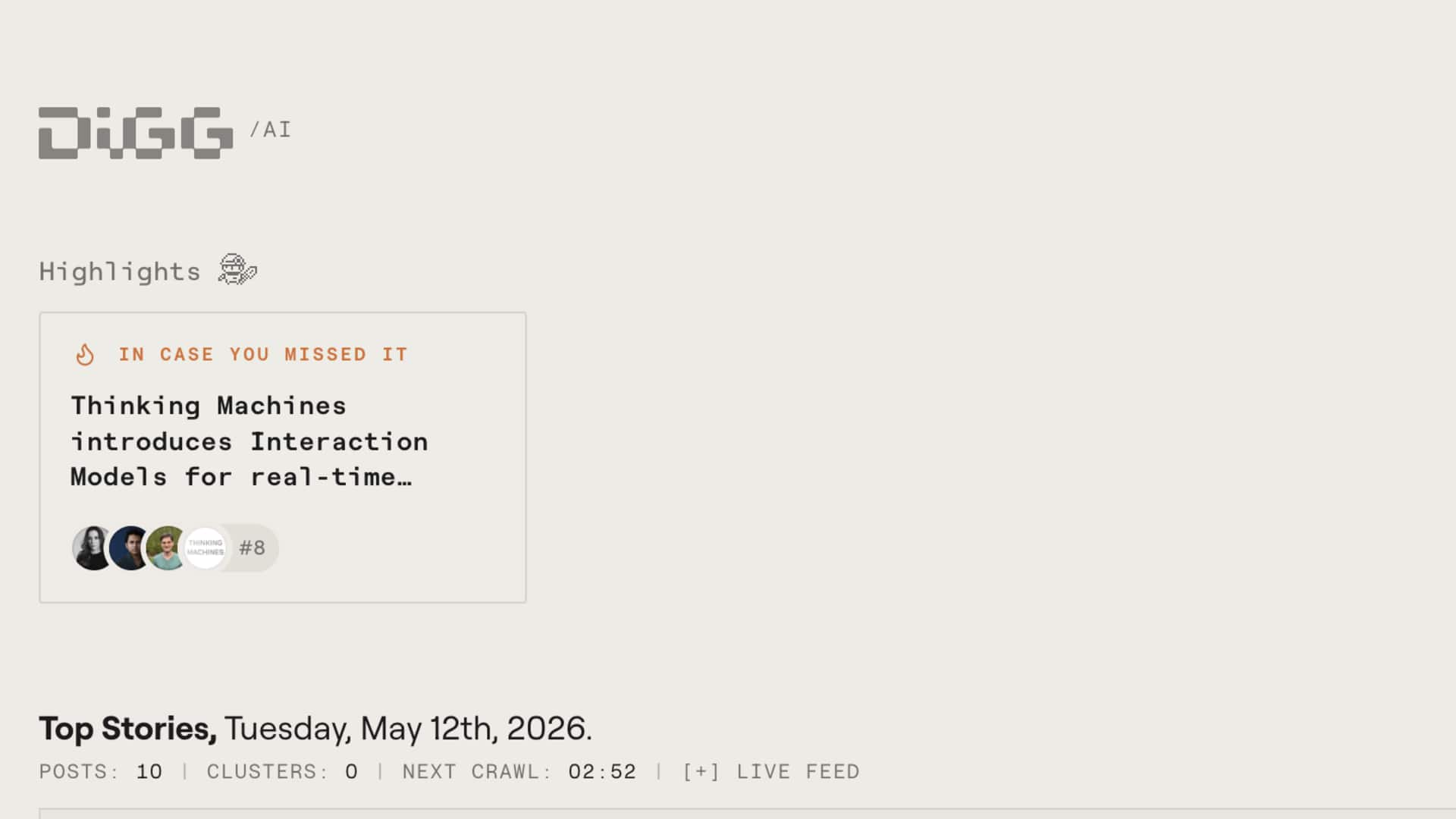
The homepage highlights categories such as “most viewed,” “rising discussion,” “fastest-climbing,” and “in case you missed it,” followed by a continuously updated ranking of AI-related stories. Those stories range from research papers and product launches to viral debates and industry commentary.
Unlike Reddit or older versions of Digg, engagement metrics displayed on the platform are not generated primarily from Digg users themselves. Instead, the system pulls conversation signals directly from X and processes them through Digg’s own analysis layer.
According to emails sent to beta testers, the goal is to identify which discussions are genuinely shaping the AI industry rather than simply tracking what is trending broadly online.
The Platform Tracks Influential AI Voices Across X
At the core of the system is a large AI-focused social graph built from activity on X.
Digg reportedly follows and analyzes around 1,000 influential figures connected to AI research, investing, product development, and media coverage. The tracked network includes high-profile names such as Sam Altman, Elon Musk, Andrej Karpathy, Jeff Dean, Yann LeCun, and Fei-Fei Li.
The platform analyzes how often stories are shared, which influential people are discussing them, and what sentiment patterns emerge around those conversations.
That data is then used to rank and surface content inside Digg’s highlights and main feed.
The company’s broader thesis is that influence-weighted conversation analysis can produce a more useful AI news experience than either generic trending algorithms or raw chronological feeds.
The New Digg Looks Nothing Like Its Reddit Experiment
The launch also represents a sharp shift away from Digg’s previous direction.
In 2025 and early 2026, Digg attempted to relaunch itself as a Reddit competitor built around AI-assisted moderation, community transparency, and user-driven discussion feeds. That version entered alpha testing with an iOS app before being publicly launched and later shut down only months afterward amid reports of layoffs and strategic resets.
The new AI feed strips away most community mechanics entirely.
Instead of focusing on user participation and threaded discussion, Digg is now functioning more like a curated aggregation layer built on top of social media conversations and external content sources.
The interface itself is intentionally lightweight, emphasizing ranking systems, highlight cards, and leaderboards rather than deep social interaction.
Kevin Rose Says AI Is Just the First Category
Digg founder Kevin Rose has reportedly described AI as only the beginning of a larger strategy.
According to statements surrounding the launch, the company plans to expand the model into other high-noise, fast-moving categories such as crypto, politics, technology, and finance if the AI-focused version gains traction.
The underlying idea is to build a topic-based intelligence layer that continuously filters massive amounts of social discussion into ranked, influence-driven information streams.
In practice, Digg is betting that users increasingly want curated interpretation rather than endless feeds or raw algorithmic timelines.
The Platform Is Still Extremely Early
Digg has openly acknowledged that the current release is experimental.
The alpha version is described internally as raw and buggy, with limited features and a highly simplified interface. Many reviewers have noted that the product currently feels more like a live prototype than a polished mainstream platform.
At the moment, most of the engagement indicators visible on the site still originate from X rather than a native Digg community. That has led some critics to question whether the platform is truly rebuilding a social network or simply adding another algorithmic layer on top of discussions already happening elsewhere.
Others argue the value lies precisely in filtering those conversations more intelligently than users can on their own.
AI Information Overload Is Becoming a Market Opportunity
The launch reflects a broader problem emerging across the AI industry: information overload.
AI news now moves at an unusually fast pace, with research papers, product launches, funding announcements, and social debates appearing constantly across platforms. For many users, especially investors, developers, and creators, keeping track of meaningful developments has become increasingly difficult.
Digg appears to believe that influence mapping and conversation analysis can solve part of that problem by surfacing not just popular stories, but the stories influential AI figures are paying attention to most intensely.
That positioning puts Digg somewhere between a news aggregator, a social intelligence tool, and an AI-curated trend analysis platform.
Digg Is Betting on Curation Over Community
The broader significance of the reboot is philosophical as much as technical.
The original Digg was built around crowdsourced voting and community participation. The new Digg is built around algorithmic interpretation of influence networks and AI-powered signal detection.
That shift reflects how much the internet itself has changed. Instead of relying on communities to manually surface important information, platforms increasingly use machine learning and social graph analysis to determine what matters.
Whether Digg can regain relevance through that model remains uncertain. The platform still faces competition from X itself, AI-powered search engines, newsletters, Reddit, and specialized AI media outlets.
But the company’s latest experiment suggests it believes the future of information discovery will depend less on traditional social feeds and more on systems capable of identifying meaningful signals inside overwhelming streams of online noise.
Post Comment
Be the first to post comment!