On This Page
- What exactly is Emergent AI?
- My step-by-step experience, start to finish
- The features that actually mattered to me
- What other people are saying about Emergent
- What real users are saying
- What it costs, in plain numbers
- Pros and cons after real use
- How Emergent compares to other AI app builders
- So, would I actually recommend it?
I keep a long list of tools I mean to try and rarely get to. Emergent sat on it for weeks, because the pitch sounded a little too good: describe an app in plain English, and an AI builds the whole thing. I have heard that before and walked away unimpressed, so I went in skeptical.
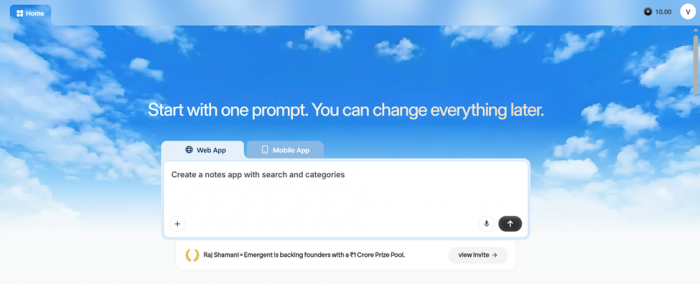
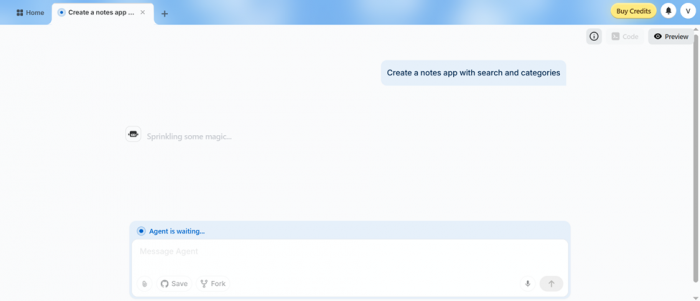
I gave it one quiet afternoon and a real task: a personal notes app with proper search and categories, the kind of thing I would usually spend a weekend wiring together. Here is the exact prompt I started with:
> Create a notes app with search and categories
| THE TASK | A notes app with search, categories, and AI summaries |
| MY INPUT | One prompt, plus five quick questions answered |
| BUILD TIME | Around 5 to 10 minutes, fully hands off |
| TIME ON PLATFORM | Close to an hour, mostly just using the app |
| THE RESULT | A real, working app I would actually keep |
That single line was the whole brief. Here is the short version first, then the full walkthrough.
MY VERDICT · 4.2 OUT OF 5 Genuinely impressive for going from idea to working app Fast, beginner friendly, and the output was a real app rather than a pretty mockup. The one thing to keep an eye on is the credit based pricing, which the wider community flags often. Worth it for: Founders, makers, and non technical builders who can write a clear brief and want a real, deployable app in an afternoon. Think twice if: You iterate constantly on a budget, or you need pixel level design control and predictable monthly costs from day one. |
What exactly is Emergent AI?
Emergent is an agentic AI app builder. Rather than dragging blocks around a canvas, you talk to it. You describe the product you want, and a team of specialized AI agents handles the architecture, writes the code, tests it, and ships it. The team calls English the programming language, and after a day with it, that framing holds up.

| BUILT BY | Ex Google, Amazon, and Dropbox engineers |
| BACKED BY | Y Combinator |
| POWERED BY | Frontier models from Anthropic, OpenAI, and Google |
| CODE OWNERSHIP | Full export to GitHub, no lock in |
In plain terms, here is what people build with it:
• Full-stack web apps: dashboards, internal tools, client portals, and SaaS style products with real logins and databases.
• Mobile apps: iOS and Android builds from the same prompt-driven flow, testable on a real device.
• Landing pages: marketing sites and simple front ends generated from a short description.
• MVPs and prototypes: fast, working proofs of concept to validate an idea before committing real engineering time.
My step-by-step experience, start to finish
This is the part I cared about most. A demo video can look polished. I wanted to know what it actually feels like to sit down and build something, so here is the real sequence, nothing skipped.
Signing in took seconds
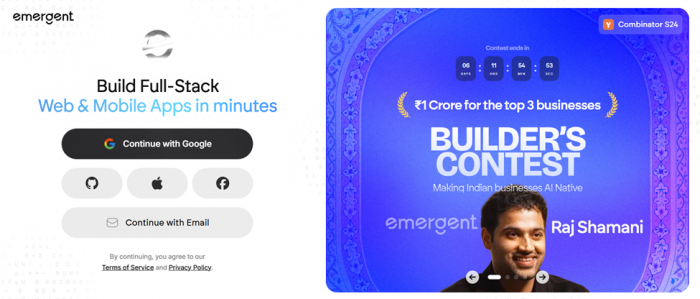
The first screen asks you to log in before anything else. I went with email, but Google, GitHub, Facebook, and Apple sign-in were all there too. No splash screens, no setup wizard, just a clean dark interface and a prompt box waiting for me.
One prompt to kick it off

After logging in I landed on a chat-style screen where you type what you want to build. I dropped in my single line about a notes app with search and categories and hit send. That was the whole input from my side.
It asked me five smart questions
Instead of guessing, it came back with five clarifying questions, each with selectable options and the freedom to type my own answer instead. This was the moment my skepticism started to fade. It felt less like a black box and more like a real developer asking which decisions I wanted to make. I answered all five and let it run.
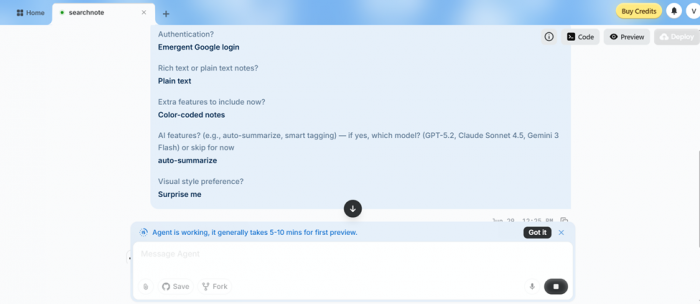
It built the whole app in about 5 to 10 minutes
Then it just worked. Over roughly five to ten minutes it generated a full, functioning app while I watched the progress. The AI-built UI looked genuinely nice, clean and simple rather than the cluttered output I half expected. This was a complete app, not a wireframe.
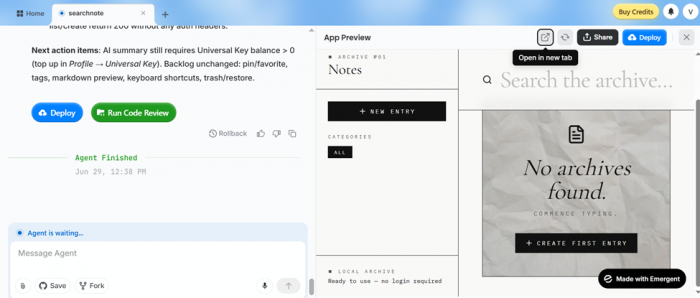
I removed the login so I could start using it
It had set up authentication by default, which is a sensible thing to include. For my own quick use I did not need a sign-in wall, so I had it removed, then clicked through to start using the app. Easy change, no friction.

The AI summarize feature sealed it
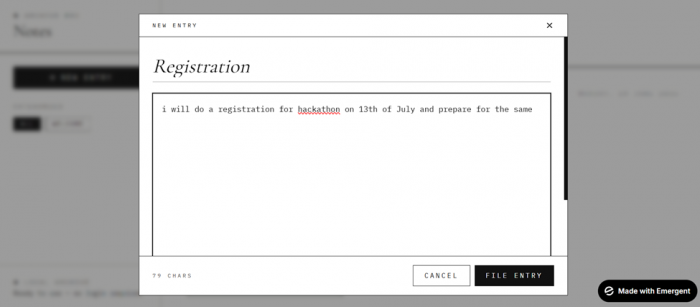
Inside the finished app there was an AI summarize option, and this is where I stopped taking notes and just started using it. I fed it a few of my actual notes and the summaries came back clean and accurate. That was the moment it went from neat demo to something I would genuinely keep around.

The features that actually mattered to me
Plenty of tools have long feature lists. These are the ones I touched directly or that clearly shape the experience, rather than a copy paste of the marketing page.
• Simple prompt to full app: you describe the product and it produces working front end, back end, and database together, not just a screen.
• Multi-agent system: specialized agents split the work of planning, coding, testing, and deploying, which is why the output feels coherent.
• Clarifying questions: it interviews you before building, so the result reflects your choices instead of its assumptions.
• Built-in AI features: things like the summarize tool can be baked straight into the app you generate, and mine worked accurately.
• You own the code: export to GitHub for full ownership, with browser based editing if you want to go deeper.
• One-click deploy: publishing the live app is essentially a button press, with hosting and a domain available on the platform.
What other people are saying about Emergent
My afternoon was positive, but one experience is just one experience. So I checked how Emergent lands across the well known review platforms. The short story: people split hard, and it almost always comes down to cost rather than capability.
THE PATTERN Loved for fast, real full-stack apps. Criticized almost entirely for how quickly credits burn.

Here is how the scores stack up across platforms.
| PLATFORM | SCORE | WHAT STANDS OUT |
|---|---|---|
| Product Hunt | 4.7 / 5 | Fast full-stack output, clean code, and a smooth publish flow. 100+ reviews. |
| G2 | Largely positive | Verified users love one-prompt builds; free credits feel tight. |
| Trustpilot | 2.9 / 5 | Powerful but divisive across ~492 reviews; credit burn is the top complaint. |
| Editorial test | 3.4 / 5 | Capable and quick, tempered by unpredictable usage costs. |
| My hands-on score | 4.2 / 5 | Built a real working notes app fast; the AI summarize feature was the highlight. |
Scores reflect publicly listed ratings as of June 2026.
What real users are saying
To round out my own take, here is a snapshot of what people report across the review sites, the good and the not so good.
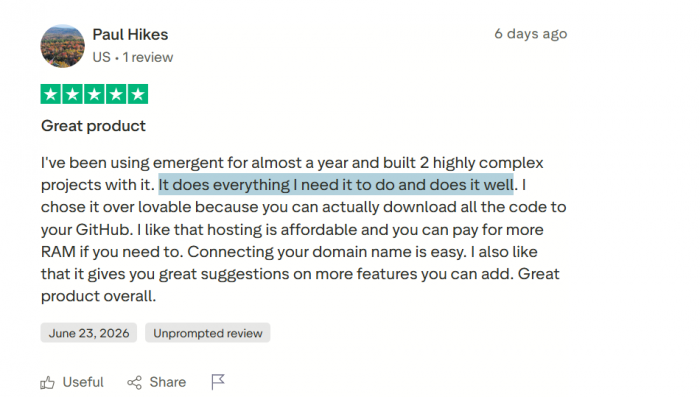
“I had a fully functional app on my first attempt.” Product Hunt · PRAISE | “It does everything I need it to do and does it well.” Trustpilot · PRAISE |
“The free credits are too low at 10 per month.” G2 · CREDIT GRIPE | Several non technical founders say it finally let them ship a product without a developer or a co-founder. Common theme · PRAISE |
A recurring warning is that credits can drain fast during back and forth debugging, so watch your usage. Trustpilot · CRITIQUE | Others single out the support team for staying involved until a stuck build actually worked. Trustpilot · SUPPORT |
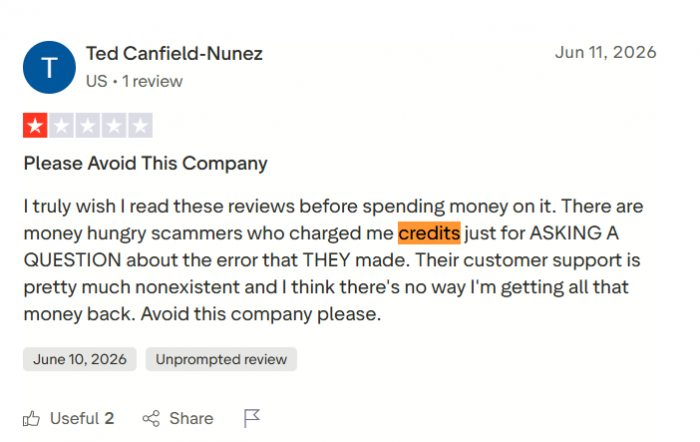
A roundup of common sentiments from public reviews. Individual experiences vary.
What it costs, in plain numbers
Emergent runs on a credit based model, so your real cost depends on how much you build, test, and keep live rather than a flat feature tier. That flexibility is nice on the way in, and it is also the thing most worth understanding before you commit.
| PLAN | PRICE | BEST FOR |
|---|---|---|
| Free | $0 | About 10 credits a month. Enough to try the builder and ship something small. |
| Standard | About $20/mo | The sweet spot for solo builders and freelancers. |
| Pro | About $167/mo | Power users on larger, more complex builds. |
| Teams | About $250/mo | Shared workspaces and pooled credits for groups. |
Two things to plan around: keeping an app live costs an ongoing slice of credits each month, and iterative debugging eats into your balance even when the fixes are small. If you map your work out in phases and keep an eye on the meter, the value holds up well. If you like to tinker endlessly, budget accordingly.
Pros and cons after real use
| What I loved | What to watch |
• Went from one prompt to a full, working app in minutes • The clarifying questions made the result feel tailored to me • Clean, simple UI rather than cluttered AI output • The built-in AI summarize feature was accurate and genuinely useful • You own the code and can export it to GitHub | • Credit costs can climb quickly, especially while debugging • The free tier is generous to start but runs out fast • Reviews are split on support and reliability at scale • Big jump between the entry and the higher paid tiers • Design control is good, not pixel-perfect, out of the box |
How Emergent compares to other AI app builders
Emergent is not the only option in this space. If it is not the right fit, here are the closest alternatives and where each one is strongest.
| TOOL | BEST FOR | HOW IT COMPARES TO EMERGENT |
|---|---|---|
| Lovable | Clean, editable React and Supabase apps with strong design control | Often cited as more affordable and great for fine UI tweaks; lighter on heavy backend logic. |
| Bolt.new | Fast, in-browser prototyping of web apps from a prompt | Excellent for quick UIs and demos; Emergent pushes further into full backend and deployment. |
| Base44 | The simplest, most guided path for non technical solo founders | Easier to start with, but offers less architectural control than Emergent. |
| Replit | Developers who want an AI agent inside a full coding environment | More hands-on and code-first; Emergent automates more of the stack end to end. |
| Cursor | People who already write code and want an AI pair programmer | Assists with coding rather than building whole apps; aimed at a more technical user. |
Pricing and features for these tools change often. Compare current plans before committing.
So, would I actually recommend it?
I will be honest, I did not expect to be writing this. I went in half expecting to roll my eyes, type a prompt, get some half-finished skeleton, and quietly close the tab. That is not what happened. I typed one line about a notes app, answered five quick questions, and a few minutes later I had a real, working app sitting in front of me with search, categories, and a clean little interface I did not have to fight with. Then I tried the AI summarize feature on my own notes, and that was the moment it clicked for me. It was accurate, it was fast, and it just felt good to use. Is it perfect? No. The thing I would tell a friend before they sign up is to keep half an eye on the credits, because that is the complaint I see everywhere and I get why. If you are the type to rebuild the same screen forty times, this is going to cost you. But if you can write a clear brief, answer the questions properly, and build in sensible phases, the speed you get back is honestly a little addictive. I sat down expecting to lose an afternoon and walked away with an app I would actually keep. For me, Emergent earns a solid spot on the shortlist. If you have an idea that has been stuck in your head because you cannot code or cannot justify hiring someone to build it, this is the closest I have come to just thinking of something and watching it become real. I would tell you to grab the free credits, give it one genuine project, and see for yourself. I am glad I finally did. |
BOTTOM LINE One prompt, one afternoon, a real app I kept. Watch the credits, and it is well worth a try.
Post Comment
Be the first to post comment!