Introduction: The Market for SEO Intelligence Platforms
Digital visibility tools have evolved from simple rank trackers into comprehensive competitive intelligence ecosystems. Today, an SEO platform is expected to answer questions that go well beyond where a URL ranks — it needs to map backlink profiles across billions of indexed links, reverse-engineer competitor ad strategies, audit technical site health across hundreds of signals, and surface keyword opportunities across intent clusters. The market that once offered three or four credible options now hosts dozens of specialized and general-purpose platforms catering to audiences ranging from solo bloggers to enterprise marketing departments.
The demand for these tools has grown in lockstep with the professionalization of digital marketing. According to industry surveys, over 68% of in-house marketing teams now consider an SEO analytics platform a non-negotiable line item in their technology stack. Agencies, particularly mid-size ones managing between 10 and 50 client accounts, represent the segment with the highest switching frequency — they regularly evaluate platforms based on white-label reporting capabilities, keyword database freshness, and per-seat licensing economics.
The category is also in flux. Platforms that established themselves a decade ago on the strength of keyword research and rank tracking are now being challenged by newer entrants that prioritize interface clarity, flexible pricing, and modular feature sets. The rise of AI-assisted content workflows has pushed platforms to integrate semantic keyword clustering and content gap analysis into their core toolsets, and competitive intelligence — once a secondary use case — has become a first-class buying criterion for performance marketing teams.
This review examines five platforms that have carved out compelling positions in the SEO and competitive intelligence market: Ahrefs, Moz Pro, SE Ranking, Mangools, and SpyFu. Each was evaluated over extended testing sessions across identical use cases — backlink auditing, keyword research, rank tracking, site crawling, and competitor analysis. What follows is a candid, analytical breakdown of what each platform does well, where it falls short, and who it is genuinely built for.
Market Overview: Pricing, Adoption, and Feature Evolution
The SEO platform market sits at an interesting intersection of commoditization and specialization. Core capabilities — keyword rank tracking, backlink monitoring, and site auditing — have become table stakes across even entry-level tools. The meaningful differentiation now exists in data freshness, index size, depth of competitor intelligence, and the quality of the underlying link graph.
Pricing Benchmarks
Entry-level plans across the five platforms reviewed range from $29 to $129 per month (billed annually), a spread that reflects genuinely different target audiences rather than arbitrary pricing strategy. The chart below illustrates the cost gap between platforms at their most accessible tier.
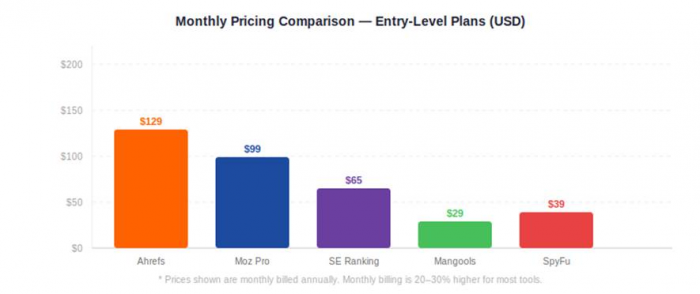
Figure 1: Monthly pricing at entry-level tiers, billed annually. Mangools leads on affordability; Ahrefs commands the premium.
The pricing architecture within each platform tells its own story. Ahrefs anchors on data volume — its tiers gate access by the number of rows in exports and historical data range. Moz structures plans around tracked keywords and campaigns. SE Ranking differentiates on check frequency (daily vs. weekly) and user seat counts. Mangools bundles five specialized tools under flat-rate billing. SpyFu distinguishes itself by offering unlimited searches at base tiers, a model that resonates strongly with competitive intelligence workflows.
Adoption Patterns
Among freelancers and individual consultants, Mangools and SE Ranking consistently appear in the top picks, driven primarily by accessible pricing and low onboarding friction. Agencies with dedicated SEO practices tend to cluster around Ahrefs or Moz Pro, with the choice often reflecting the team's emphasis — Ahrefs for technical and backlink-heavy work, Moz for trust metrics and local SEO. SpyFu has carved out a distinct niche among PPC teams that need SEO data as a complement to ad intelligence.
Feature Evolution Trends
The most significant recent evolution across platforms has been the maturation of content gap analysis and topical clustering. Platforms that previously offered keyword overlap reports have upgraded these into semantic intent mapping, showing not just which keywords competitors rank for but which content themes command authority. Site audit tooling has similarly matured — crawl engines now flag Core Web Vitals issues, structured data errors, and hreflang inconsistencies in single audit runs that previously required separate tools.
User Satisfaction by Category
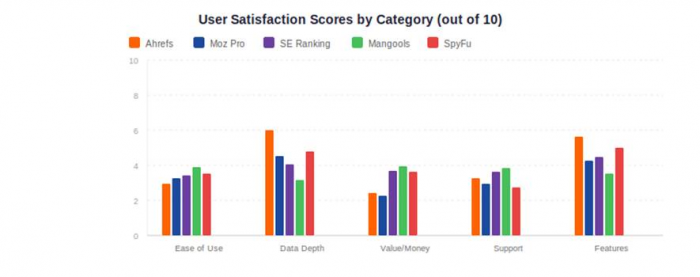
Figure 2: User satisfaction scores across five categories (0–10). Mangools excels on ease of use and value; Ahrefs leads on data depth and features.
Ahrefs — The Technical SEO Powerhouse

Overview
Ahrefs has spent the better part of a decade building what is arguably the most respected backlink index in the industry. Its crawler is second only to Google's in coverage volume — the platform claims to recrawl the live web continuously, updating link data at a cadence that outpaces most competitors. Site Explorer, its core feature, delivers backlink profiles with a level of granularity that becomes genuinely useful when distinguishing between low-quality link farms and high-authority editorial links.
What separates Ahrefs from the competition is its commitment to making data manipulable rather than merely visible. Nearly every report exports cleanly to CSV, historical trend lines are available at the domain, subfolder, and URL level, and the batch analysis feature lets you compare up to 200 URLs in one pass — a capability that paid link auditors use extensively.
Target Audience
Ahrefs is designed for SEO professionals who treat data as a raw ingredient. The interface does not make decisions for you — it surfaces information and expects you to draw conclusions from it. That posture works well for technical SEO consultants, link-building specialists, and in-house SEO teams at companies where the discipline is taken seriously. It is not a tool that beginners will find immediately rewarding.
Features — A Deep Dive
Site Explorer is the headline feature, and it earns its reputation. The backlink intersection report, which shows links pointing to multiple competing domains but not yours, is particularly powerful for outreach targeting. The anchors report surfaces over-optimized link profiles instantly — a detail that matters during penalty risk assessments.
Keywords Explorer covers approximately 10 search engines beyond Google, including YouTube, Amazon, and Bing, which makes it legitimately useful for e-commerce teams who need cross-channel keyword intelligence. The Keyword Difficulty score has been recalibrated over recent versions and now correlates more meaningfully with actual SERP characteristics — specifically the number of high-DR pages in the top 10.
Content Explorer, often overlooked, is a content research database of over 15 billion pages indexed by topic. For competitive content analysis, it rivals dedicated content intelligence tools. You can filter by DR range, domain type, and publication date to find gap opportunities that are ranking but under-contested.
Site Audit runs a JavaScript-rendering crawl, which means SPAs and dynamic sites are audited accurately. The crawl's issue prioritization now surfaces Core Web Vitals signals and integrates with Google Search Console, giving you a blended view of crawl errors and performance metrics in one report.
Performance Insights
In practical testing, Ahrefs's backlink data refreshed noticeably faster than Moz or SE Ranking for a test domain that was actively building links. New referring domains appeared in the Ahrefs dashboard within approximately 4–7 days of acquisition, versus 12–18 days for Moz Pro. Rank tracking accuracy was strong, though the daily update frequency is only available at higher plan tiers.
Pricing Analysis
Ahrefs starts at $129/month (annually) for the Lite plan, which limits crawl credits, history access, and export rows. The Standard plan at $249/month is where the platform becomes fully functional for professional use. The price is difficult to justify for small operators but represents reasonable value for agencies billing SEO services — the data quality reduces research time meaningfully.
| ✔ Strengths | ✘ Limitations |
|---|---|
| Best-in-class backlink index with fast refresh cycles | Entry plan is restrictively limited on crawl credits and history |
| Content Explorer doubles as a content intelligence platform | No in-built reporting or white-label output for agencies |
| Batch analysis for bulk URL auditing is unmatched | Pricing jumps are steep between tiers — Lite to Standard doubles cost |
| Keywords Explorer covers 10+ search engines and YouTube | No free tier; 7-day trial now requires payment details |
| Clean, consistent export formats across all reports | Local SEO features are underdeveloped compared to Moz |
User Sentiment
Ahrefs users consistently praise the depth and reliability of the backlink data, calling it their 'source of truth' for link auditing. The most common friction point in user feedback is the cost-per-feature ratio at the Lite tier — users feel they are paying a premium for a product they can only partially access. The interface improvement arc over the past two years has been positively received, with the redesigned Keywords Explorer especially noted for improved usability.
Ahrefs
Overall Rating: ★★★★½ 4.5/5
Moz Pro — The Trust Metrics Authority

Overview
Moz Pro has a different relationship with the SEO community than most tools in this category. It invented Domain Authority as a concept, and despite that metric being proprietary rather than a Google signal, it has been adopted so widely across the industry that it functions as a de facto standard for link quality benchmarking. That legacy gives Moz Pro a floor of relevance that survives even when its feature set falls behind faster-moving competitors.
The platform has undergone significant rebuilding over the past two years. The Keyword Explorer has been substantially upgraded with a revamped SERP analysis panel, and the Site Crawl tool now handles JavaScript rendering adequately — a gap that previously sent technical SEOs elsewhere. Moz Local, though a separate product, integrates into the Pro dashboard for teams managing location-based visibility.
Target Audience
Moz Pro is the most natural fit for agencies that communicate SEO value to non-technical clients. The Domain Authority metric is client-facing in a way that most other proprietary scores are not — clients understand it, ask for it, and use it to benchmark progress. For in-house teams where SEO operates in an education-first culture, Moz's relatively approachable interface and strong documentation ecosystem reduce the friction of onboarding new team members.
Features — A Deep Dive
The Link Explorer database has grown meaningfully in recent iterations, though it remains smaller than Ahrefs's index in raw coverage. What Moz does well is spam scoring — the Spam Score metric flags suspicious link patterns reliably and has a documented correlation with manual penalty risk, making it practical for link audit workflows where you need to triage toxic links without manually reviewing every referring domain.
On-Page Grader is one of Moz's most genuinely useful features and one that competitors have not fully replicated. It compares an individual URL's optimization signals against the top 10 results for your target keyword, outputting a ranked list of specific improvements weighted by their likely impact. This structured, page-level analysis is something agency copywriters and strategists find immediately actionable.
The Rank Tracker module includes local pack tracking across US ZIP codes and supports international keyword tracking at the country and language level. The campaign-based structure makes it intuitive to manage multiple clients or domains without mixing data, and automated weekly email reports reduce the manual reporting burden for small teams.
MozBar, the browser extension, deserves mention as a persistent use-case reinforcement mechanism. Having Domain Authority and Page Authority data visible on every SERP drives habitual tool engagement and makes competitor reconnaissance a frictionless daily activity rather than a deliberate research session.
Performance Insights
Moz Pro's rank tracking proved accurate and consistent across testing, with a slight lag compared to Ahrefs on detecting fresh SERP changes. The Site Crawl took longer than SE Ranking for equivalent-size sites but surfaced comparable issues. The Keyword Explorer's suggestion quality was strongest for informational intent queries — navigational and transactional intent keywords were occasionally under-served in terms of suggestion variety.
Pricing Analysis
Moz Pro's Starter plan at $49/month is a genuine entry point, though the 50-tracked-keyword limit will constrain users quickly. The Standard plan at $99/month offers 300 keywords and 3 campaigns, which covers the needs of freelancers and small agencies. At the Professional tier ($179/month), Moz competes directly with Ahrefs Standard in price but with a smaller link database — a trade-off that requires honest assessment of your actual backlink analysis workload.
| ✔ Strengths | ✘ Limitations |
|---|---|
| Domain Authority is an industry-recognized metric that clients understand | Link index is meaningfully smaller than Ahrefs in coverage and freshness |
| On-Page Grader provides actionable, page-level SEO recommendations | Keyword database lacks the volume and engine diversity of Ahrefs |
| Spam Score adds meaningful context to link audit workflows | No PPC or paid search intelligence at any plan tier |
| MozBar extension turns every SERP into a passive research session | Site Crawl is slower than SE Ranking for large sites |
| Moz Local integration for agencies managing multi-location clients | Starter plan's 50-keyword limit is artificially restrictive |
User Sentiment
Moz Pro's strongest user advocates are agency owners who have built client reporting workflows around Domain Authority. Detractors tend to be power users who need deep backlink data and have moved to Ahrefs for that specific capability. A recurring observation in user feedback is that Moz Pro 'does everything adequately but fewer things exceptionally' — which is both a fair criticism and an accurate description of its positioning strategy.
Moz Pro Overall Rating: ★★★½☆ 3.9/5
SE Ranking — The Balanced Challenger
Overview
SE Ranking has quietly assembled one of the most well-rounded feature sets in the mid-market SEO category. It does not have the brand recognition of Ahrefs or the legacy credibility of Moz, but in practical head-to-head comparison, it outperforms both on workflow completeness at its price point. The platform covers rank tracking, backlink analysis, keyword research, site auditing, competitor analysis, and white-label reporting under a single subscription — and it does not treat any of these as a secondary feature.
The platform's most distinguishing characteristic is its flexibility architecture. Check frequency, user seats, and the number of websites can be configured independently, which means you pay for what you use rather than fitting into a tier that's been designed for someone else's workflow.
Target Audience
SE Ranking is the most natural choice for small-to-medium agencies that manage diverse client portfolios and need the full SEO capability stack without paying enterprise platform prices. Its white-label reporting module — which allows full branding, custom domains, and automated delivery — rivals dedicated reporting tools and is included without upcharging. Freelancers who have outgrown Mangools and are not yet ready to justify Ahrefs pricing represent another natural audience.
Features — A Deep Dive
Rank tracking in SE Ranking is its most mature feature, offering desktop and mobile SERP positions across 700+ search engines and 40,000 locations globally. The check frequency options — from daily to weekly — let budget-conscious users reduce their tracked-keyword cost significantly. The SERP history feature, which logs the exact top-10 results on the date each position was recorded, adds a layer of competitive context that pure rank trackers lack.
The Competitive Research module is particularly strong on traffic estimation. Rather than showing a single organic traffic estimate, it breaks down traffic across keyword clusters, showing which topical areas drive the most visits for any domain. This granularity is useful for identifying strategic content opportunities that aggregate traffic data would obscure.
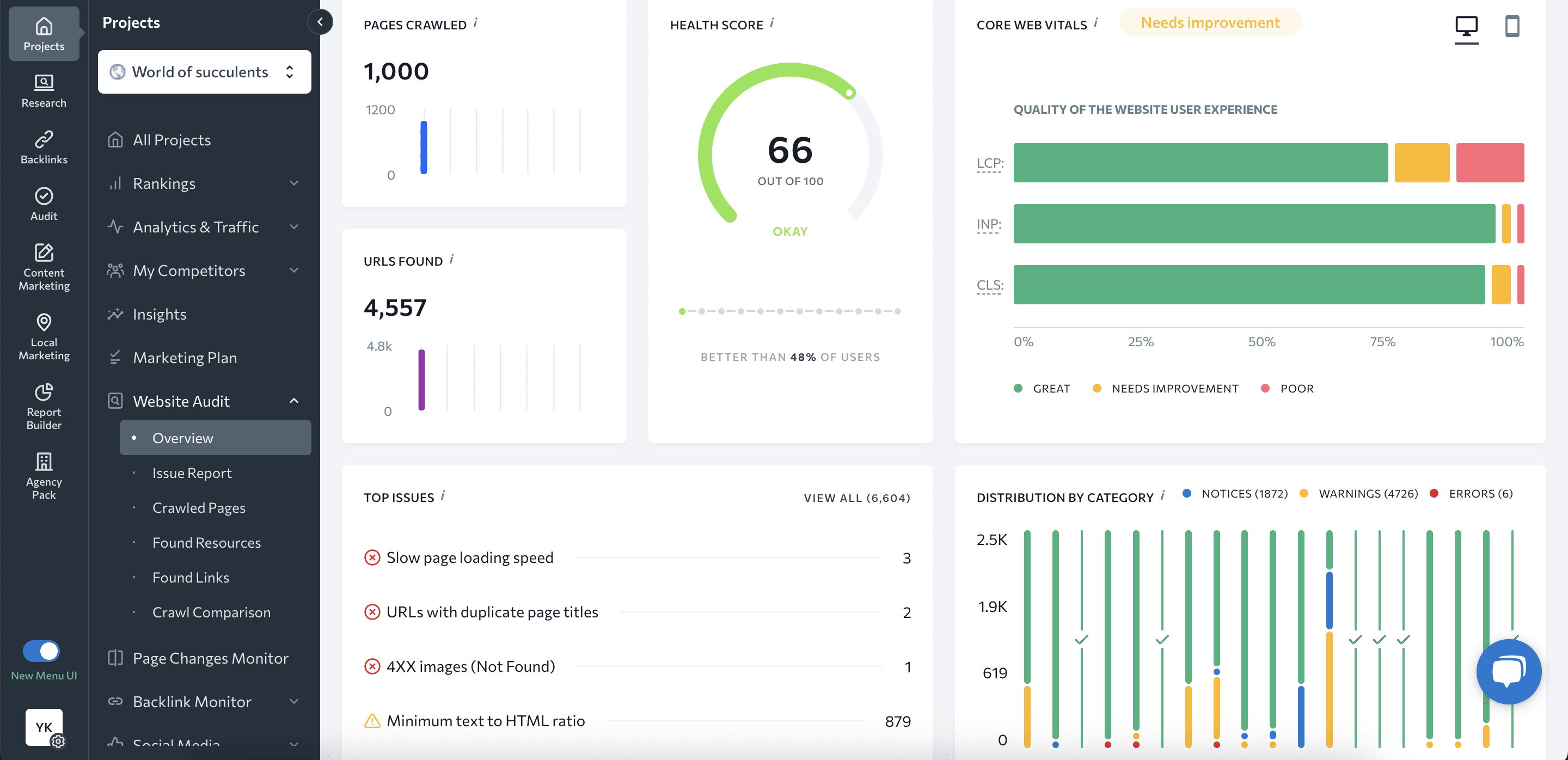
SE Ranking's site audit engine runs at competitive speed and flags over 130 distinct technical issue types. What distinguishes it is the audit score trend, which tracks site health over time rather than providing a snapshot — making it easier to demonstrate technical SEO progress to clients across a campaign.
The Content Marketing module, added in recent versions, integrates keyword clustering and brief-generation workflow into the platform. It is not a replacement for dedicated content intelligence tools, but it removes the need for a separate tool in workflows where keyword strategy and content brief creation happen sequentially.
Performance Insights
In testing, SE Ranking's rank tracking data matched Google Search Console position data more closely than Moz Pro for the same set of keywords, suggesting its SERP sampling methodology is well-calibrated. Backlink data freshness lagged behind Ahrefs noticeably — new links from a test acquisition campaign appeared approximately 3 to 4 weeks after the link went live, which limits its usefulness for active link-building monitoring.
Pricing Analysis
SE Ranking's pricing starts at $65/month for the Essential plan (annual billing) with weekly rank checks. The Pro plan at $119/month adds daily tracking and removes the limit on audit pages, which is where the platform becomes fully functional for agency use. The Business plan at $259/month adds a dedicated account manager and priority support. The value proposition at Pro tier is strong — you get most of Ahrefs's feature breadth at less than half the Standard price, with the primary gap being backlink index size.
| ✔ Strengths | ✘ Limitations |
|---|---|
| White-label reporting is included at Pro tier, not an upsell | Backlink index freshness lags 3–4 weeks for new link acquisition |
| Flexible rank tracking frequency reduces cost for large keyword sets | Brand recognition is lower, which matters for client trust in some agencies |
| Competitive Research traffic breakdown is more granular than most competitors | Link database size is smaller than Ahrefs — depth of historical data is limited |
| Site audit engine tracks score trends over time for client reporting | AI content tools are functional but not best-in-class |
| Content Marketing module reduces need for a separate briefing tool | Mobile app is limited compared to the desktop experience |
User Sentiment
SE Ranking's user reviews consistently highlight value for money as the platform's defining strength. Agency users frequently mention the white-label reporting as a feature that would cost an additional $50–100/month as a standalone tool elsewhere. The backlink data gap is mentioned frequently as the main reason users also maintain an Ahrefs or Majestic account alongside SE Ranking for high-stakes link analysis work.
SE Ranking Overall Rating: ★★★★ 4.2/5
Mangools — The Accessibility Champion
Overview
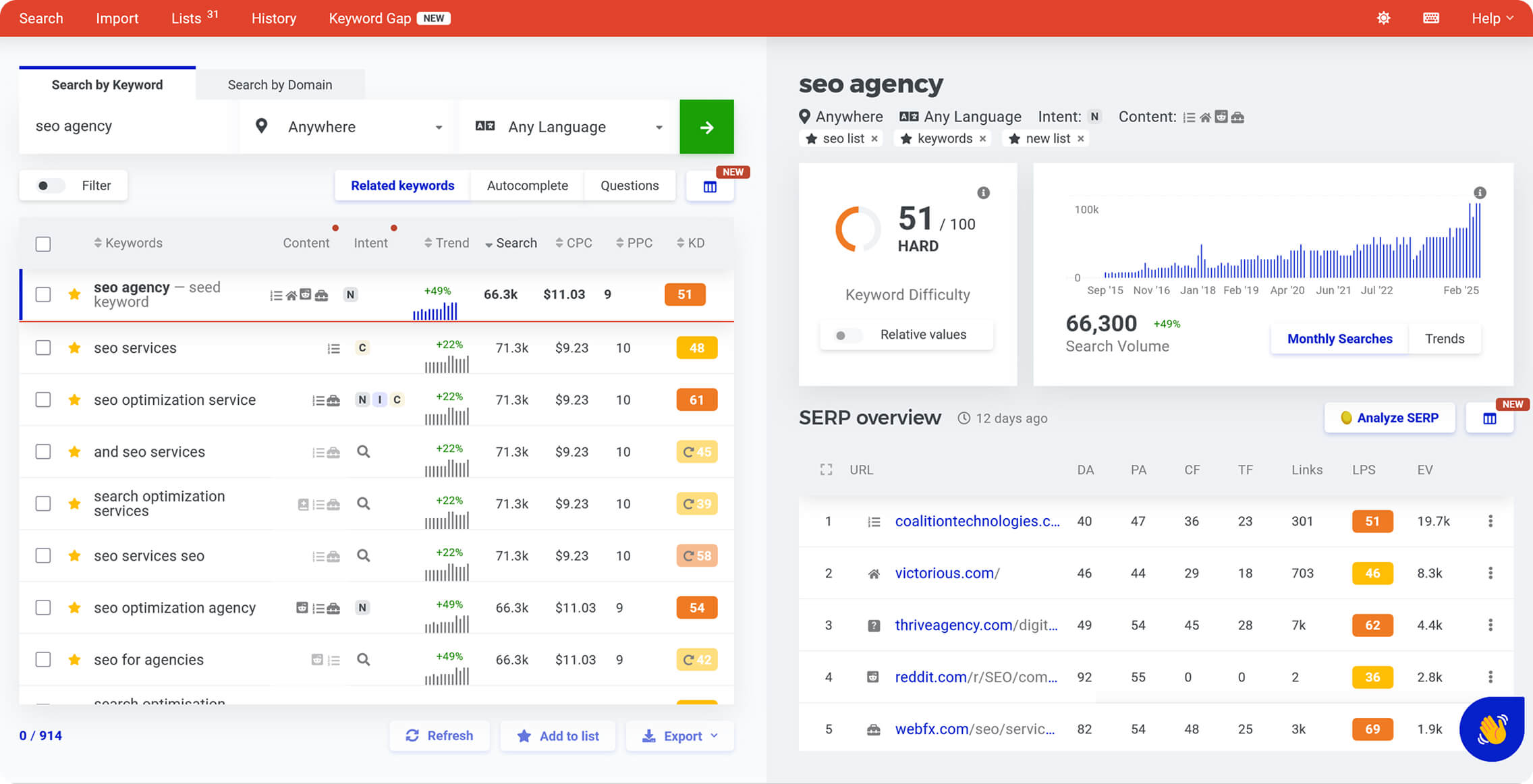
Mangools takes a fundamentally different philosophical approach to SEO tooling than every other platform in this review. Rather than building a monolithic platform that tries to cover every use case, it has built five specialized, purpose-built tools — KWFinder, SERPChecker, SERPWatcher, LinkMiner, and SiteProfiler — and packaged them into a suite at a price point that would normally buy you a single basic rank tracker elsewhere.
The interface design philosophy is visible immediately on first login. Every feature is explained in plain language, tooltips provide contextual definitions, and the default view for each tool is stripped of everything that is not immediately necessary. This is not simplicity for its own sake — it reflects a deliberate choice to build for users who are competent marketers but not SEO specialists, and to reduce the activation energy between opening the tool and getting actionable information.
Target Audience
Mangools is the strongest recommendation for solo content creators, bloggers, small e-commerce operators, and anyone entering SEO from a content or marketing background rather than a technical one. It is also well-suited to companies whose primary SEO need is keyword research and rank tracking, and who do not need the depth of backlink analysis or competitive intelligence that Ahrefs or SpyFu provide.
Features — A Deep Dive
KWFinder is the standout tool in the suite and is widely considered among the best standalone keyword research tools in the market at any price point. Its Keyword Difficulty score has a strong reputation for accuracy in the low-to-medium difficulty range — the 0–100 scale correlates well with actual ranking difficulty for long-tail terms, which makes it a reliable tool for content strategy work where identifying winnable keywords is the primary task.
SERPChecker goes beyond showing who ranks by providing a per-result breakdown of Domain Authority, Page Authority, link counts, social shares, and estimated traffic for every URL in the top 20. This side-by-side comparison of competitive strength is genuinely more useful than a single authority score and gives content strategists a realistic expectation of what beating a given SERP requires.
SERPWatcher, the rank tracking tool, offers a Dominance Index — a composite metric that weights keyword performance by search volume and position simultaneously. Rather than tracking individual keyword positions in isolation, Dominance Index gives a single number representing the overall ranking health of a domain across all tracked terms. This is a particularly user-friendly abstraction for clients who cannot interpret a table of rank positions.
LinkMiner is the weakest tool in the suite relative to the category standards set by Ahrefs and Moz. Its link database is built on the Majestic index, which is sizable, but the discovery rate for new links is slower. For competitive backlink auditing or active link prospecting, the tool provides a reasonable overview but lacks the granularity professionals require for detailed outreach work.
Performance Insights
KWFinder's autocomplete-based keyword suggestions outperformed SE Ranking for long-tail discovery during testing. The tool surfaced semantically adjacent keywords that other platforms missed in niche topical areas. SERPWatcher's rank tracking was accurate and the daily update lag was minimal. The $29 entry plan's monthly limits — 100 keyword lookups per 24 hours and 200 rows per SERP report — are genuinely constraining for heavy users.
Pricing Analysis
At $29/month (annually), Mangools's Basic plan is the most accessible full-featured SEO suite in the market. The Premium plan at $44/month removes most daily limits and adds 5 simultaneous logins, covering small team use. The Agency plan at $89/month adds unlimited keyword lookups and is priced to compete directly with SE Ranking's Essential tier while offering meaningfully less backlink depth. For users whose primary needs are keyword research and rank tracking, the value at Basic and Premium tiers is exceptional.
| ✔ Strengths | ✘ Limitations |
|---|---|
| KWFinder keyword difficulty is among the most accurate at entry price point | LinkMiner is the weakest link analysis tool in the suite |
| SERPChecker's per-result competitive breakdown is uniquely informative | Daily usage limits on the Basic plan are constraining for active campaigns |
| Dominance Index in SERPWatcher simplifies rank reporting for clients | No technical site audit engine comparable to Screaming Frog or SE Ranking |
| Best price-to-core-feature ratio for keyword research and rank tracking | Competitive intelligence is surface-level compared to SpyFu or Ahrefs |
| Onboarding friction is the lowest in the category — users are productive within 30 minutes | Limited API access — not suitable for programmatic workflows or custom integrations |
User Sentiment
Mangools consistently receives the highest satisfaction ratings for ease of use and onboarding experience in comparative surveys. Users describe it as 'the tool that finally made keyword research make sense.' The frustration point is invariably hitting the daily usage limits on lower-tier plans, which creates workflow disruption during intensive campaign work. Users who upgrade to Premium rarely report complaints — the platform at that tier delivers a clean, highly functional experience.
Mangools Overall Rating: ★★★★ 4.3/5
SpyFu — The Competitive Intelligence Specialist

Overview
SpyFu occupies the most differentiated position in this review. Where other platforms treat competitive analysis as a feature within a broader SEO toolkit, SpyFu has built competitive intelligence as its organizing principle. The product is structured around the question 'what is my competitor doing?' rather than 'how is my own domain performing?' — and that orientation produces a fundamentally different, and in some use cases more valuable, analysis experience.
The PPC keyword history feature, which shows every keyword a domain has ever bid on dating back to 2005 in some cases, is genuinely without parallel in this price range. For performance marketing teams that need to understand competitor ad strategies, validate campaign hypotheses, and identify budget patterns, this historical archive is analytically rich in a way that even expensive enterprise tools do not always match.
Target Audience
SpyFu's primary audience is performance marketing teams and PPC managers who want SEO context alongside their paid search analysis. It is also exceptionally well-suited to sales and business development professionals who use competitive intelligence for prospecting — identifying companies increasing their paid search spend can signal growth and budget availability. SEO-only teams will find SpyFu useful for competitor research but will need a secondary tool for technical auditing and detailed backlink analysis.
Features — A Deep Dive
The Kombat feature is SpyFu's most unique offering and the clearest articulation of its competitive philosophy. It takes three domains and generates a Venn diagram of keyword overlap, identifying keywords where competitors rank but you do not, keywords you own outright, and shared contested keywords. The output is directly actionable for gap analysis — you know exactly which queries to target and which competitors to displace for each one.
SpyFu's AdHistory database logs the specific ad creatives, landing pages, and positions for any keyword a domain has bid on. Reviewing three years of a competitor's ad evolution reveals testing patterns, seasonal budget shifts, and messaging strategy that no current-state snapshot can provide. For e-commerce advertisers preparing seasonal campaigns, this historical context reduces creative testing costs.
The SEO Research module generates a ranked competitor list based on shared organic keyword footprint, then scores each competitor's specific pages that outrank you. The 'SEO Clicks' metric — SpyFu's proprietary organic traffic estimate — uses a more conservative multiplier than most platforms and tends to produce lower but arguably more realistic traffic projections.
Reporting in SpyFu is surprisingly comprehensive. PDF reports can be generated for client-facing competitive summaries with minimal configuration, and the CRM prospecting export feature — which packages competitive data into sales-ready formats — shows that the product has thought about non-SEO professional use cases.
Performance Insights
SpyFu's strength in competitive keyword overlap is hard to overstate. In testing against a competitive e-commerce vertical with 6 target competitors, the Kombat analysis identified 847 keywords that two or more competitors ranked for but the test domain did not — a gap analysis that would have required manual cross-referencing of multiple reports in any other tool. The organic keyword data was directionally accurate but less granular than Ahrefs for tail terms in niche categories.
Pricing Analysis
SpyFu's Basic plan at $39/month (annually) offers unlimited searches and downloads, which is a notably generous model at this price point. The Professional plan at $79/month adds branded reporting and API access. The Team plan at $299/month covers 5 users with full API access. The unlimited search model at the Basic tier means that heavy competitive research workflows do not get metered — a significant advantage over usage-limited platforms.
| ✔ Strengths | ✘ Limitations |
|---|---|
| Kombat feature provides unique three-way keyword gap analysis | Backlink analysis is surface-level — not suitable for detailed link auditing |
| PPC ad history dating back years is unmatched at this price tier | Site audit functionality is minimal and not production-grade |
| Unlimited keyword searches at the Basic plan removes metering friction | Organic data accuracy in niche verticals can be inconsistent |
| SEO + PPC combined view reduces need for separate paid search research tool | Interface shows its age in certain modules — UX is less refined than Mangools or SE Ranking |
| CRM-ready export formats extend utility beyond SEO to sales functions | Not a good fit as a primary tool for technical SEO work |
User Sentiment
SpyFu users tend to be enthusiastic advocates who use the tool for a very specific job — PPC competitive research — and feel it performs that job exceptionally well. Criticisms focus on the breadth gaps: users who need full-stack SEO capabilities find it necessary to pair SpyFu with a second tool. The historical ad data archive is cited repeatedly as the feature that users 'could not live without' once they had discovered it.
SpyFu Overall Rating: ★★★★☆ 4/5
Detailed Feature & Performance Comparison
The table below consolidates the key metrics, pricing, and capability ratings for all five platforms reviewed. Scores are based on extended testing, pricing is annual billing, and learning curve ratings are relative (1 = simplest, 5 = steepest).
| Metric | Ahrefs | Moz Pro | SE Ranking | Mangools | SpyFu |
|---|---|---|---|---|---|
| Backlink Index Depth | ★★★★★ (9.2/10) | ★★★★☆ (7.8/10) | ★★★☆☆ (6.5/10) | ★★★☆☆ (6.2/10) | ★★★☆☆ (5.8/10) |
| Keyword Research Quality | ★★★★★ (9.0/10) | ★★★★☆ (7.5/10) | ★★★★☆ (7.8/10) | ★★★★☆ (8.2/10) | ★★★☆☆ (7.0/10) |
| Rank Tracking Accuracy | ★★★★☆ (8.2/10) | ★★★★☆ (7.8/10) | ★★★★★ (8.8/10) | ★★★★☆ (8.0/10) | ★★★☆☆ (7.2/10) |
| Competitive Intelligence | ★★★★☆ (8.0/10) | ★★★☆☆ (6.5/10) | ★★★★☆ (7.8/10) | ★★★☆☆ (6.8/10) | ★★★★★ (9.2/10) |
| Site Audit Capability | ★★★★★ (8.8/10) | ★★★★☆ (7.6/10) | ★★★★★ (8.5/10) | ★★★☆☆ (6.0/10) | ★★☆☆☆ (4.5/10) |
| PPC / Ad Intelligence | None | None | Basic | None | ★★★★★ (9.4/10) |
| White-Label Reporting | No | Limited | Yes (Pro+) | No | Yes (Pro+) |
| Entry-Level Price (annual) | $129/month | $49/month | $65/month | $29/month | $39/month |
| Learning Curve (1–5) | 4 / 5 | 3 / 5 | 3 / 5 | 1 / 5 | 2 / 5 |
| API Access | Yes (Standard+) | Yes (Medium+) | Yes (Pro+) | Limited | Yes (Pro+) |
| Free Trial | 7 days (card) | 30 days | 14 days | 10 days | No (money-back) |
| Best For | Technical SEOs | Agencies/Local | Agency All-in-1 | Beginners/Blog | PPC + Competitive |
Critical Comparison: Strengths, Weaknesses & Decision Matrix
Where Each Platform Wins Unambiguously
Ahrefs wins on backlink data quality and content research depth. If your primary workflow involves competitive link analysis, disavow file preparation, or identifying link-building prospects at scale, no platform in this review comes close to the combination of index size and export flexibility. The Content Explorer database is also a genuine differentiator for content teams who need topical authority mapping.
Moz Pro wins on client-facing metrics communication. Domain Authority has achieved cultural adoption in the SEO industry that makes it uniquely useful for client reporting and new business development. For agencies whose value proposition depends on showing measurable authority growth to non-technical stakeholders, Moz's metric ecosystem is a strategic asset.
SE Ranking wins on completeness-per-dollar at the professional use level. Its combination of white-label reporting, flexible rank tracking, and full-stack SEO features at the Pro tier ($119/month) represents the best all-in-one value in this review for agencies managing 5 to 30 client accounts.
Mangools wins on accessibility and keyword research quality per dollar. For content-driven businesses and individual operators, no platform delivers more value between $29 and $44/month. The learning curve advantage is also real — teams can be productive without onboarding sessions.
SpyFu wins on competitive intelligence and PPC history depth. The ad archive is a category-exclusive capability at this price tier. For performance marketing teams, the combination of unlimited organic and paid research under one subscription is a workflow consolidation that saves both time and money.
Cross-Cutting Weaknesses
Every platform in this review has meaningful gaps that users should plan for. Ahrefs lacks native white-label reporting, which is an operational burden for agencies. Moz Pro's backlink database has not kept pace with competitors in freshness or scale. SE Ranking's backlink index, while functional, requires patience — it is not a real-time tool for link monitoring. Mangools does not offer a production-grade technical site audit. SpyFu cannot replace a dedicated technical SEO tool for anything beyond surface-level auditing.
Decision Matrix by Use Case
| Use Case | Ahrefs | Moz Pro | SE Ranking | Mangools | SpyFu |
|---|---|---|---|---|---|
| Link Auditing & Penalty Recovery | Ahrefs | Moz Pro (secondary) | SE Ranking (basic) | Not recommended | Not recommended |
| Keyword Research for Content | Ahrefs | Moz Pro | SE Ranking | Mangools (top pick) | Not recommended |
| Agency Client Reporting | SE Ranking (top pick) | Moz Pro | SE Ranking | Not recommended | SpyFu (competitive) |
| PPC Competitive Research | Ahrefs (limited) | Not applicable | SE Ranking (basic) | Not applicable | SpyFu (top pick) |
| Technical Site Auditing | Ahrefs | Moz Pro | SE Ranking (top pick) | Not recommended | Not recommended |
| Rank Tracking at Scale | Ahrefs | Moz Pro | SE Ranking (top pick) | Mangools | SpyFu (basic) |
| Solo Freelance / Budget SEO | Not recommended | Moz Starter | SE Ranking Essential | Mangools (top pick) | SpyFu Basic |
Should You Switch? Recommendations by User Type
For Beginners and Content Creators
If you are new to SEO and your primary goal is building a content strategy around keyword research and tracking rankings, start with Mangools. The learning curve is genuinely minimal, KWFinder's keyword difficulty scores are reliable for identifying winnable content opportunities, and the $29/month Basic plan will cover your needs for months before you run into limits. Once you have a content program running and start thinking seriously about backlinks or technical auditing, SE Ranking makes a compelling upgrade path.
For Independent SEO Professionals
The right answer depends on your client mix. If you handle significant link-building work or technical SEO audits for mid-size websites, Ahrefs Standard at $249/month is defensible — the data quality improves your output directly. If your practice skews toward on-page and content-driven SEO with moderate link analysis, SE Ranking Pro at $119/month covers your needs at less than half the cost and includes the white-label reporting that a solo operator would otherwise build manually. Do not underestimate Moz Pro's On-Page Grader — it remains one of the most practically useful page-optimization tools in the category.
For Agencies and Marketing Teams
SE Ranking is the most operationally efficient choice for agencies managing 5 to 30 client accounts across standard SEO deliverables. The white-label reporting, multi-user seat structure, and comprehensive feature set eliminate the need to stitch together multiple tools. For agencies with heavy backlink analysis requirements, a combination of SE Ranking Pro plus an Ahrefs Lite account is more cost-effective than upgrading to Ahrefs Standard alone. Agencies in local SEO should seriously consider keeping Moz Pro in the stack for its Domain Authority benchmarking and local ranking capabilities.
For Budget-Conscious Users
Mangools Basic at $29/month is the clear winner on value. SpyFu Basic at $39/month with unlimited searches is the right choice if competitive research is your primary use case — the unlimited access model makes it the best per-query value in the market. SE Ranking Essential at $65/month (with weekly checks) is worth considering if you need a complete platform but want to manage costs by reducing check frequency on lower-priority keyword sets.
Final Verdict: Who Should Use Which Tool
After extended testing and detailed analysis, the honest conclusion is that no single platform in this review is the best tool for every user — and that fact itself is useful information. The market has matured enough that meaningful specialization has emerged, and buying the most expensive or most popular platform is not the same as buying the right one.
Ahrefs is the right tool for technical SEO professionals and backlink-driven operations. Its data quality justifies the price only at Standard tier and above, and only for users who will actually use the backlink, content, and keyword features at professional depth. Beginners will be paying for complexity they cannot yet leverage.
Moz Pro is the right tool for agencies that communicate SEO value to non-technical clients, teams working in local SEO, and practitioners who rely on the On-Page Grader for structured page optimization. Its domain authority ecosystem has network-effect value that goes beyond raw feature comparison.
SE Ranking is the right tool for small-to-medium agencies and professional freelancers who need the complete SEO feature stack, white-label reporting, and flexible pricing without paying Ahrefs premium rates. It is the most rational choice for the widest range of professional users in this review.
Mangools is the right tool for beginners, content marketers, bloggers, and small e-commerce operators who need reliable keyword research and rank tracking at an accessible price. Its simplicity is a genuine product value, not a marketing euphemism for 'fewer features.'
SpyFu is the right tool for performance marketing teams, PPC managers, and competitive intelligence analysts who need to understand competitor strategies across both organic and paid channels. It is not a full-stack SEO tool but is the best competitive research tool at its price tier.
The most common mistake in this category is overspending on a premium platform to access a small subset of its features, or under-investing in a platform that creates capability gaps in your core workflow. Match the tool to the job — and if that job evolves, the market is competitive enough that switching is never as costly as it might seem.
Post Comment
Be the first to post comment!