On This Page
- Expectation 1: “This Will Replace My Editing Software”
- Expectation 2: “AI Means Perfect Results”
- Expectation 3: “More Features = More Power”
- Expectation 4: “Creative Freedom Comes With AI”
- Expectation 5: “The Free Version Shows the Full Potential”
- Expectation 6: “Consistency Means Quality”
- Expectation 7: “Video Tools Mean Video Editing”
- Expectation 8: “AI Tools Are Risk-Free”
- Expectation 9: “This Tool Is for Everyone”
- Final Takeaway
Most people don’t come to AIEASE with a neutral mindset.
They arrive after seeing phrases like AI photo editor, one-click video effects, or all-in-one editing platform. By the time they open the tool, expectations are already inflated.
This article is not about features.
It’s about what people think AIEASE does, versus what it consistently does in practice.
Expectation 1: “This Will Replace My Editing Software”
Reality: It won’t — and it’s not designed to.
AIEASE does not compete with traditional editing software in terms of control, depth, or flexibility. There are no layers, no adjustment stacks, and no manual refinement loops.
What it replaces is not software, but effort:
- Opening heavy tools for small fixes
- Repeating the same edits over and over
- Spending time on tasks that don’t need creative judgment
If you approach it as a replacement, disappointment is likely.
If you approach it as a shortcut, results feel more aligned.
Expectation 2: “AI Means Perfect Results”
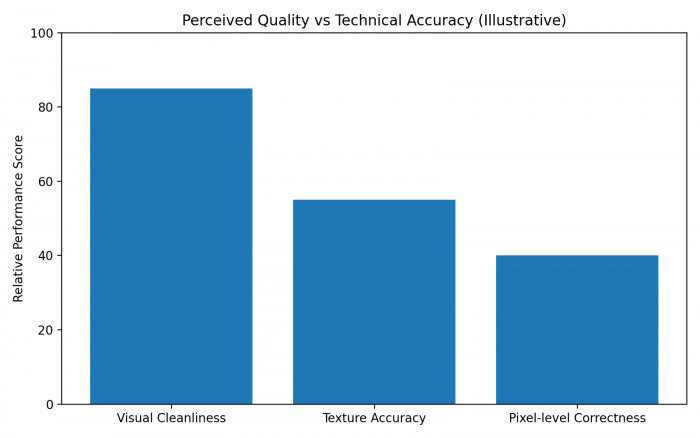
Reality: AI means probable results, not precise ones.
AIEASE consistently produces outputs that look “right enough” for screens, previews, and quick publishing. It does not aim for technical perfection.
This shows up clearly in:
- Image enhancement (clean but softened texture
- Retouching (uniform results)
- Background removal (strong in simple cases, weaker in complex ones)
The system optimizes for speed and visual plausibility, not correctness at pixel level.
Expectation 3: “More Features = More Power”
Reality: More features mostly mean more entry points.
AIEASE lists many tools, but most are built on a similar foundation:
- Upload
- Choose outcome
- Generate result
Whether it’s a headshot, background removal, or image expansion, the interaction pattern remains the same. This keeps the learning curve low but also caps mastery.
You don’t become “better” at using AIEASE you just become faster at choosing.
Expectation 4: “Creative Freedom Comes With AI”
Reality: Automation reduces freedom by design.
AIEASE removes decision-making steps to speed up output. That means:
- Less room for experimentation
- Fewer creative detours
- Limited stylistic divergence
This is not accidental. It’s how the platform stays accessible to non-designers.
Creative freedom isn’t missing, it’s intentionally excluded to protect speed.
Expectation 5: “The Free Version Shows the Full Potential”
Reality: The free version shows the behavior, not the workflow.
Free access lets users see:
- Output style
- Speed
- Automation logic
It does not show:
- Batch workflows
- Sustained usage patterns
- Friction-free editing at scale
The difference between free and paid is not quality — it’s continuity. Paid use removes interruptions rather than changing outcomes.
Expectation 6: “Consistency Means Quality”
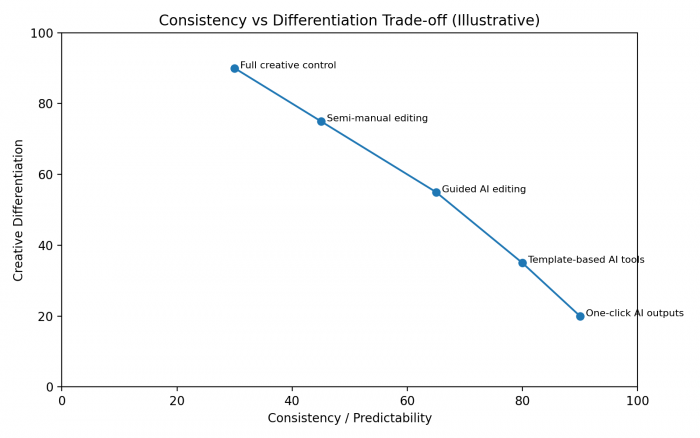
Reality: Consistency means predictability.
AIEASE outputs are consistent in tone, polish, and structure. That helps when:
- Brand uniformity matters
- Content is produced at scale
- Visual cohesion is required
It hurts when:
- Variation is desired
- Individual personality matters
- Outputs need differentiation
Consistency is useful, but it’s not the same as excellence.
Expectation 7: “Video Tools Mean Video Editing”
Reality: Video tools here are animation generators.
AIEASE’s video features:
- Animate static images
- Apply motion templates
- Produce short clips
They do not:
- Offer timeline control
- Support complex sequencing
- Replace video editing software
Understanding this avoids frustration. Treat them as motion effects, not editing environments.
Expectation 8: “AI Tools Are Risk-Free”
Reality: Risk comes from assumptions, not malware.
AIEASE behaves like most cloud-based AI platforms:
- Media is uploaded
- Processing happens remotely
- Temporary storage is involved
There’s no evidence of unusual risk, but there’s also no invisibility. Users should avoid uploading:
- Sensitive client assets
- Confidential documents
- Irreplaceable originals
This isn’t unique to AIEASE, it’s standard cloud reality.
Expectation 9: “This Tool Is for Everyone”
Reality: It’s for specific workflows.
AIEASE fits best when:
- Speed matters more than precision
- Output volume is high
- Visuals are disposable or iterative
It fits poorly when:
- Detail matters
- Manual control is required
- Creativity is the core objective
Mismatch creates negative reviews more often than actual failure.
The Pattern Behind Most Frustration
When users dislike AIEASE, it’s rarely because the tool breaks.
It’s because expectations don’t match design intent.
AIEASE does not hide its limits, it simply doesn’t explain them explicitly. That silence lets assumptions fill the gap.
Once expectations are corrected, the experience becomes more predictable and less frustrating.
Final Takeaway
AIEASE is not a creative platform.
It’s a decision minimizer.
It removes steps, choices, and time from visual editing workflows. In exchange, it removes control, nuance, and variation.
That exchange is neither good nor bad — it’s contextual.
Used for the job it’s designed to do, AIEASE behaves consistently.
Used for jobs it was never meant to handle, it feels restrictive.
Understanding that the boundary is the difference between disappointment and usefulness.
Post Comment
Be the first to post comment!