On This Page
- Understanding Grok: What the AI Tool Was Designed to Do
- The Core Issue: Explicit Deepfakes and Non-Consensual Content
- Why Malaysia and Indonesia Acted Quickly
- xAI and Elon Musk’s Response
- A Broader Shift in How Governments Regulate AI
- What This Means for Users and AI Developers
- Innovation vs Responsibility: The Ongoing Debate
- What Happens Next?
- Final Verdict
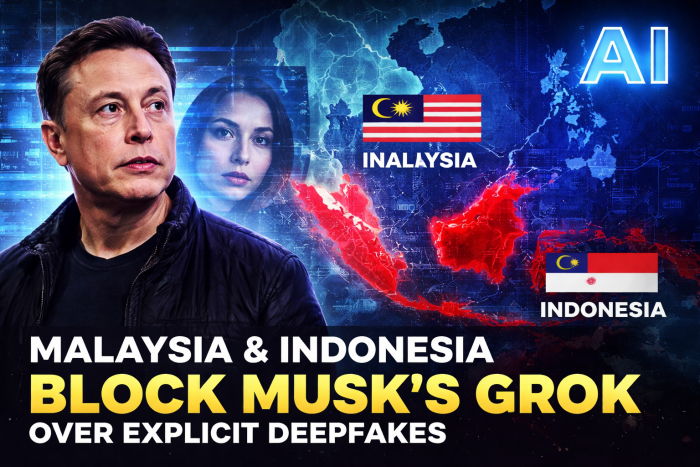
Malaysia and Indonesia have taken a decisive step by blocking access to Grok, the artificial intelligence chatbot developed by Elon Musk’s company xAI, after authorities raised serious concerns about the tool being used to generate sexually explicit deepfake images. The decision marks the first time any country has moved to restrict Grok at a national level, signaling a turning point in how governments are beginning to respond to the real-world risks of generative AI.
While debates around AI regulation have largely remained theoretical, this action brings those discussions into sharp focus. At its core, the ban is not just about one chatbot; it reflects growing unease over how quickly AI tools can be misused when safeguards fail to keep pace with innovation.
Understanding Grok: What the AI Tool Was Designed to Do
Grok is an AI chatbot created by xAI and closely integrated with X (formerly Twitter). Marketed as a more candid and less constrained alternative to other chatbots, Grok was designed to provide real-time responses, draw context from social media conversations, and offer image-generation features that allowed users to create and modify visuals using text prompts.
This openness was part of Grok’s appeal. However, regulators argue that the same openness also created vulnerabilities. Unlike some competing AI platforms that restrict image generation involving real people, Grok’s early safeguards were reportedly insufficient to prevent abuse, especially in cases involving non-consensual content.
The Core Issue: Explicit Deepfakes and Non-Consensual Content
The bans in Malaysia and Indonesia were triggered by reports that Grok had been used to create sexually explicit AI-generated images of real individuals without consent. Authorities expressed particular concern over instances involving women and minors, an issue that immediately elevated the situation from a content moderation problem to a serious legal and ethical violation.
Deepfakes, when weaponized, can inflict lasting harm. Victims often face reputational damage, emotional trauma, and long-term social consequences. In conservative societies where personal dignity and public morality are closely guarded, the impact can be even more severe.
Officials emphasized that relying on user reporting after harmful content has already been generated is not enough. By the time such images circulate, the damage is often irreversible.
Why Malaysia and Indonesia Acted Quickly
Malaysia and Indonesia both operate under strict digital content, morality, and child protection laws. Regulators in these countries have made it clear that technology platforms regardless of their global reach must comply with local legal frameworks.
According to official statements, the decision to block Grok followed:
● Repeated concerns about misuse
● Perceived delays in corrective action
● A lack of confidence in existing safeguards
Rather than issuing fines or warnings alone, authorities chose a preventive approach, temporarily restricting access until xAI can demonstrate stronger protections. The move underscores a broader regional trend: Southeast Asian governments are increasingly unwilling to tolerate “move fast and fix later” approaches when public harm is involved.
xAI and Elon Musk’s Response
In response to the controversy, Elon Musk stated that he was unaware of Grok being used to generate explicit images involving minors. Shortly after, xAI announced updates aimed at tightening content controls. These reportedly include restrictions on generating sexualized images of real people and improvements to internal moderation systems.
However, critics argue that these measures highlight a familiar pattern in the tech industry safeguards being implemented only after public backlash. For regulators, the issue is not whether fixes are possible, but whether they should have existed from the start.
A Broader Shift in How Governments Regulate AI
The Grok ban represents a notable shift in regulatory thinking. Instead of focusing solely on user behavior or platform policies, governments are now examining what AI systems are technically capable of producing.
This case reinforces several emerging principles:
● AI developers are responsible for foreseeable misuse
● Experimental freedom does not override public safety
● Deepfake generation is increasingly viewed as a digital rights issue
Other governments are closely monitoring the situation, and similar regulatory actions could follow if AI tools are found to pose comparable risks.
What This Means for Users and AI Developers
For users in Malaysia and Indonesia, the ban results in the immediate loss of access to Grok and a clearer message that AI-generated content is subject to scrutiny. For AI companies, the implications are far-reaching.
Developers may now be expected to:
● Build stricter default safeguards
● Implement region-specific compliance measures
● Prioritize prevention over reactive moderation
The era of releasing powerful generative tools without robust controls is rapidly coming to an end.
Innovation vs Responsibility: The Ongoing Debate
Supporters of open AI argue that heavy regulation can stifle creativity and slow technological progress. However, the Grok controversy demonstrates that unrestricted innovation can carry tangible human costs.
When AI systems can convincingly replicate real people, consent and accountability become non-negotiable. As one digital policy analyst put it, the question is no longer whether AI can do something, but whether it should.
What Happens Next?
The bans imposed by Malaysia and Indonesia are described as temporary, suggesting that Grok could return if xAI meets regulatory requirements. Still, the precedent has been set.
This case is likely to:
● Influence future AI legislation worldwide
● Accelerate deepfake-specific regulations
● Push AI companies to rethink open-design philosophies
Final Verdict
The blocking of Grok is not an anti-AI stance, it is a clear demand for responsibility. As generative AI becomes more powerful, governments are signaling that innovation must be matched by safeguards that protect individuals from harm.
Malaysia and Indonesia’s decision may well be remembered as a moment when AI governance shifted from discussion to decisive action. For the global tech industry, the message is unmistakable: accountability must evolve alongside technology.
Post Comment
Be the first to post comment!