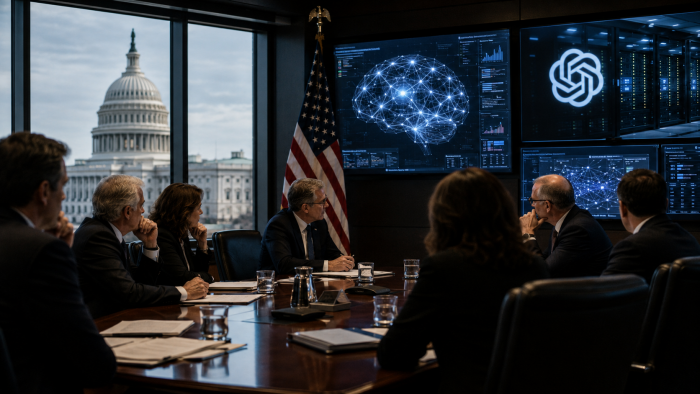
The Biden administration is moving to formalize a new pledge requiring major AI and cloud companies to absorb electricity costs tied to their rapidly expanding data centers. The effort comes as energy demand from AI infrastructure becomes a growing political issue ahead of the 2026 election cycle.
Yet many of the companies targeted by the proposal have already publicly committed to covering those costs, raising questions about whether the initiative is more symbolic than substantive.
Washington’s new ratepayer protection push
The administration’s concern centers on the surge in electricity demand driven by AI data center construction. Rapid buildouts across the United States have contributed to retail electricity prices rising more than 6 percent over the past year, according to policy discussions cited by officials.
In his State of the Union address, President Donald Trump announced what he called a “ratepayer protection pledge.” He said major technology firms must fund their own power needs so that household electricity bills do not increase because of AI infrastructure.
The White House is planning a signing event next week where companies including Amazon, Google, Meta, Microsoft, Oracle, xAI, and OpenAI are expected to endorse the framework. None of the firms have publicly confirmed participation so far.
Tech companies largely ahead of the policy
Despite the administration’s push, several leading AI players have already issued similar commitments in recent months.
Microsoft said in January that it would ensure the electricity costs tied to its data centers would not be passed on to residential customers. OpenAI followed later in the month with a pledge to fund its own energy usage to avoid raising consumer bills.
Anthropic went further in February, committing to cover all consumer price increases linked to its facilities and to pay for grid upgrades required to connect its data centers. Google has also been investing heavily in dedicated clean energy capacity, including a large battery project supporting a Minnesota facility.
Policy analysts note the White House effort appears to formalize promises the industry has already been making voluntarily.
Enforcement questions remain unresolved
Even with broad alignment in principle, significant uncertainty remains about how the pledge would work in practice.
Regulators and utilities still face complex questions about attribution. It is not clear how officials would determine which specific data center caused local electricity price increases, or how reimbursement calculations would be standardized across regions.
There is also debate over whether the forthcoming commitments will carry legal force or function primarily as political signaling. Some lawmakers have expressed concern that voluntary agreements may not adequately protect consumers.
Arizona Senator Mark Kelly and others have warned that informal arrangements with large technology firms may fall short without enforceable guarantees and stronger community oversight of new power deals.
Broader energy and infrastructure implications
Experts caution that even if hyperscalers fund new generation or build dedicated power capacity, the broader system effects may persist. Large-scale AI infrastructure can still strain supply chains for fuel, transmission equipment, and construction resources.
There are also environmental and land-use considerations. Rapid data center expansion may complicate regional decarbonization plans or shift pollution burdens depending on how new power is sourced.
Reflecting these concerns, several senators have already introduced or drafted legislation that would require AI companies to pay for grid upgrades and fully offset rate impacts. Portions of the voluntary pledge could eventually be written into federal law.
A political moment around AI power demand
The administration’s move underscores how quickly AI infrastructure has become an energy and political flashpoint. With electricity demand from data centers expected to climb sharply through the decade, pressure is mounting on both regulators and technology companies to demonstrate that AI growth will not come at the expense of household utility bills.
Whether the upcoming pledge becomes a meaningful regulatory tool or remains largely symbolic will depend on how enforcement, measurement, and accountability are ultimately defined.
Post Comment
Be the first to post comment!