Google Cloud has unveiled a new generation of custom AI chips, stepping up its challenge to Nvidia’s dominance in the data center market. Announced at Google Cloud Next 2026, the eighth-generation Tensor Processing Units, TPU 8t and TPU 8i, are designed to handle the two most demanding layers of modern AI systems: large-scale model training and real-time inference.
The launch is not just about new silicon. It is part of a wider push to position Google Cloud as a fully integrated AI infrastructure provider, combining chips, networking, storage, and orchestration into what it calls its AI Hypercomputer stack. The same system already powers Google’s Gemini models, and the new TPUs are meant to extend that capability to enterprise customers building and deploying their own AI systems.
A Two-Chip Strategy for a Split AI Workload
Google’s approach reflects a growing divide in AI infrastructure. Instead of relying on a single type of processor, the company is separating training and inference into two specialized chips.
TPU 8t is built for training, where models are created and refined using massive datasets and compute clusters. TPU 8i, by contrast, is optimized for inference, where trained models are deployed in real-world applications that require speed, responsiveness, and cost efficiency.
This mirrors broader industry trends, where the demands of building models and running them in production have diverged. Training requires scale and parallelism, while inference demands low latency and high concurrency. By splitting these roles, Google is trying to outperform general-purpose GPU systems that attempt to handle both.
TPU 8t Pushes Toward Supercomputer-Scale Training
TPU 8t is positioned as Google’s primary engine for training frontier AI models, including multi-agent systems that require large-scale coordination. The company claims the chip delivers nearly three times the compute performance of its previous generation for training workloads.
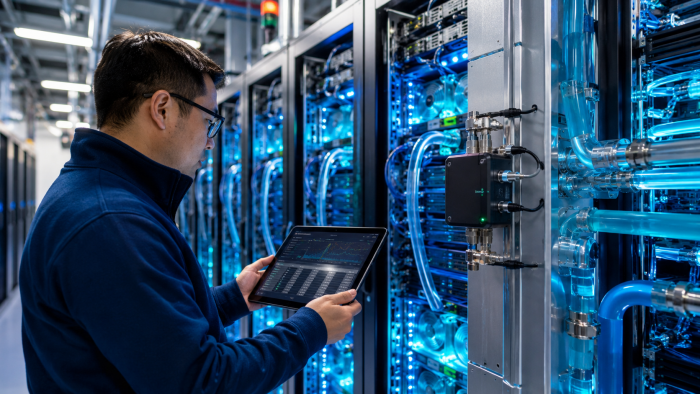
The scale of deployment is central to its pitch. A single TPU 8t superpod can include up to 9,600 chips, delivering 121 exaflops of compute and two petabytes of shared memory. This architecture is designed to scale efficiently as models grow larger, minimizing the bottlenecks that often slow down distributed training systems.
Google is also emphasizing its ability to connect these systems at extreme scale. Using its new network fabric, the company says it can link more than 134,000 TPUs within a single data center and over one million across multiple sites, effectively creating a unified training environment that behaves like a single global supercomputer.
TPU 8i Targets Real-Time AI and Cost Efficiency
While TPU 8t focuses on building models, TPU 8i is designed for running them. The chip is optimized for inference workloads, particularly those tied to agent-based AI systems, reinforcement learning, and large models that require continuous interaction.
Its architecture prioritizes low latency and high throughput. By increasing on-chip memory and reducing communication overhead between chips, TPU 8i is built to handle high-concurrency workloads where response time is critical.
Google says the chip delivers roughly 80 percent better performance per dollar for inference compared to its previous generation. That claim is aimed directly at Nvidia’s GPU-based inference systems, where cost per query and latency are key competitive factors.
Competing With Nvidia While Still Partnering
Despite the competitive tone, Google is not abandoning Nvidia’s ecosystem. Alongside its TPU announcement, the company also introduced new cloud instances powered by Nvidia’s latest GPU systems, giving customers the option to choose between TPU-based and GPU-based infrastructure.
This dual approach reflects a pragmatic strategy. Many enterprises are already deeply invested in Nvidia’s software and tooling, and Google is positioning itself as a flexible provider rather than forcing a full transition.
At the same time, the company is clearly pushing its own silicon as a more tightly integrated alternative. By combining TPUs with its networking, storage, and orchestration stack, Google is trying to reduce the complexity and overhead of building large-scale AI systems compared to more fragmented GPU-based setups.
AI Hypercomputer Stack Expands the Battleground
The new TPUs are only one piece of a broader infrastructure push. Google is upgrading multiple layers of its AI platform to support increasingly complex workloads.
A new network fabric is designed to increase bandwidth and reduce scaling friction for large clusters. Storage systems have been enhanced to deliver higher throughput and lower latency, ensuring that data can be fed to accelerators without bottlenecks. Kubernetes-based orchestration has also been improved to handle what Google calls “agent-native” workloads, where AI systems operate continuously rather than responding to single prompts.
These changes are aimed at a specific future: one where AI systems are not just generating text or images, but coordinating tasks, calling tools, and operating across multiple steps in real time.
A Shift Toward the “Agentic” AI Era
Google is framing the new chips around what it calls the “agentic era” of AI. In this model, systems move beyond static responses and begin to act more like autonomous agents that can reason, plan, and execute tasks.
That shift changes the demands placed on infrastructure. Training becomes more complex as models incorporate multiple agents and decision loops, while inference becomes more demanding as systems operate continuously and interact with external tools.
The design of TPU 8t and TPU 8i reflects those changing requirements. One focuses on scaling model creation to extreme levels, while the other is built to handle the speed and concurrency of real-world deployment.
What This Means for the AI Hardware Race
The launch of TPU 8t and TPU 8i highlights how the AI hardware race is evolving. It is no longer just about raw compute power, but about how well hardware integrates with software, networking, and real-world workloads.
Nvidia still dominates the market, particularly through its GPU ecosystem and developer tools. But Google’s latest move shows a clear attempt to compete not just on performance, but on system-level efficiency and integration.
For customers, the choice is becoming more nuanced. Instead of a single standard, the market is shifting toward a mix of specialized hardware options, each optimized for different parts of the AI pipeline.
With its new TPUs and broader Hypercomputer strategy, Google is betting that tightly integrated infrastructure, rather than standalone chips, will define the next phase of AI computing.