On This Page
- Why Fakeyou AI Exists
- How Fakeyou AI Actually Sounds in Real Use
- The Queue System Shapes the Entire Experience
- Text-to-Speech vs Voice-to-Voice: Two Very Different Experiences
- Lip Sync and Video: Fun, Not Studio-Grade
- Pricing in Context: Cheap, But Not Casual
- How Fakeyou AI Compares to Tools Like ElevenLabs
- Who Fakeyou AI Is Actually For
- The Real Verdict
Fakeyou AI doesn’t usually show up when people search for “professional voiceover software.”
It shows up when people search for fun, parody, memes, or “how do I make this character say that?”
That difference matters, because Fakeyou AI was never built to compete head-to-head with studio-grade narration tools. It was built to let regular users experiment with voice identity in ways that used to require technical expertise.
To understand Fakeyou AI properly, you have to look at how people actually use it, not just what it claims to do.
Why Fakeyou AI Exists
Fakeyou AI grew out of a simple idea:
voice cloning should be accessible, not intimidating.
Most advanced voice synthesis tools are:
- Technically impressive
- Expensive
- Focused on realism over personality
Fakeyou AI took the opposite approach. It leaned into:
- Characters
- Nostalgia
- Community-created voices
- Low barrier to entry
That’s why it became popular with:
- Meme creators
- YouTubers
- Discord communities
- Hobbyist developers
People don’t come to Fakeyou AI to sound professional.
They come to sound like someone else.
The Voice Library Is the Real Product
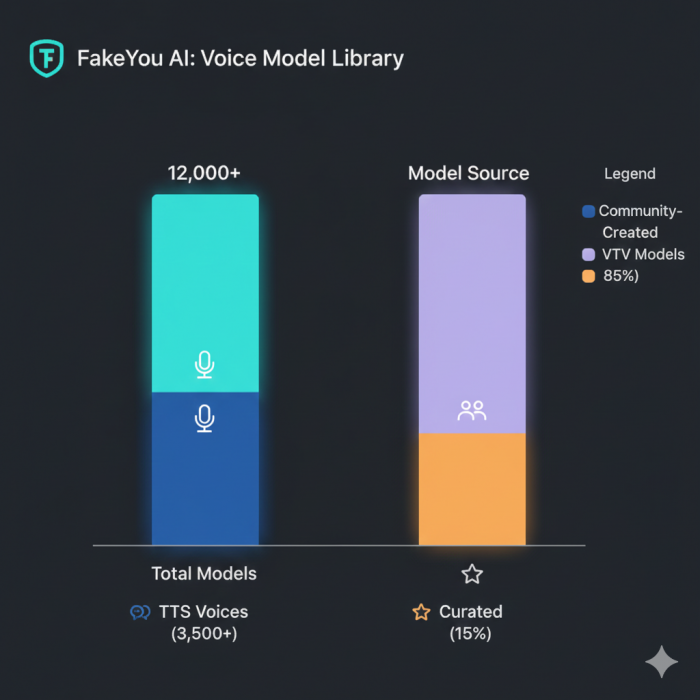
Fakeyou AI’s most important asset isn’t its engine, it’s its voice catalog.
As of 2025:
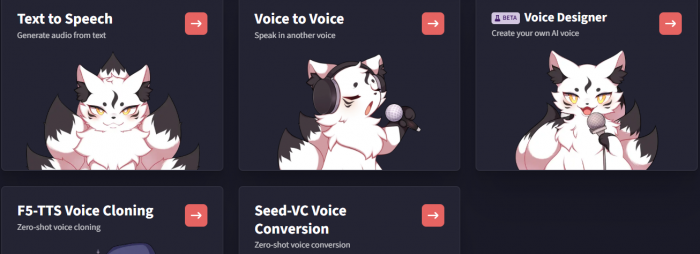
- 3,500+ Text-to-Speech voices
- 8,500+ Voice-to-Voice models
- Thousands of recognizable characters and public figures
This library isn’t centrally curated. It’s community-driven, which explains both its strength and its inconsistency.
Some voices sound shockingly accurate.
Others feel rushed, compressed, or oddly paced.
But the sheer range is what keeps users experimenting. You don’t open Fakeyou AI for one voice — you open it to browse.
How Fakeyou AI Actually Sounds in Real Use
On short clips, Fakeyou AI can be impressive.
For:
- One-liners
- Catchphrases
- Meme dialogue
- Short narration
Accuracy is high. Many users rate it around 4.5/5 for voice matching.
But problems emerge as scripts get longer.
Common user-reported issues:
- Robotic pacing
- Swallowed words
- Over-fast delivery
- Emotional flattening
This isn’t a dealbreaker for entertainment content — but it limits Fakeyou AI’s usefulness for professional narration.
The Queue System Shapes the Entire Experience
Fakeyou AI’s queue-based processing is not just a pricing feature, it fundamentally changes how people use the tool.
Free tier reality:
- Wait times from 1 to 15 minutes
- Unpredictable delays
- Short clip limits
This pushes free users toward:
- Short scripts
- Experimentation
- Casual use
Paid tiers change behavior:
- Processing begins in seconds
- Longer clips become viable
- Iteration becomes practical
In other words, Fakeyou AI is usable for free, but usable comfortably only when paid.
That’s an important distinction for expectations.
Text-to-Speech vs Voice-to-Voice: Two Very Different Experiences
Text-to-Speech (TTS)
This is Fakeyou AI’s most used feature.
Strengths:
- Easy to use
- No audio skills needed
- Massive voice variety
Limitations:
- Emotion control is limited
- Long scripts lose natural flow
Voice-to-Voice (VTV)
This is where Fakeyou AI becomes more interesting technically.
By uploading your own voice:
- Timing
- Emphasis
- Pauses
…are preserved better.
Results are often:
- More natural
- Less robotic
- More expressive
This explains why VTV is popular with creators who want their performance, just with a different voice.
Lip Sync and Video: Fun, Not Studio-Grade
Fakeyou AI’s lip-sync feature works best for:
- Talking head memes
- Short clips
- Comedy content
It’s not designed for:
- Film-quality animation
- Precision mouth movement
- High-frame-rate realism
Users generally treat this as a bonus feature, not a core reason to subscribe.
Voice Designer and Custom Models: Power With Responsibility
Fakeyou AI allows users to upload samples and create private voices — a powerful feature that comes with clear ethical implications.
From a technical perspective:
- Results depend heavily on sample quality
- Clean, consistent audio matters more than length
- Training isn’t instant
From a practical perspective:
- This is not “click and clone”
- It requires experimentation
- Results vary significantly
This feature appeals more to advanced users than casual meme creators.
API Access: Where Fakeyou AI Quietly Expands
Fakeyou AI’s API is often overlooked, but it’s a major reason developers stay.
Common uses:
- Discord bots
- Games
- Interactive apps
- Custom voice experiments
The API isn’t as polished as enterprise tools, but it’s flexible — which aligns with Fakeyou AI’s community-first DNA.
Pricing in Context: Cheap, But Not Casual
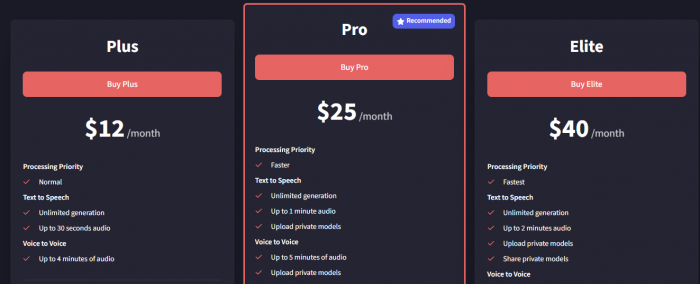
Fakeyou AI’s pricing sits in a middle ground:
- Affordable compared to professional tools
- Necessary if you want consistent performance
What users actually pay for:
- Shorter queues
- Longer clip limits
- Private models
- Reliability
Free users experiment.
Paid users create.
How Fakeyou AI Compares to Tools Like ElevenLabs
This comparison comes up constantly — and it’s often misunderstood.
Fakeyou AI excels at:
- Character voices
- Parody
- Fun experimentation
- Community creativity
ElevenLabs excels at:
- Natural narration
- Emotional control
- Professional audio quality
They’re not substitutes.
They solve different problems.
Trying to use Fakeyou AI for audiobook narration is like using a meme generator for graphic design — technically possible, but misaligned.
Who Fakeyou AI Is Actually For
Based on usage patterns, Fakeyou AI works best for:
- Meme creators
- YouTubers
- Hobbyists
- Developers experimenting with voice identity
- Fans of animation, anime, and pop culture
It is less suitable for:
- Corporate voiceovers
- Audiobooks
- Commercial advertising
- High-fidelity storytelling
Understanding this prevents frustration.
The Real Verdict
Fakeyou AI is not trying to be the best-sounding voice engine on the market.
It’s trying to be the most playful.
Its biggest strength, community-driven voice variety, is also what makes it inconsistent. Its queue system frustrates some users, but keeps the platform sustainable. Its audio quality is good enough for fun, but not flawless enough for professional narration.
Used for what it’s built for, Fakeyou AI delivers exactly what people expect.
Used outside that lane, it falls behind more specialized competitors.
And that’s not a flaw, it’s a design choice.
Post Comment
Be the first to post comment!