On This Page
- How AI Is Applied in Cybersecurity Platforms
- Check Point, AI-Driven Prevention and Attack Correlation
- Key strengths
- Best for
- Wiz, AI-Powered Cloud Risk Prioritization
- Key strengths
- Best for
- SentinelOne, Autonomous Detection and Response
- Key strengths
- Best for
- Fortinet, AI-Assisted Security for Network-Centric Environments
- Key strengths
- Best for
- Palo Alto Networks, AI Across the Security Lifecycle
- Key strengths
- Best for
- AI-Powered Cybersecurity Tools by Use Case
- Final Thoughts
Artificial intelligence has become a foundational component of modern cybersecurity. As attacks grow more automated and adaptive, security teams increasingly rely on AI-driven systems to identify threats earlier, reduce alert fatigue, and respond faster than manual processes allow.0
However, not all AI-powered cybersecurity tools use AI in the same way. Some focus on prevention, others on detection and response, while others apply AI to prioritize risk or automate security operations. Understanding these differences is essential when evaluating which platform fits a specific organization.
This guide examines several widely used AI-powered cybersecurity tools and explains how each uses AI to address a different security challenge.
How AI Is Applied in Cybersecurity Platforms
In practice, AI-powered cybersecurity usually falls into a few core use cases:
Threat prevention, where AI helps block attacks before execution
Behavioral detection, identifying abnormal activity rather than known signatures
Risk prioritization, highlighting the most exploitable weaknesses first
Automated response, reducing the need for manual intervention
Operational efficiency, helping teams investigate and triage incidents faster
The platforms below are commonly evaluated because they apply AI effectively in one or more of these areas.
Check Point, AI-Driven Prevention and Attack Correlation

Check Point applies AI primarily to threat prevention and attack chain analysis. Its ThreatCloud AI engine continuously analyzes global telemetry to update protections across networks, cloud environments, endpoints, and users.
Rather than relying only on detection after compromise, Check Point’s approach focuses on stopping threats early in the attack lifecycle. Horizon XDR extends this by correlating signals across environments, helping teams understand how individual events relate to broader attack patterns.
Key strengths
● AI-driven prevention across hybrid and multi-cloud environments
● Attack chain correlation that reduces fragmented alerts
● Centralized policy enforcement across security layers
Best for
Organizations that prioritize early threat prevention and unified security management.
Wiz, AI-Powered Cloud Risk Prioritization
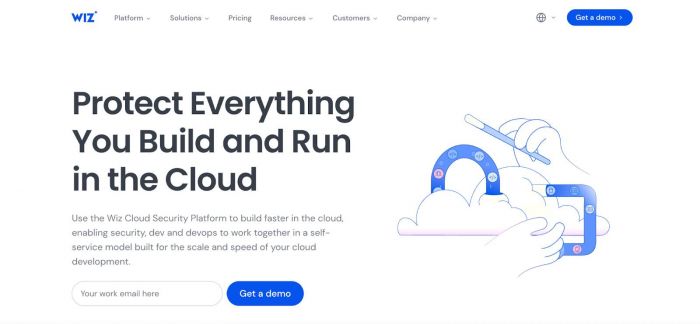
Wiz is explicitly designed for cloud security and uses AI to help teams understand which risks actually matter in large-scale cloud environments.
By mapping relationships between cloud assets, identities, and configurations, Wiz identifies realistic attack paths rather than isolated misconfigurations. This allows security teams to focus remediation efforts on issues with the highest potential impact.
Its agentless design makes it easy to deploy and scale across cloud environments without operational overhead.
Key strengths
● AI-powered attack path analysis
● Agentless visibility across cloud environments
● Clear prioritization of exploitable risks
Best for
Cloud-first organizations are managing complex public cloud infrastructure.
SentinelOne, Autonomous Detection and Response
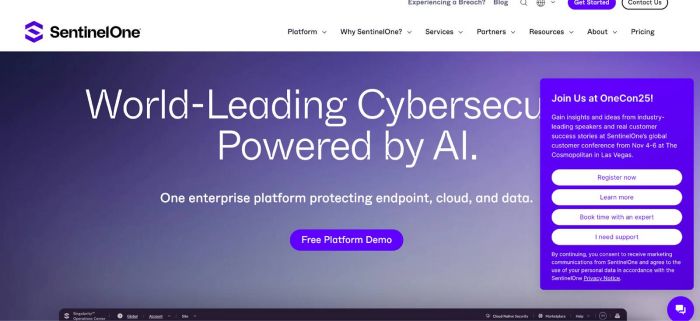
SentinelOne uses AI and machine learning to deliver autonomous detection and response across endpoints, workloads, and identities.
Its Singularity Platform focuses on behavioral detection, allowing it to identify suspicious activity without relying solely on known signatures. Automated response actions, including device isolation and ransomware rollback, reduce the need for manual intervention. Purple AI adds generative AI support for investigation and threat hunting.
Key strengths
● Autonomous detection and response
● AI-based behavioral analysis
● Automated containment and rollback
Best for
Lean security teams are looking to reduce manual investigation and response workloads.
Fortinet, AI-Assisted Security for Network-Centric Environments
Fortinet integrates AI into its Security Fabric to improve both security and network operations. Machine learning is used to correlate network traffic, endpoint signals, and firewall data across environments.
FortiAI-Assist applies generative AI to speed up incident investigation and operational workflows. This combination makes Fortinet particularly effective in environments where networking and security are tightly interconnected.
Key strengths
● Integrated security and networking
● AI-assisted investigation and operations
● Scalable architecture for large environments
Best for
Organizations with network-heavy, on-prem, or hybrid infrastructures.
Palo Alto Networks, AI Across the Security Lifecycle
Palo Alto applies AI across network security, cloud protection, and security operations through a unified platform approach.
Precision AI underpins prevention, detection, and response across its portfolio. Cortex XSIAM uses AI to automate correlation, investigation, and remediation, helping SOC teams reduce noise and respond faster.
This breadth makes Palo Alto Networks a common choice for organizations consolidating multiple security tools.
Key strengths
● End-to-end AI-powered security platform
● AI-driven SOC automation
● Consistent AI foundation across products
Best for
Large enterprises are seeking platform consolidation and advanced security operations.
AI-Powered Cybersecurity Tools by Use Case
| Primary use case | Platform | Why it stands out |
| Threat prevention | Check Point | AI-driven early attack blocking |
| Cloud risk prioritization | Wiz | Attack path analysis |
| Autonomous response | SentinelOne | AI-based containment and rollback |
| Network-centric security | Fortinet | Integrated security and networking |
| SOC automation | Palo Alto Networks | AI-powered investigation workflows |
Final Thoughts
AI-powered cybersecurity tools are most effective when their capabilities align with real operational needs. Some organizations benefit most from prevention-first platforms, while others need better visibility, automation, or cloud-specific risk prioritization.
Rather than choosing a tool based solely on popularity, security teams should evaluate how AI is applied in practice, the level of automation they are comfortable with, and how well a platform integrates with existing infrastructure.
A clear understanding of these factors helps ensure that AI is used not just as a buzzword, but as a practical force multiplier for security operations.
Post Comment
Be the first to post comment!