Ask any practice owner who has switched electronic health records what it cost them, and watch their expression change. The sticker price is the cheap part. The real bill arrives later, in retraining staff, half-migrated charts, and the quiet dread of a system nobody wants to open on a Monday. One long-time Valant user said leaving felt less like a choice and more like being “held hostage” by their own patient records.
That is the part most comparison posts skip. Choosing between Valant and TherapyNotes is not a feature beauty contest. It is a bet on how you will work for the next five years. Both are built only for behavioral health, both have devoted followings, and both solve the same problem from opposite ends. Here is which one fits your real practice, minus the brochure language.
The answer, if you are skimming
TherapyNotes is the better pick for therapists and small group practices that want documentation, scheduling, and insurance billing to feel obvious on day one, at a price you can read off a webpage. Valant is the better pick for prescriber-heavy practices, psychiatry groups, and organizations running intensive outpatient or partial hospitalization programs that need medication management and outcome tracking baked into the workflow. The scorecard below sets the table.
| How they compare | Valant | TherapyNotes |
|---|---|---|
| Overall user rating | ★★★★☆ 4.1 | ★★★★★ 4.7 |
| Best for | Prescribers, psychiatry, IOP/PHP, scaling groups | Therapists, solo and small group practices |
| Starting price | Custom quote (~$150/provider/mo est.) | $69/provider/mo (published) |
| Price transparency | ★★☆☆☆ 2.0 | ★★★★★ 5.0 |
| Free trial | No (live or recorded demo) | Yes, 30 days, no card |
| Prescriber tools (EPCS / PDMP) | ★★★★★ 5.0 | ★★☆☆☆ 2.4 |
| Ease of use | ★★★☆☆ 3.2 | ★★★★★ 5.0 |
| Support reputation | ★★★☆☆ 3.2 | ★★★★★ 4.6 |
| Scales to larger orgs | ★★★★☆ 4.2 | ★★★☆☆ 3.0 |
Star ratings are an editorial 1–5 read of documented features and review themes. Overall ratings reflect Capterra scores (June 2026).
A word on the market you are buying into
Two numbers explain why niche platforms like these exist. General-purpose medical EHRs run roughly $300 to $600 per provider each month, while behavioral-health tools deliver the documentation, billing, and outcome features therapists need at a fraction of that. And authorization issues drive an estimated 15 to 30 percent of behavioral health claim denials, which is why billing depth, not mere presence, matters.
The story of 2025 and 2026 is AI documentation showing up everywhere. Both platforms now offer ambient or assisted note generation, and both lean on the same pitch: less time charting, more time with patients. The interesting differences are not whether AI exists, but how each company prices it, how much oversight it leaves you, and whether the rest of the platform earns its keep once the novelty fades.
Valant: built by a psychiatrist, for prescribers
★★★★☆ 4.1 Capterra (338 reviews) · G2 3.2 · Founded 2005, Seattle
Valant was founded in 2005 in Seattle by psychiatrist Dr. David Lischner, and that origin shows in nearly every design decision. This is an EHR that assumes someone in your practice writes prescriptions and manages medication, not just session notes. Controlled-substance e-prescribing, integrated Prescription Drug Monitoring Program lookups, and structured medication workflows are first-class citizens here, which is unusual at this price tier.
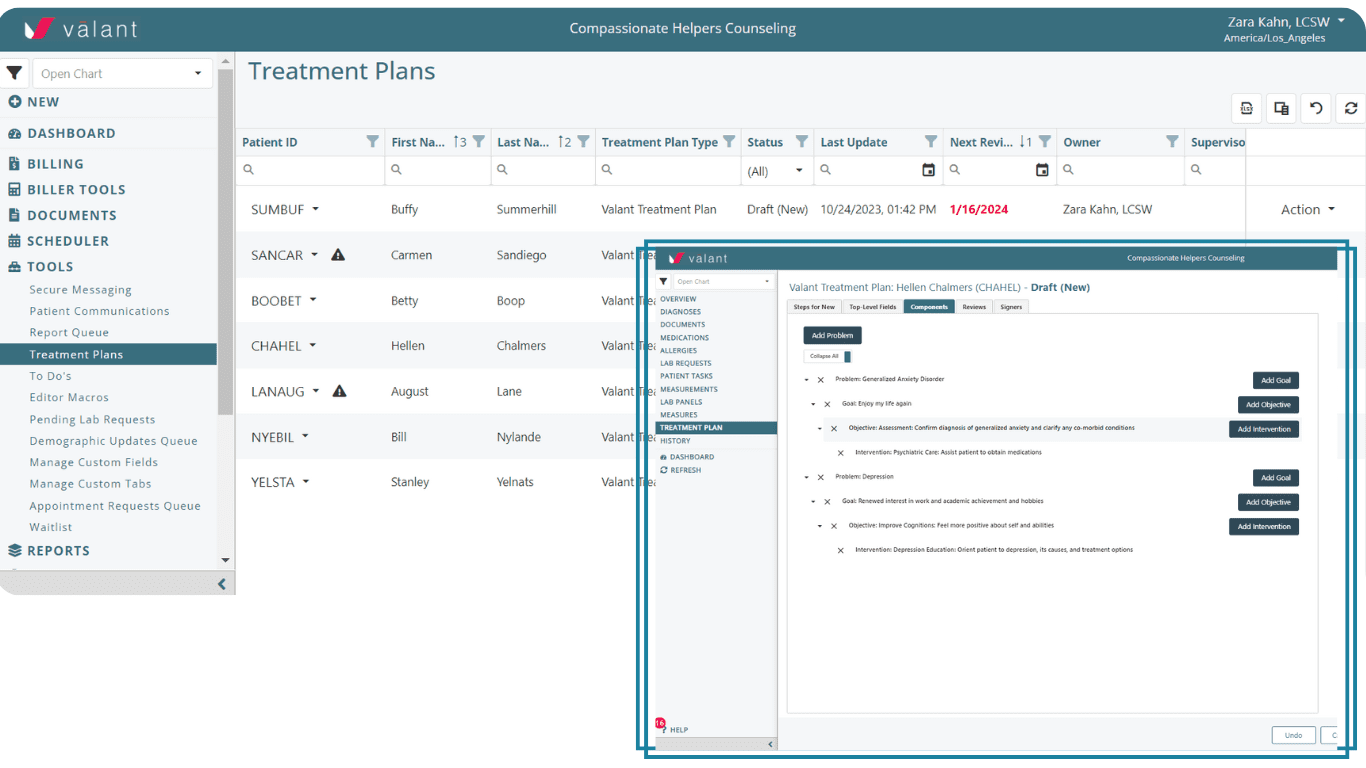
The clinical toolkit is deep. Valant ships more than 100 configurable note templates spanning psychiatric evaluations, SOAP notes, CBT, DBT, MFT, TMS, and eating-disorder care, several developed alongside named clinical advisors including DBT pioneer Dr. Marsha Linehan. Its measurement-based care engine is the standout: over 80 reportable outcome measures that auto-send to patients, score themselves, and graph progress directly inside notes and reports. Practices use that data to demonstrate effectiveness to payers and, in some cases, negotiate better reimbursement.
What Valant actually does
| Module | Capability | Standout detail |
|---|---|---|
| Documentation | 100+ templates with AI narrative generation | Notes Assist drafts narrative text; pre-built for audit-ready payer requirements |
| Outcome measures | 80+ reportable assessments | Auto-send, auto-score, and graph PHQ-9, GAD-7 and more inside the note |
| E-prescribing | EPCS + PDMP, medication management | Controlled substances, drug interaction alerts, estimated medication cost lookups |
| Billing / RCM | Integrated claims, ERA, rules by payer | Charges adjust rates per payer; referral-source and aging reports built in |
| Patient experience | MYIO portal + native telehealth | Intake packets self-send; outcome measures scheduled before visits |
| Programs | Outpatient, IOP, PHP, group therapy | Multi-provider scheduling and role-based permissions for larger teams |
Valant supports providers and patients on iOS and Android. Platform language: English.
What Valant costs
Valant does not publish prices. Plans are quote-based and shaped by provider count, provider type, and the add-ons you switch on. Based on user reports and analyst estimates, expect the ranges below, and remember the line items beyond the license fee, which is where buyers most often get surprised.
| Cost component | Typical range | What to know |
|---|---|---|
| License per provider | $100–$300 / mo | Higher tiers add reporting, AI, and expanded integrations |
| Implementation / setup | ~$1,500–$5,000+ | One-time; scales with practice size and configuration |
| Data migration | $500–$7,500 | Depends on chart volume and the system you are leaving |
| Add-ons | Varies | Telehealth, e-prescribing, faxing, and API may be tiered or extra |
| Contract | Annual (typical) | Annual commitments usually beat month-to-month rates |
| Free trial | None | Evaluate through a live or pre-recorded demo instead |
Estimates compiled from FindEMR, ITQlick, and EHR Source, June 2026. Always confirm with a current quote.
The honest pros and cons
| Where Valant shines | Where it frustrates |
|---|---|
|
|
Two review themes are worth weighing. On the upside, a psychiatrist noted that Valant's progress-note sections for suicidal ideation showed the platform understood real clinical workflows, the kind of detail generic EHRs miss. On the downside, several long-tenured users describe migration and data export as a sore point, including the reviewer who felt locked in. Valant says customers can export their data at the end of a contract at no charge, so clarify that process in writing before you sign.
What reviewers say, by source
| Source | Score | What stands out |
|---|---|---|
| Capterra | 4.1 / 5 | Praised for behavioral-health fit and scheduling; flagged for occasional downtime |
| Software Advice | ~4.1 / 5 | 338 verified reviews; strong on integrated design, weaker on billing clarity |
| G2 | 3.2 / 5 | Smaller sample; ease-of-use liked, customization and glitches criticized |
TherapyNotes: the therapist's workhorse
★★★★★ 4.7 Capterra (~950 reviews) · HITRUST certified · Founded 2010
TherapyNotes was launched in 2010 by clinical psychologist Dr. Debra Pliner and her husband Brad, a developer. It remains independently owned and unfunded, with a team north of 100, and that independence shows in a product that prizes consistency over endless customization. Workflows are structured and repeatable, which is precisely why solo clinicians and small groups can be productive on it within a day.
It is also one of the few platforms in this category to carry HITRUST certification on top of HIPAA compliance, a meaningful trust signal. The pitch is not dazzling flexibility. It is reliability: clean documentation templates, dependable insurance billing through integrated ERA and EDI, and the rare promise of pricing you can find without a sales call.
What TherapyNotes actually does
| Module | Capability | Standout detail |
|---|---|---|
| Documentation | Structured notes + treatment plans | TherapyFuel AI scribe drafts progress notes from session data |
| Billing | Integrated claims, ERA, card processing | Electronic claims billed per transaction; stores credit, debit, and HSA cards |
| Scheduling | Calendar, reminders, to-do lists | Syncs with Google and Outlook calendars; automated text and email reminders |
| Telehealth | Free SD tier + Premium HD | Launches from the calendar; free tier covers two participants and a waiting room |
| Outcome measures | Built-in, auto-scored | Screen at intake and track progress without manual scoring |
| Patient experience | Custom client portal | E-prescribing available via pharmacy partner; English and Spanish supported |
Non-clinical staff such as schedulers and billers are included at no extra charge.
What TherapyNotes costs
This is where TherapyNotes earns its reputation. Pricing is published, flat, and easy to forecast. Note that rates rose roughly 15 to 17 percent in December 2025, which annoyed some long-tenured users who had been promised a locked rate. Even after the bump, it is among the better values in behavioral health.
| Plan or line item | Price | What is included |
|---|---|---|
| Solo | $69 / mo | One provider, all core features, free non-clinical staff seats |
| Group (per add'l clinician) | $79 + $50 | $79 first clinician, then $50 each additional provider |
| Enterprise (30+ users) | $79 + $50 | Same per-seat rate plus a dedicated account manager |
| TherapyFuel AI scribe | $40 / clinician | Optional add-on for AI-drafted progress notes |
| Premium telehealth | $15 / clinician | HD video, screen sharing, and larger group sessions |
| Electronic claims + ERA | $0.14 each | 14 cents per claim and 14 cents per claim in an ERA |
| Free trial + setup | $0 | 30-day trial, no card, free data import, no signup fee |
Published rates as of December 2025. Unlimited clients, appointments, notes, and file storage on every plan.
The honest pros and cons
| Where TherapyNotes shines | Where it frustrates |
|---|---|
Fast to learn, hard to break: structured workflows reduce errors Transparent, low pricing with free seats for non-clinical staff In-house phone and email support with a strong reputation 30-day trial, free data import, HITRUST certification | Templates are reliable but not deeply customizable Reporting is functional rather than rich; power users want more Prior authorization is manual, and prescriber tooling is lighter than Valant's The December 2025 price increase stung users promised a fixed rate |
What reviewers say, by source
| Source | Score | What stands out |
|---|---|---|
| Capterra | ~4.7 / 5 | Roughly 950 reviews; value for money rated 4.6; praised for ease and support |
| Software Advice | 4.7 / 5 | Highest rating among the major mental health EHRs across 950+ reviews |
| Common gripe | n/a | Billing complexity and pricing changes are the recurring complaints |
Head to head: the comparison that matters
Put them side by side and the trade-off becomes clear. Valant buys you clinical depth and prescriber muscle at the cost of price clarity and a gentler learning curve. TherapyNotes buys you simplicity, support, and a predictable invoice, with less room to grow into complex, high-acuity care.
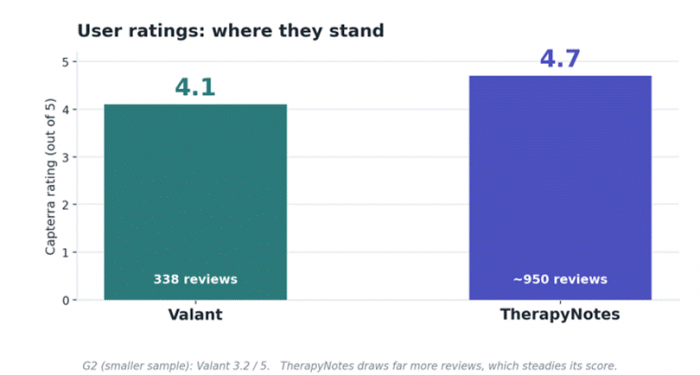
Review volume matters: TherapyNotes' larger base makes its high score more durable than a small sample would.
| Factor | Valant | TherapyNotes |
|---|---|---|
| Built for | Psychiatry, prescribers, groups, IOP/PHP | Therapists, solo and small groups |
| Pricing model | Custom quote, annual contract | Published, month-to-month, per seat |
| Entry cost | ~$100–$300/provider (est.) | $69/provider |
| Controlled-substance e-prescribing | Yes, integrated EPCS + PDMP | E-prescribing via partner; lighter prescriber stack |
| Outcome measures | 80+ auto-scored and graphed | Built in, auto-scored |
| AI documentation | Notes Assist, tiered into plans | TherapyFuel, $40/clinician add-on |
| Telehealth | Native, in most packages | Free SD tier; $15 Premium HD |
| Prior authorization | Supported in workflow | Manual submission |
| Free trial | No | Yes, 30 days |
| Languages | English | English, Spanish |
| Compliance signal | HIPAA | HIPAA + HITRUST |
The radar below summarizes the same trade-off visually.
What it really costs, by practice size
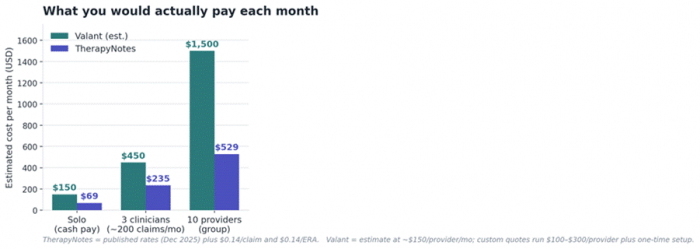
Headline prices mislead. The figure that matters is the total monthly check once seats, claims, and add-ons are counted. Here is the realistic picture, with Valant shown as an estimate because its pricing is private.
| Scenario | Valant (est.) | TherapyNotes | Notes |
|---|---|---|---|
| Solo, cash pay | ~$150 / mo | $69 / mo | TherapyNotes wins decisively on a cash-pay solo budget |
| 3 clinicians, ~200 claims/mo | ~$450 / mo | ~$235 / mo | TherapyNotes total includes claim and ERA fees |
| 10-provider group | ~$1,500–3,000/mo | ~$529 / mo | Gap narrows in value if you need Valant's prescriber depth |
TherapyNotes 10-provider math: $79 + nine seats at $50. Valant figures are estimates plus one-time implementation.
The takeaway is not simply that TherapyNotes is cheaper, although it usually is. It is that you are paying Valant for capability a therapy-only practice may never use. If nobody on your team prescribes and you are not running an IOP, that premium is hard to justify. If half your providers prescribe and you live in measurement-based care, Valant's price can pay for itself in cleaner audits and stronger payer conversations. One factor that rarely shows up in a quote: TherapyNotes bills month to month, so an unhappy practice can walk away without penalty, while Valant's annual contracts reward commitment but make a mid-year exit expensive. Build that flexibility, or the lack of it, into the real price.
So which one should you choose?
Skip the feature checklist and start with how your practice actually operates. The right answer falls out quickly.
Choose TherapyNotes if
• You are a solo therapist or small group and want to be productive on day one.
• Predictable, published pricing and a real free trial matter to your decision.
• Your work is mostly talk therapy with straightforward insurance or cash-pay billing.
• Responsive phone support and low training overhead rank near the top of your list.
Choose Valant if
• Your practice prescribes, and you need EPCS, PDMP checks, and medication management in one place.
• You run intensive outpatient or partial hospitalization programs, or expect to scale into them.
• Measurement-based care is central, and you want outcome data feeding payer negotiations.
• You have the appetite for a steeper setup in exchange for clinical and financial depth.
One caveat for fairness: these are not the only contenders. SimplePractice starts around $49 per month and rivals TherapyNotes on polish for therapy-only practices, while enterprise platforms like Netsmart or Qualifacts suit very large organizations with complex state reporting. If neither Valant nor TherapyNotes fits cleanly, those are sensible next looks before you commit.
The bottom line
The best EHR is the one your team stops noticing, the software that disappears into the day so the work can happen. For most therapists and small groups, that quiet competence is TherapyNotes, and the price makes the choice easy. For prescribers and growing clinical organizations, the depth is worth the homework, and that points to Valant.
Before you sign anything, do two things. Run the TherapyNotes trial with a few real charts, not a sandbox, and book a live Valant demo with your own messy edge cases in hand. Ask each vendor exactly how you would get your data out if you ever left. The platform that answers that question without flinching is the one that respects you as a customer.
Post Comment
Be the first to post comment!