Welcome to Data Hell: The Moment Your Dashboard Goes Red
Alright, let's talk real life in data engineering. You build a beautifully complicated ETL (Extract, Transform, Load) package in SSIS, you test it for hours, and it runs perfectly on your dev machine. You high-five yourself, deploy it to the server, schedule it with SQL Server Agent, and then you go home. You feel like a genius.
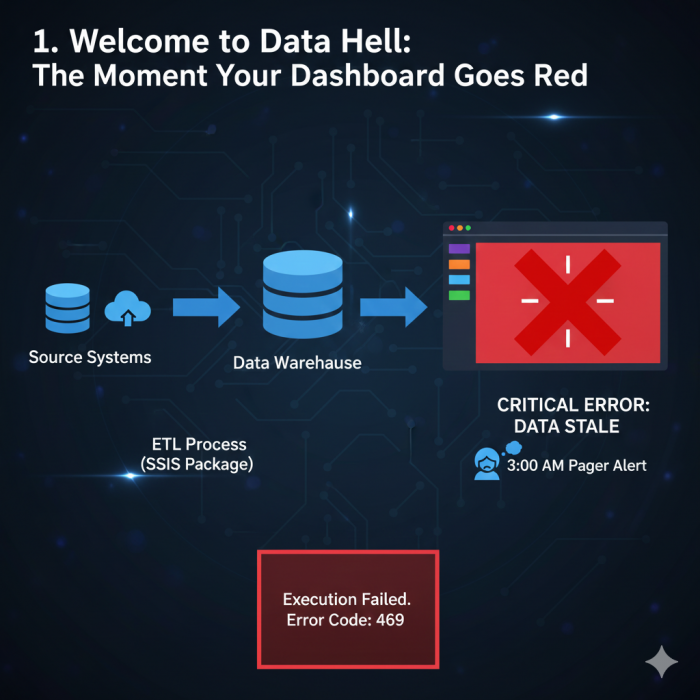
Then, 3:00 AM rolls around, and your pager (or, let's be honest, Slack channel) blows up. Your critical workflow, the one that updates the CEO's dashboard, has failed. You log in, squint at the error log, and there it is, that cryptic, useless message: SSIS Error Code 469. It’s the "We don't know what went wrong, but it's totally your fault" message. It’s the worst kind of ghosting: a digital ghosting that paralyzes your entire company.
The Great Deception: Why 469 Is a Total Liar
The thing about Error 469 is that it’s almost never the actual problem. It's like your car's "Check Engine" light coming on—it just means something is broken, but it could be anything from a loose gas cap to a blown transmission.
The Vague Alarm: The log might just say "Task Failed" or "Execution was disrupted." It's infuriatingly vague. It doesn't give you a nice, clean error message like "You misspelled the column name!" or "The network is down!"
The Sneaky Culprit: This code usually means one of three things went sideways in a way the package couldn't handle gracefully. It’s the kind of subtle failure that makes you want to throw your monitor out the window. We're talking deep-cut technical drama here, not simple typos.
Suspect Number One: The Permission Monster (Security Contexts)
Hands down, the most common reason for a 469 is a permission slip-up. This happens because your developer account is God-level, but the poor, lonely Service Account running the package on the server is basically a peasant.
The 'Double Identity' Problem: You wrote the package, and it worked, because you have all the database access. But when the SQL Server Agent runs the package, it uses a completely different account (a "proxy account" or the SQL Agent Service account). This account often doesn't have the SELECT permissions on the source table, the INSERT/UPDATE rights on the destination table, or the file access rights to read that random Excel file you put on a shared network drive.
The Protection Level Headache: This is a classic rookie mistake, and it throws 469s like confetti. If you set your package's ProtectionLevel to something like EncryptSensitiveWithUserKey, only your Windows account can decrypt the passwords in the connection managers. The Service Account tries to read the password, can't, throws an access failure, and what do you get? A beautiful, misleading 469 error. You have to change it to something universal like EncryptSensitiveWithPassword or just use the secure SSIS Catalog storage.
Suspect Number Two: The Data Flow Diva (Metadata & Mismatch)
If permissions are clean, the next place to look is the data itself. Data flows are like a diva: everything has to be perfect, or they stop the show.
Metadata Drift is Real: Imagine you built your package based on a source table that had a column named Customer_Name (VARCHAR(50)). Then, a lazy colleague decided to rename it to Client_Name in the source system. When your SSIS package runs, it sees the old column name, can't find it, and immediately throws its hands up in the air. The result? Error 469.
The Data Type Nightmare: A less obvious one is the dreaded data type mismatch. You're expecting a neat, non-Unicode string, but the source system sends you a Unicode string. The package chokes during the transformation process because it can't smoothly convert the data in its buffer. Since the failure is deep inside the data pipeline, the external message is often just a generic 469.
Suspect Number Three: The Connection Hoarder (Parallelism Fail)
This one is the most frustrating because it often only happens when you’re trying to make things faster. You designed two data flow tasks to run simultaneously (parallelism), which is great for speed, right?
The Shared Resource Fight: If both parallel tasks try to use the exact same Connection Manager object at the exact same millisecond to talk to the database, they fight over the resource lock. One task wins, and the other task throws an access error—which SSIS, being the dramatic tool it is, logs as a 469 failure.
Leakage in Script Tasks: If you're a heavy user of Script Tasks (where you write custom C# or VB.NET code), you might be opening database connections and forgetting the crucial .Close() or .Dispose() calls. That connection hangs around, contaminating the connection pool and causing problems for the next task that tries to use it.
The 469 Firefighter's Playbook: How to Find the Real Problem
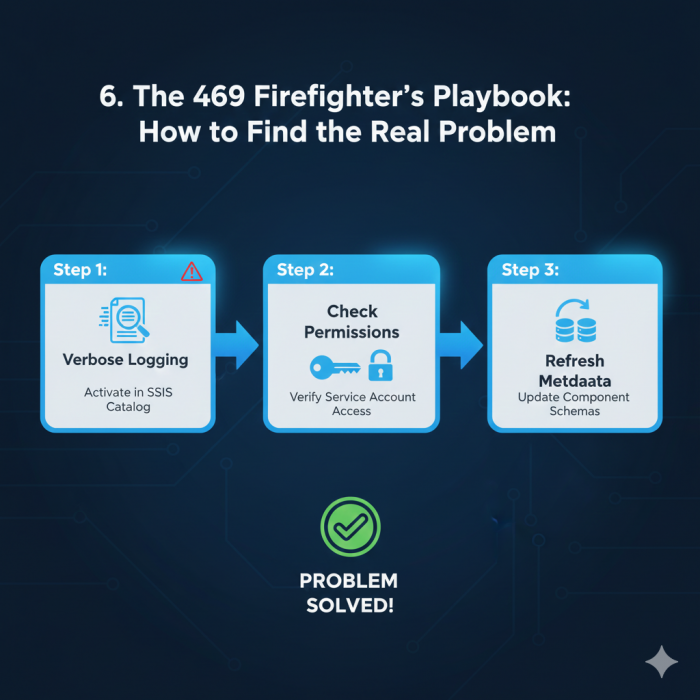
When the alarm goes off, you need a plan, not panic. Here’s the simple, effective strategy:
Step 1: Turn on the Floodlights (Verbose Logging!): Seriously, the default logging level is useless. You must enable Verbose Logging in the SSIS Catalog (SSISDB). This makes the execution log incredibly detailed, but it's the only way to catch the tiny, specific error message that X-rays the actual problem.
Step 2: Check the Identity (The Permission Check): Log into the server as the Service Account and try to access the resources directly. Can it read the source file? Can it connect to the destination database? If it can't, you need to go talk to the Database Administrator (DBA) right now.
Step 3: Update Everything (Metadata Refresh): Open your package in the Visual Studio designer (SSDT). Double-click all your OLE DB Source and Destination components. Make sure the column mappings are all green. If any component looks weird or throws a warning, right-click, select "Refresh Metadata," and save. This fixes 60% of metadata-related 469s instantly.
Living the Dream: Architecting Your Way Out of the 469 Trap
The best fix is prevention. A smart data engineer doesn't just fix 469; they design the system so it almost never happens again.
Externalize Everything: Never, ever hard-code passwords or server names into the package itself. Store all sensitive information outside the package using SSIS Environment Variables or Configuration Files. When the server changes, you change one line in one file, not 50 lines in 10 packages.
Go Modular (Master/Child): Break your giant, 50-task workflow into 10 smaller, independent packages. If one small 'Child' package fails with 469, the 'Master' package just logs the error and moves on to the next one. This prevents a single error from bringing down the entire data warehouse.
Build in a Do-Over (Retry Logic): For those annoying, intermittent network glitches (transient errors), build retry mechanisms into your control flow. Use a For Loop Container to tell the failing task, "Hey, try that connection three more times before you call me." This dramatically cuts down on those 3:00 AM wake-up calls.
Final Thoughts

SSIS Error 469 is a rite of passage for every data engineer. It forces you to become a detective, digging past the noise to find the real culprit—usually a forgotten permission, a sneaky schema change, or an impatient parallel process. Master the 469, and you’ve mastered the art of building resilient, enterprise-grade data pipelines. Go forth and debug!
Post Comment
Be the first to post comment!