Songscription, a Stanford-born startup, has launched an AI-powered music transcription platform that’s quickly gaining attention as the “Shazam for sheet music.” Designed to convert any audio—including YouTube links—into clean, readable sheet music, the tool caters to musicians, educators, and composers looking for a faster, smarter transcription workflow.
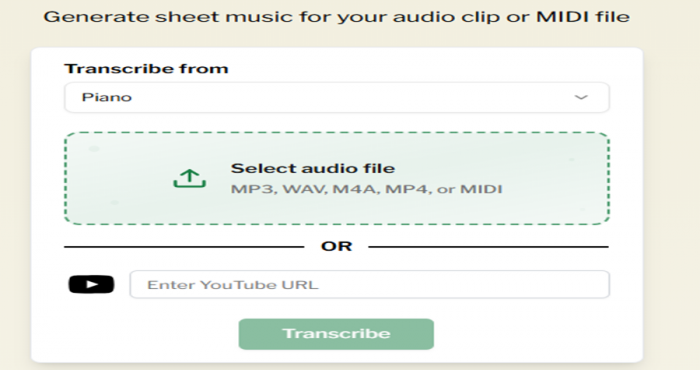
Transforming Audio to Sheet Music—Instantly
The platform supports common file formats like MP3, WAV, M4A, MP4, and MIDI. Users can upload a file or paste a YouTube link, and Songscription’s algorithm transcribes the audio into:
- Individual instrument sheet music
- MIDI-style piano roll for visual learners
- Customizable parts with PDF exports
While piano transcriptions are currently the most accurate, support is already available for guitar, flute, and violin—with full-band arrangements and guitar tabs on the roadmap.
Built with Real Data, Powered by Transformers
Songscription’s AI model was developed using a transformer architecture co-built by co-founder Tim Beyer and researcher Angela Dai. Unlike models trained on commercial data, Songscription’s training set consisted of synthetic performances based on public domain sheet music—modified with reverb, noise, and tempo shifts to better reflect real-world conditions.
This approach not only avoids copyright concerns but also enhances the model’s ability to generalize to varied music genres and playing styles.
Rapid Growth and Early Market Validation
According to CEO Andrew Carlins, over 3,000 users from 150+ countries have already created more than 20,000 transcriptions in just a few months. Monthly user growth is reported at 60%, with the platform gaining traction among music teachers and independent creators.
Songscription was recently accepted into the prestigious Stanford StartX accelerator and secured pre-seed funding from Reach Capital—early signs of strong investor and academic validation.
Solving Real Problems for Music Teachers and Creators
A core use case is in educational settings where band or orchestra teachers need to generate arrangements based on their students’ abilities. Carlins emphasized that teachers in underfunded or rural schools often spend hours transcribing parts manually. Songscription automates that work, allowing them to focus on pedagogy rather than notation.
Crucially, the platform requires users to confirm they have legal rights to the uploaded content. Songscription does not generate AI-composed music; instead, it helps musicians extract what’s already present in the audio—a critical legal distinction in today’s copyright-sensitive environment.
What’s Next: Expanding the Toolset
The team is actively working on:
- Support for more instruments and polyphonic arrangements
- Guitar tabs and stem-splitting
- Real-time feedback on transcription quality
- A browser-based editor for adjusting notation before export
They also plan to expand licensing support to better serve commercial music publishers and educational institutions.
Final Thoughts
Songscription is positioning itself at the intersection of AI and music literacy—solving a real problem without crossing into controversial generative territory. With strong early traction, defensible tech, and clear educational value, it’s a promising signal in the growing market of AI music tools.
Post Comment
Be the first to post comment!