The global aviation industry is currently navigating one of its most significant logistical challenges in recent history as European aerospace giant Airbus initiates a worldwide recall of approximately 6,000 A320-family aircraft. This unprecedented safety directive follows findings that intense solar radiation could compromise critical flight control systems, a vulnerability that has already led to at least one mid-air emergency. Airlines across Europe, Asia, and the Americas are now scrambling to implement mandatory software and hardware updates, resulting in a wave of flight cancellations and schedule disruptions just as the busy holiday travel season begins to accelerate.
The urgency of this recall stems from a directive issued by the European Union Aviation Safety Agency (EASA), which mandates that operators must rectify a specific vulnerability in the Elevator Aileron Computer (ELAC) before these aircraft can carry passengers again. This system is crucial for interpreting pilot inputs and stabilizing the aircraft’s pitch and roll. Investigations revealed that under specific conditions, high-energy particles from solar flares often referred to as cosmic rays could penetrate the aircraft's shielding and "flip" digital bits within the computer's memory. This data corruption can trick the system into believing the aircraft needs to descend, potentially causing the nose to pitch down without any command from the pilots.
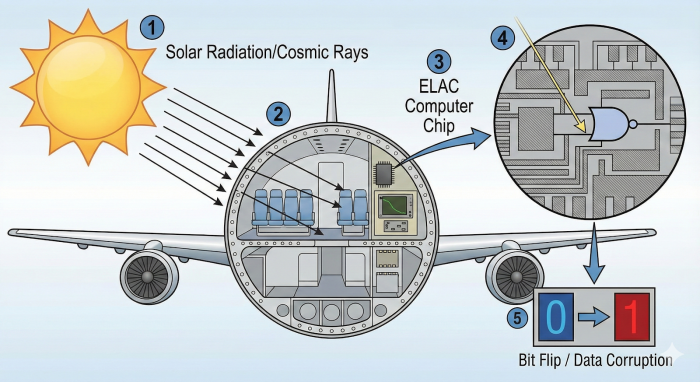
The critical nature of this flaw was brought to light following a terrifying incident on October 30, 2025, involving a JetBlue A320 flight traveling from Cancun to Newark. During cruise flight, the aircraft experienced a sudden, uncommanded pitch-down event that forced the nose towards the ground. While the pilots were able to regain control, the abrupt maneuver resulted in injuries to several passengers and necessitated an emergency landing in Tampa, Florida. Subsequent analysis by Airbus engineers traced the anomaly back to the ELAC system’s susceptibility to solar radiation, prompting the manufacturer to issue a "major" alert to all operators of the popular A319, A320, and A321 models.
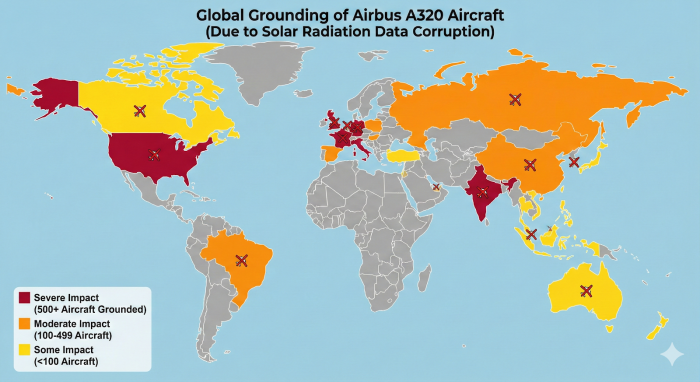
In response to the EASA mandate, aviation regulators worldwide, including India’s DGCA and the U.S. FAA, have enforced strict compliance, grounding affected fleets until the necessary modifications are complete. For the majority of the 6,000 impacted aircraft, the remedy involves a software update that takes a few hours to install, allowing for a relatively quick return to service. However, older models equipped with legacy hardware require physical component replacements, a process that could keep those planes out of the sky for significantly longer. Major carriers such as British Airways, Lufthansa, IndiGo, and American Airlines are currently working around the clock to patch their fleets, though passengers are being advised to check for delays as operational rotations remain tight.
A world map highlighting countries with the highest density of grounded A320s.
This event marks a rare intersection of space weather and commercial aviation safety, highlighting how modern, highly digitized aircraft are increasingly sensitive to environmental factors beyond the atmosphere. While Airbus has emphasized that the recall is a precautionary measure to ensure the highest safety standards, the scale of the grounding underscores the industry's reliance on the A320 family, which serves as the workhorse for short- and medium-haul routes globally. As engineers rush to deploy the "cosmic ray" proof patches, the aviation community is reminded that safety often requires swift, decisive action, even if it means temporarily grounding half the world’s fleet to guarantee a safe journey for all.
Post Comment
Be the first to post comment!