On This Page
- Quick Context: What This Site Claims to Be
- First Impression of the Website
- What the Platform Promises vs What Is Actually Visible
- Promise vs Reality
- Transparency Check
- Pricing and Monetization Reality
- Real Usability Walkthrough
- External Trust Signals
- Technical and Behavioral Risk Signals
- Who Should Be Careful Before Using It
- The Bottom Line: A Promising Tool That Still Needs Trust Maturity
Skipit positions itself as a fast AI companion for YouTube and long-form content, promising to summarize hours of material and let users chat with videos instead of watching them end-to-end. On paper, this is a very real and useful category. Tools that compress information overload are in high demand, especially among students, researchers, and knowledge workers.
However, once the surface marketing is separated from the actual product experience, the picture becomes more nuanced. The platform appears functional in concept, but several transparency and usability signals suggest users should proceed thoughtfully rather than blindly trusting the claims.
Quick Context: What This Site Claims to Be
Skipit markets itself as an AI video and content summarizer that can process YouTube videos, PDFs, articles, and websites, then allow conversational Q&A on top of that content. The messaging focuses heavily on productivity themes such as “watch less, learn more,” instant summaries, and unlimited chat capability.
This positioning is credible at a category level. AI video summarization is real and widely implemented across multiple competing tools. The claimed use case is specific enough to avoid pure buzzword territory, which gives the concept baseline legitimacy even before deeper inspection.
What the site claims to offer
- AI summaries of long YouTube videos
- Interactive chat with video content
- Support for PDFs and websites
- Unlimited messages and saved chats
- Fast answers and condensed insights
First Impression of the Website
The visual presentation feels clean but noticeably template-driven. The layout resembles many low-to-mid budget SaaS builds rather than a heavily engineered product environment. This alone is not a deal breaker, but it does influence perceived maturity.
More importantly, the trust layer feels thin. The review strip relies on static Reddit screenshots rather than verifiable embeds or linked sources. The blog section contains mostly generic informational posts rather than company insight, roadmap discussion, or product transparency content.
Immediate friction observed
- Early push toward account creation
- Core functionality hidden behind login
- No obvious public demo or sandbox
- Generic review presentation
First-glance risk signals
| Signal | Observation | Risk Impression |
| Design quality | Functional but template-like | Low–Medium |
| Review proof | Static Reddit screenshots | Medium |
| Blog relevance | Mostly generic content | Medium |
| Public demo | Not visible | Medium |
What the Platform Promises vs What Is Actually Visible
Marketing copy across the site and directories highlights several strong claims. The challenge is that most of these cannot be verified from the public interface without both registration and payment.
Core marketing promises
- Long video support (up to ~12 hours)
- Unlimited chats and zero rate limits
- Multi-format ingestion (YouTube, PDFs, websites)
- Fast AI answers and summaries
In practice, access to these capabilities is tightly gated. The workflow requires account creation first, and attempting to use chat triggers a payment wall before any meaningful testing can occur.
Promise vs Reality
| Claimed Feature | Marketing Position | Public Verification Status |
| Long video summaries | Handles very long content | Cannot test without signup |
| Unlimited chats | “Zero rate limits” messaging | Not verifiable pre-payment |
| Multi-format support | Works with videos, PDFs, sites | Hidden behind login |
| Instant AI answers | Fast productivity workflow | No public demo available |
Key takeaway: Core functionality is not observable without committing both data and payment, which increases perceived risk for new users.
Transparency Check
Transparency is where the platform shows the most friction relative to highly trusted SaaS products.
The site does include legal pages, but ownership visibility and company presence are relatively light. WHOIS records use privacy protection, and strong founder or team visibility is not prominently featured in public sections.
This does not automatically imply malicious intent, but it does reduce confidence for users being asked to upload content and pay upfront.
Transparency signal breakdown
| Trust Signal | Status | Risk Level |
| Company visibility | Limited prominence | Medium |
| Physical address | Not clearly highlighted | Medium |
| Team/founder page | Largely absent | Medium–High |
| Legal pages | Present but low visibility | Low–Medium |
| WHOIS ownership | Privacy protected | Medium–High |
Why it matters: Tools that request login credentials, uploaded content, and payment typically benefit from strong operator transparency.
Pricing and Monetization Reality
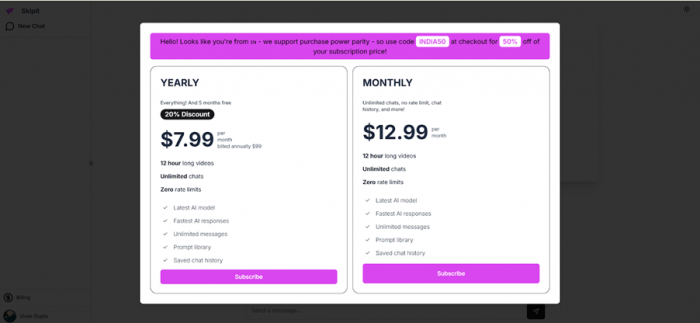
Directory listings indicate Skipit offers subscription plans with unlimited chat positioning. The friction appears during actual product entry.
The workflow strongly pushes account creation, and once inside the interface, chat access immediately routes to a payment requirement. No clearly visible free trial, demo credits, or sandbox experience surfaced during the initial journey.
Another notable detail is the payment flow presentation. The absence of clearly recognizable processor branding during the observed flow may increase hesitation among cautious users.
Pricing clarity assessment
- Free tier visibility: weak
- Trial availability: not obvious
- Paywall timing: immediate after login
- “Unlimited” wording: prominent but not publicly testable
- Refund terms: not front-and-center
Monetization risk table
| Area | Assessment |
| Free testing path | Limited visibility |
| Paywall timing | Early and firm |
| Pricing transparency | Moderate–weak |
| Payment confidence signals | Not strongly reinforced |
Real Usability Walkthrough
The intended product flow is straightforward on paper: sign up, paste a video link, generate a summary, and chat with the content. External reviews suggest the summarization itself can be reasonably useful, though not perfect.
The practical issue is that meaningful usability cannot be evaluated from the public experience because the paywall blocks real testing.
Observed workflow
| Step | Observed Behavior |
| Account creation | Required |
| Feature preview | Not available publicly |
| Chat access | Paywall triggered |
| Speed and output | Not testable without payment |
| Error handling | Not observable |
Primary UX concern: no low-risk validation path before payment.
External Trust Signals
The broader web footprint shows a mixed but not alarming picture.
ScamAdviser assigns a relatively high technical trust score based on SSL and infrastructure signals but explicitly notes hidden ownership and low traffic. AI tool directories list the platform with generally neutral descriptions, and at least one independent review describes the tool as useful but imperfect.
Reddit mentions are sparse and mixed, with at least one user noting that quality feels comparable to mainstream AI tools.
External reputation snapshot
| Source | Signal | Interpretation |
| ScamAdviser | High technical score, hidden owner | Not obviously fraudulent but small |
| AI directories | Neutral listings | Known but lightly validated |
| Independent reviews | Moderately positive | Suggests real functionality |
| Sparse, mixed feedback | Limited social proof |
Overall pattern: existent but not deeply battle-tested reputation.
Technical and Behavioral Risk Signals
Several behavioral patterns raise the caution level even though none individually prove malicious intent.
Notable caution signals
- Heavy login gating
- Immediate post-login paywall
- No public demo environment
- Generic testimonial presentation
- Limited team transparency
- Strong “unlimited” marketing language
Risk pattern table
| Pattern | Presence | Concern Level |
| Login wall | Yes | Medium |
| Pay-first workflow | Yes | Medium–High |
| Live demo | Missing | Medium |
| Founder visibility | Weak | Medium |
| Marketing hype level | Moderate | Medium |
Who Should Be Careful Before Using It
Certain users should move more carefully before committing time, data, or payment. Anyone planning to upload proprietary course material, internal company videos, or confidential documents should pause until the platform’s transparency improves. The current flow requires trust before verification, which is rarely ideal for sensitive workflows.
Lower-risk experimentation may still make sense for users working only with public YouTube content and short-term testing. Choosing monthly billing over annual commitments and avoiding mission-critical reliance on the summaries can significantly reduce downside exposure while evaluating the tool’s real-world value.
The Bottom Line: A Promising Tool That Still Needs Trust Maturity
Skipit does not present clear evidence of being a fake platform. The core product concept is legitimate, external directories recognize the tool, and technical trust scanners do not flag it as outright malicious. There are credible signs that a real product exists behind the marketing.
That said, the current experience sits firmly in the proceed carefully category. The generic site feel, thin trust signals, login-first gating, and immediate paywall create unnecessary friction for new users trying to validate value. Mature SaaS tools typically reduce risk upfront with demos, transparent trials, and stronger company visibility.
For now, the most rational stance is cautious curiosity. The tool may deliver real utility for video-heavy workflows, but the onboarding and transparency signals have not yet reached the comfort level expected from fully established AI platforms. Testing with non-sensitive content and avoiding long billing commitments remains the safest path until the platform demonstrates stronger trust maturity.
Post Comment
Be the first to post comment!