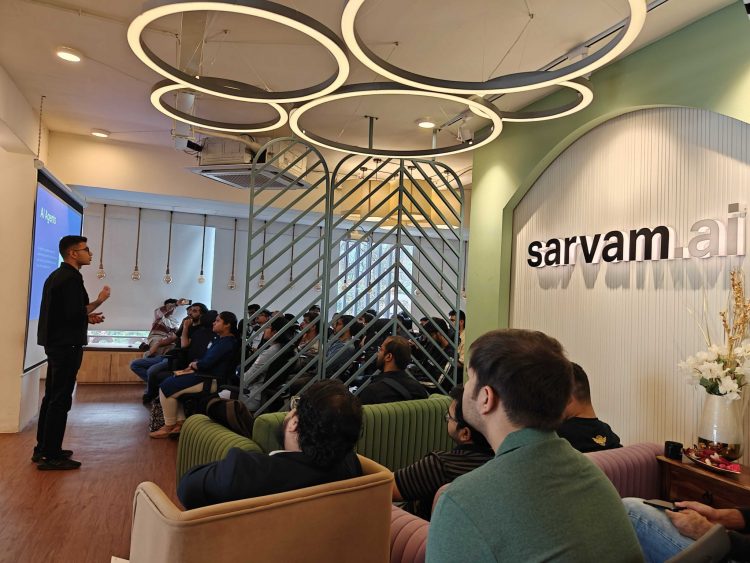
Bengaluru-based startup Sarvam AI has introduced Indus, a multilingual AI chatbot now available across web, Android, and iOS platforms. The launch places the company directly into competition with established assistants such as ChatGPT and Gemini, while positioning Indus as a product built specifically for India’s language and usage landscape.
A phased rollout with limited access
Indus is currently being released in beta with controlled access. Users can sign in using a phone number, Google account, or Apple ID, and interact with the assistant through both text and voice. Early reports indicate the rollout is intentionally gradual as Sarvam manages compute capacity and gathers user feedback.
Co-founder Pratyush Kumar noted publicly that availability is being expanded in stages. Many prospective users are encountering waitlists, and the service appears primarily accessible to India-based accounts for now, reflecting the company’s domestic-first strategy.
Built on Sarvam’s new language models
The chat app serves as the consumer-facing layer for Sarvam’s recently unveiled large language models. At the India AI Impact Summit 2026 in New Delhi, the company introduced two systems: Sarvam-30B and the larger Sarvam-105B flagship.
Coverage from technology outlets suggests Indus is closely tied to the 105B model, although the broader ecosystem may leverage both versions. Sarvam says these models were trained from scratch using domestic compute resources and optimized specifically for Indian languages, accents, and mixed-language conversations such as Hinglish.
This focus aligns with the company’s broader ambition to build a sovereign AI stack for India under the umbrella of the national IndiaAI Mission.
Key features in the early version
App store listings and early testing point to Indus being positioned as a general-purpose assistant rather than a niche tool. Among the capabilities highlighted so far:
- Multilingual chat across 22 official Indian languages
- Seamless code-switching between languages within a single conversation
- Voice input and spoken responses tailored to Indian accents
- Document summarization and drafting support
- Web-connected research capabilities
Sarvam has also indicated a roadmap that includes deeper multimodal features, building on its existing vision and OCR systems.
Why the launch matters
India has rapidly become one of the largest growth markets for AI assistants. Recent industry data shows ChatGPT has surpassed 100 million weekly users in the country, while Anthropic reports India accounts for nearly 6 percent of global Claude usage.
Against this backdrop, Indus represents one of the first serious attempts to deliver a locally built alternative optimized for India’s linguistic diversity. Sarvam appears to be betting that strong support for regional languages and cultural context will help it gain traction beyond English-dominant urban users.
The startup has raised roughly $41 million from investors including Lightspeed, Peak XV, and Khosla Ventures to support this push.
Early limitations and user feedback
Despite the interest, the beta release comes with visible constraints. Access remains restricted as the company scales infrastructure, and some early users report usability gaps.
Among the commonly noted issues:
- Waitlists and capacity throttling during the rollout
- Limited chat management options, including the inability to delete individual conversations
- Occasional response latency during more complex queries
- Availability largely confined to India-region accounts
These are typical growing pains for a compute-heavy AI launch, but they will likely shape user perception in the near term.
The bigger picture
Indus is emerging not just as a consumer chatbot but as a showcase for Sarvam’s broader model ambitions. Success with end users could strengthen the company’s positioning in enterprise and government AI deployments centered on Indic language capabilities.
For now, the app remains an early-stage entrant in a crowded global field. Its long-term impact will depend on how quickly Sarvam can scale infrastructure, refine performance, and prove that a locally trained AI assistant can compete with well-funded international rivals.
Post Comment
Be the first to post comment!