On This Page
- Interface Silence as an Interaction Strategy
- Customization as User-Controlled Constraint Design
- Feedback Granularity Without Interpretation
- Attention Management and Flow Preservation
- Transparency, Trust, and Perceived System Integrity
- Misalignment Between Measured Tasks and Real-World Typing
- Summary
From a human–computer interaction perspective, Monkeytype is less interesting as a typing website and more interesting as an interaction system that deliberately minimizes guidance, feedback framing, and visual persuasion. Its design choices reveal a strong bias toward user autonomy, low cognitive interference, and measurement over instruction.
Rather than asking how Monkeytype improves typing, an HCI-oriented analysis asks a different question: how does the interface shape user behavior, attention, and interpretation of performance data?
Interface Silence as an Interaction Strategy
In most digital skill-training systems, the interface actively talks back to the user. Prompts, highlights, alerts, encouragement banners, and corrective messages continuously mediate the interaction. Monkeytype deliberately rejects this pattern. When accessed via https://monkeytype.com/, the interface presents only what is strictly necessary for task execution: a text stream, a caret, and a results summary after completion.
From a human–computer interaction perspective, this choice functions as intentional interface silence. The system minimizes linguistic and visual intervention during the task itself. Errors are not explained, posture is not corrected, and pacing is not suggested. The interface observes rather than instructs.
This silence has measurable cognitive implications. By removing instructional overlays and real-time feedback cues, Monkeytype reduces extraneous cognitive load, the mental effort spent processing interface elements that are not intrinsic to the task. Attention remains anchored to motor execution and perceptual timing, rather than being divided between typing and interpreting system messages.
The result is a sustained perception–action loop, where sensory input (incoming characters) and motor output (keystrokes) remain tightly coupled. From an HCI standpoint, this supports flow continuity by avoiding micro-interruptions that can break rhythm or recalibrate attention mid-task.
At the same time, silence shifts interpretive responsibility entirely onto the user. Because the interface does not frame mistakes as “errors” or “failures” during interaction, users must reflect on outcomes retrospectively. Feedback is deferred, not embedded. This transforms interaction from guided performance into self-evaluated performance.
This design aligns with expert-oriented systems, where users are assumed to possess sufficient domain knowledge to interpret results without scaffolding. However, it also introduces asymmetry: the system remains neutral while the user performs the cognitive work of diagnosis and adjustment.
From an HCI ethics perspective, this neutrality avoids manipulation. There is no motivational language nudging behavior, no real-time correction biasing technique, and no affective feedback shaping emotional response. The interface neither rewards nor penalizes during execution, it simply records.
In effect, Monkeytype’s silence is not absence, but restraint. The interface communicates its expectations indirectly: type, finish, then reflect. For users capable of self-directed analysis, this interaction model preserves autonomy and minimizes interference. For others, the lack of scaffolding may feel opaque or unforgiving.
Seen through an HCI lens, Monkeytype exemplifies a design philosophy where interaction clarity is achieved through subtraction, and meaning emerges after action rather than during it.
Customization as User-Controlled Constraint Design
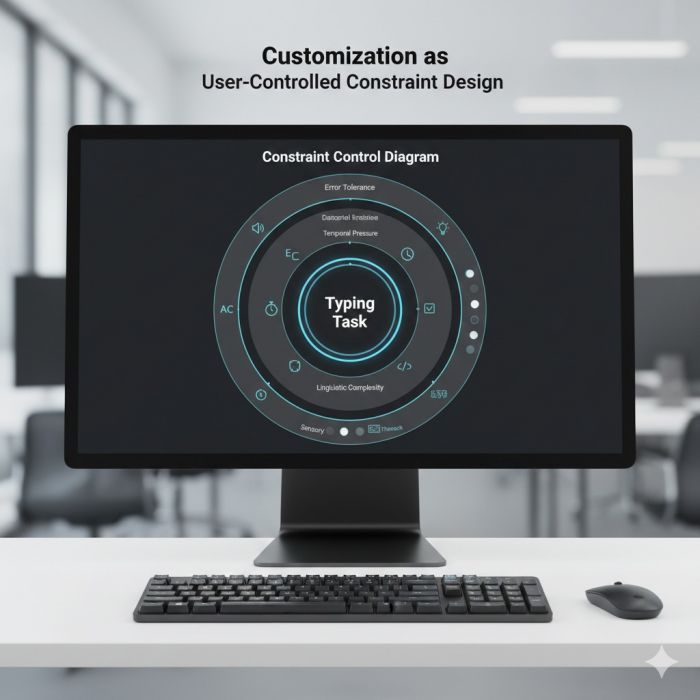
Monkeytype’s advanced settings systemis central to its HCI profile.
Rather than enforcing standardized tasks, the system allows users to define:
- linguistic complexity,
- temporal pressure,
- error tolerance,
- and sensory feedback.
In HCI terms, this enables user-defined constraints, a design approach where the system provides a framework but does not prescribe optimal usage. The interaction outcome depends heavily on how users configure the environment, making the interface adaptable but also interpretively demanding.
This approach favors experienced users capable of understanding how task parameters influence motor performance and feedback validity.
Feedback Granularity Without Interpretation
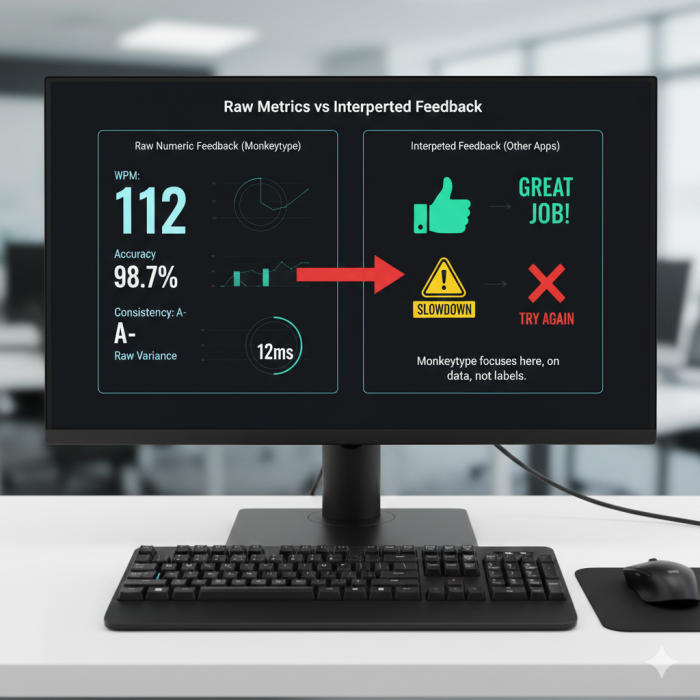
Monkeytype provides feedback through numerical outputs: speed metrics, accuracy ratios, variance indicators, and historical comparisons. Crucially, it does not interpret these metrics for the user.
From an interaction-design perspective, this avoids normative feedback. The system does not label results as “good,” “bad,” or “improving.” Instead, it exposes raw signals and leaves meaning construction to the user.
This design reduces bias and motivational framing but increases reliance on user literacy in performance data. The interface assumes that users can infer significance from patterns rather than from explicit guidance.
Attention Management and Flow Preservation
Monkeytype’s visual hierarchy is optimized for sustained attention. There are no popups, achievement animations, or notification layers interrupting the typing task. This supports flow-state preservation, a key concept in HCI related to uninterrupted task engagement.
The interface ensures that:
- visual elements remain static during typing,
- feedback is deferred until task completion,
- and interaction rhythm is not disrupted by secondary actions.
Such choices suggest that the platform prioritizes motor continuity over engagement mechanics.
Leaderboards as Peripheral Social Context
Public rankings, available at https://monkeytype.com/leaderboards, introduce a social dimension without embedding it directly into the core interaction loop. Leaderboards exist, but they are not foregrounded during task execution.
From an HCI viewpoint, this design keeps social comparison optional. Users may consult rankings as external context, but performance feedback remains primarily self-referential. This reduces performance anxiety for some users while still allowing benchmarking for others.
The system avoids coupling social validation tightly with task feedback.
Transparency, Trust, and Perceived System Integrity
User trust in interaction systems is influenced by perceived transparency. Monkeytype’s open-source development model and minimal data dependency contribute to a sense of system legibility.
External profiles such as https://www.nudgesecurity.com/security-profile/monkeytype-com highlight low-risk data practices, reinforcing confidence that interaction data is not repurposed beyond performance reporting.
From an HCI ethics standpoint, this supports informed engagement by reducing uncertainty about hidden system behavior.
Misalignment Between Measured Tasks and Real-World Typing
One notable interaction challenge lies in context transfer. Default test configurations may not reflect real-world typing environments, particularly when vocabulary size and punctuation are limited.
The system measures exactly what is presented, but the interface does not signal how representative those conditions are. This places interpretive burden on users, who must recognize the difference between task performance and situational applicability.
In HCI terms, this is a tradeoff between measurement purity and ecological validity.
Input Modality and Interaction Consistency
Monkeytype’s interaction model assumes stable physical input. While usable on mobile devices, touchscreen keyboards introduce variability that affects timing and consistency metrics.
From a human–computer interaction standpoint, this highlights the dependency of performance measurement on input-device affordances. Results across different hardware contexts may not be directly comparable, despite identical interface logic.
Summary
Viewed through an HCI lens, Monkeytype functions as a low-intervention performance interface. It minimizes instructional influence, maximizes configurability, and prioritizes uninterrupted motor interaction. Feedback is precise but non-directive, encouraging self-analysis rather than system-led correction.
Its effectiveness depends less on motivational design and more on user capacity to interpret data, manage constraints, and contextualize results. In this sense, Monkeytype exemplifies an interaction philosophy where the system observes, records, and displays—while the user decides what improvement means.
Post Comment
Be the first to post comment!