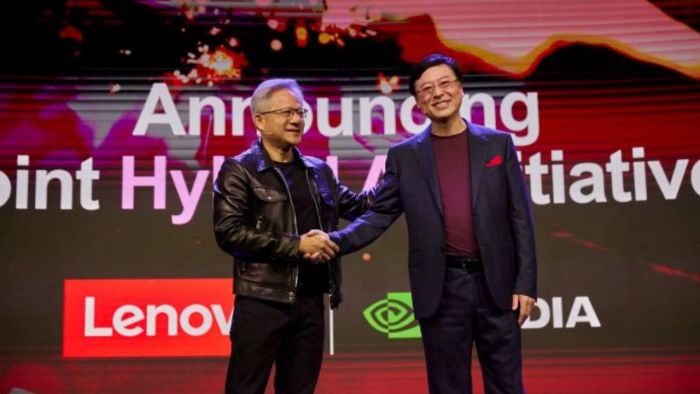
In a move that signals a seismic shift for the global technology landscape, Lenovo and NVIDIA have officially pulled the curtain back on their most ambitious collaboration to date: the AI Cloud Gigafactory. Announced at the 2026 Consumer Electronics Show (CES) nvidia and Lenovo in Las Vegas, this massive initiative aims to redefine how the world builds and scales artificial intelligence. By combining Lenovo’s world-class manufacturing and infrastructure expertise with NVIDIA’s undisputed leadership in AI silicon, the two giants are launching a gigawatt-scale "AI factory" program designed to bring enterprise-level AI workloads online in record time. This partnership represents a fundamental pivot toward industrial-grade AI, promising to compress data center deployment timelines from months to just weeks, effectively creating an express lane for the next generation of digital intelligence.
At the heart of this announcement is the Hybrid AI Factory blueprint, a modular framework that allows cloud providers and large enterprises to deploy trillion-parameter models with unprecedented efficiency. During a joint keynote that saw Lenovo CEO Yuanqing Yang and NVIDIA CEO Jensen Huang share the stage, the focus was squarely on the integration of NVIDIA’s cutting-edge Blackwell Ultra architecture and the newly introduced Vera Rubin platform. These technologies are being paired with Lenovo’s proprietary Neptune liquid cooling systems, which are capable of dissipating 100% of the heat generated by these high-performance clusters. This thermal efficiency is critical, as it allows for higher compute density without the environmental and operational costs typically associated with massive data centers.
The implications of the Gigafactory extend far beyond server racks and cooling pipes; they represent a total ecosystem play that bridges the gap between massive cloud infrastructure and the individual user. Alongside the industrial news, Lenovo introduced "Qira," a sophisticated cross-device personal AI system described as a "personal super agent." Qira is designed to function seamlessly across Lenovo and Motorola devices, including PCs, tablets, and wearables, providing a persistent and proactive digital assistant that learns from user context. This illustrates the "Hybrid AI" strategy: while the Gigafactory powers the massive models in the cloud, Qira brings that intelligence to the palm of the user’s hand, creating a feedback loop of intelligence that is both personal and powerful.
Furthermore, the CES 2026 stage served as a showcase for futuristic hardware that leverages this new AI backbone. Lenovo unveiled the "Project Maxwell" wearable, an AI assistant device capable of real-time translation and situational awareness, as well as the ThinkPad Rollable XD, a concept laptop that reimagines the workspace with an adaptable, expanding display. These innovations are supported by Lenovo’s new Agentic AI and xIQ platforms, which provide the governance and lifecycle management tools necessary for businesses to deploy autonomous AI agents safely. By offering a full-stack solution from the "Gigafactory" hardware to the software that manages the AI agents Lenovo and NVIDIA are positioning themselves as the primary architects of the AI-driven economy, ensuring that the transition from creation to production-ready AI is faster and more reliable than ever before.
Post Comment
Be the first to post comment!