On This Page
- What Kind of Platform ThotChat.ai Appears to Be
- Site Transparency and Structural Signals
- What Privacy Looks Like on Anonymous AI Chat Sites
- How Conversation Data Is Likely Handled
- Moderation Boundaries and Content Risk
- These risks are structural to conversational AI and not unique to this platform.Blog Content and Affiliate Orientation
- What ThotChat.ai Is Not Designed to Do
- Final Writer’s Assessment
Safety on AI chat platforms is often discussed narrowly, usually in terms of malware or technical threats. In reality, conversational AI introduces additional layers that shape user risk. These include privacy practices, transparency signals, moderation boundaries, and how the platform positions itself to users.
A frequent assumption is that anonymous access guarantees protection. In practice, anonymity usually means no account creation, not the absence of tracking, logging, or commercial intent. ThotChat.ai, presented as an open ended conversational AI hub with minimal friction, offers a useful case for examining how safety is influenced as much by site structure and disclosures as by technology itself.
What Kind of Platform ThotChat.ai Appears to Be
Based on publicly visible pages, ThotChat.ai functions less as a standalone AI system and more as a conversational entry point combined with an affiliate driven content site. The platform consists of a front page featuring AI chat access and promotional listings, alongside a blog section publishing guides, reviews, and comparisons related to AI companion tools.
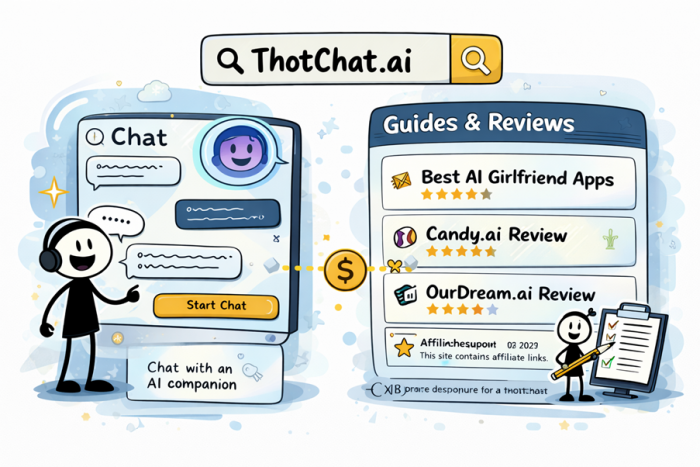
The site does not present itself as a regulated service or a task specific utility. Instead, it operates as a general conversational interface paired with editorial style content aimed at discovery and comparison. This positioning matters because it frames user expectations around entertainment and exploration rather than authoritative guidance.
Site Transparency and Structural Signals
One of the clearest ways to assess platform safety is to examine what information is publicly available about ownership, purpose, and accountability.
| Transparency Element | Observed Status on ThotChat.ai |
| About Us page | Not present |
| Company or operator details | Not disclosed |
| Contact email or support page | Not visible |
| Legal entity information | Not listed |
| Pages available | Front page and blog only |
| Copyright notice | © 2026 ThotChat |
| Affiliate disclosure | Present |
The absence of an About section or contact information does not automatically imply wrongdoing. However, it limits a user’s ability to understand who operates the platform or how issues would be addressed if problems arise.
What Privacy Looks Like on Anonymous AI Chat Sites
On platforms like ThotChat.ai, anonymity generally means users are not required to create accounts. This does not eliminate data collection entirely.
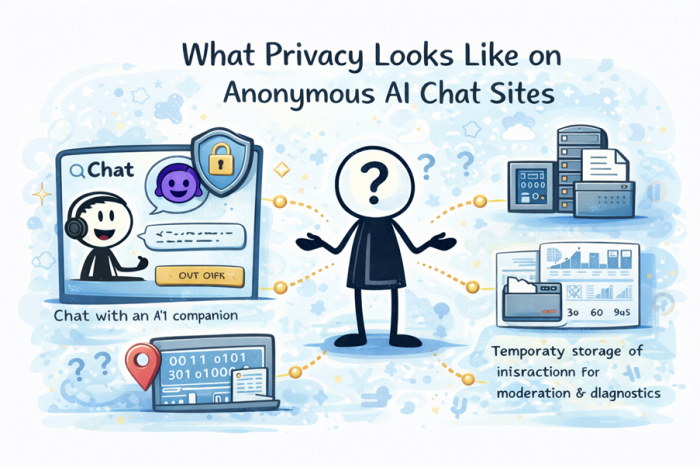
Typical realities of anonymous chat platforms include:
Logging of IP addresses and session data
- Collection of browser and device information
- Temporary storage of interactions for moderation or diagnostics
- Retention of aggregate analytics for site performance
A practical comparison helps clarify expectations:
| Common Assumption | Likely Reality |
| No login means no tracking | Technical metadata is still collected |
| Anonymous equals private | Temporary logging may occur |
| Closing the browser deletes data | Analytics often persist |
| No account means no profiling | Behavioral patterns may still be inferred |
These practices are consistent with standard web operations but place limits on absolute anonymity.
How Conversation Data Is Likely Handled
In conversational AI systems, user input is processed through inference pipelines that generate responses in real time. Text is tokenized, scanned through moderation layers, and passed to the model for output generation.
Without published technical documentation, it is reasonable to assume ThotChat.ai follows common industry practices:
- Short term buffering of conversations
- Temporary retention for moderation
- Use of aggregated usage metrics rather than permanent chat storage
Importantly, the absence of detailed disclosures reduces transparency, but it does not in itself confirm misuse of data.
Moderation Boundaries and Content Risk
Open ended chat platforms typically rely on layered moderation rather than strict filtering. These layers usually include automated blocking of illegal content, softer redirection for sensitive topics, and reactive handling of reported interactions.
Potential content related risks include:
- Confident but misleading responses
- Blurred lines between roleplay and advice
- Inconsistent moderation during edge cases
- Exposure to emotionally charged or suggestive content
These risks are structural to conversational AI and not unique to this platform.
Blog Content and Affiliate Orientation
The ThotChat.ai blog focuses primarily on reviews, comparisons, and list based articles related to AI companion platforms. Published content includes:
- Reviews of individual AI companion tools
- Comparison guides and listicles
- Articles framed around discovery and selection
Examples of tools prominently featured on the site include:
| Tool | Rating Displayed | Positioning on Site |
| GirlfriendGPT | ★★★★½ (2.8k reviews) | Advanced customization |
| Candy.ai | ★★★★½ (3.2k reviews) | Most popular |
| OurDream.ai | ★★★★☆ (1.4k reviews) | Best value |
The footer explicitly states that the site contains affiliate links. This disclosure is important context, as it indicates a commercial relationship tied to outbound links rather than neutral product cataloging.
What ThotChat.ai Is Not Designed to Do
Based on available information, ThotChat.ai is not positioned as:
- A medical advisor
- A therapist or mental health service
- A legal authority
- A private or encrypted communication tool
It does not present professional oversight, crisis intervention mechanisms, or user support infrastructure typical of regulated services.
Final Writer’s Assessment
From direct observation, ThotChat.ai appears to function primarily as a conversational AI entry point combined with an affiliate driven discovery site. The platform offers access to chat interactions and links out to a small set of AI companion tools, supported by blog content that focuses on reviews and comparisons.
The lack of an About page, company contact details, or operational transparency limits user understanding of who runs the platform and how accountability is handled. The presence of affiliate disclosures clarifies commercial intent but also reinforces the need for users to approach recommendations with awareness.
Overall, ThotChat.ai may be suitable for casual exploration and informational browsing, but it should not be treated as a private, authoritative, or support oriented service. Informed use, clear expectations, and external verification remain essential when engaging with platforms structured this way.
Post Comment
Be the first to post comment!