The risk in sourcing custom CNC parts online is rarely the part itself. It is the CAD file. Once a design goes up to an unknown platform, the file leaves your network in seconds, and what happens next depends on whether the platform between you and the factory actually verifies its suppliers or simply lists them.
Most online CNC machining platforms position themselves as solutions to this problem. Some genuinely are. Others are marketplace listings with a polished interface and almost no verification behind the platform name. The difference rarely shows up in the marketing copy, which is why most procurement teams have a story about a platform that looked legitimate until the first defective shipment arrived, or until a near-identical product appeared on Alibaba three months later.
This article covers the six criteria worth checking before you commit a CAD file to any platform, with notes on what good actually looks like in each category.
1. External Validation You Did Not Pay For
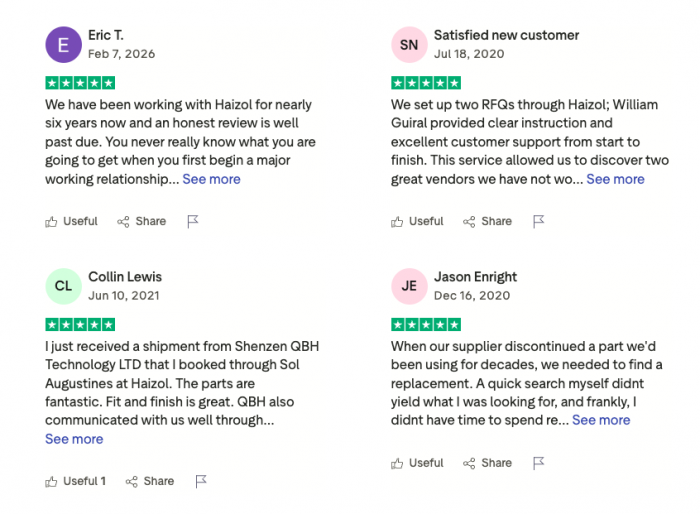
The first signal worth checking is whether independent sources verify the platform's track record. Marketing copy on a vendor's own site means very little. A Trustpilot page with verified buyer reviews, third-party industry recognition, and references from named customers means considerably more.
Haizol, as an example, holds a 4.6 out of 5 rating on Trustpilot based on verified buyer reviews. Trustpilot independently confirms purchase history before publishing, which filters out the fake-review problem that affects most B2B review sites.
The platform was also recognized as Best CNC Machining Online Platform in China in December 2025.
Before you commit to a platform you have not used, look for independently verified reviews, recognition from publications that cover the industry seriously, and customer references the platform will actually let you call.
2. Operating History and Financial Position
Platforms with serious reliability problems do not sustain a decade of operation with verifiable customer records. They run out of buyers, lose factory relationships, or get acquired and rebranded. Length of operation is a weak signal on its own, but combined with financial stability it tells you whether the company will still be there to honor support obligations on a production order that ships next quarter.
Haizol has operated since 2015 and closed a B+ financing round of more than 100 million yuan in 2025, led by the National Service Trade Innovation Development Guidance Fund. That combination of operating history and recent institutional capital makes platform abandonment substantially less likely than with a venture-backed startup still searching for product-market fit.
For any platform under three years old or without disclosed funding, ask how the company is monetized and whether the business model has shown profitability. A platform that loses money on every order is not a stable partner for long-term sourcing.
3. What "Verified Factory" Actually Means
Every CNC platform claims to verify its factories. The word covers everything from a serious capability audit to a checkbox confirming the supplier has a registered business license. The actual depth matters because verification is the layer protecting you from defective parts.
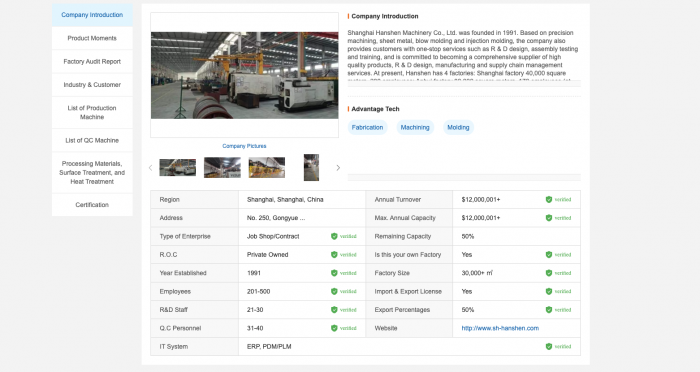
Real verification covers four things. Business credentials and registration are the baseline. Equipment audits confirm the factory actually owns the machines it claims to operate. Certification documentation (ISO 9001, ISO 13485, AS9100D where applicable) is checked against issuing bodies rather than taken at face value. Production capability documentation shows what parts the factory has actually delivered, with photos and tolerance data.
Haizol publishes equipment lists, turnover figures, employee counts, and certification data for each factory before any buyer awards a job. The visibility means you can confirm a supplier's capability for your specific part before any file moves. Platforms that surface only company names and star ratings have not done the same work, regardless of how the verification process is described in their marketing.
4. IP Protection Workflow
The most common security failure in custom parts sourcing is when a CAD file reaches a factory before any NDA is in place. Open marketplaces leave NDA management entirely to the buyer, which usually means files get sent in the rush to compare quotes and no agreement exists when something leaks.
Look for a platform with tiered NDA options built into the quoting workflow. Haizol offers three levels ranging from no NDA for non-sensitive parts, to a platform NDA covering standard cases, to a custom buyer NDA for original designs where the legal terms matter. The custom option lets a buyer impose specific terms on every factory that touches the file without negotiating separately with each one.
For any platform without an NDA workflow, assume your file will reach factories before legal protection exists. That may be acceptable for commodity parts. It is not acceptable for original product designs.
5. Quote Model and Pricing Transparency
How a platform generates quotes tells you a lot about what you are actually buying. Three models dominate.
Multi-quote aggregator platforms route the requirement to several verified factories and return real bids within roughly 24 hours. Haizol uses this model, sending standardized requests to eight or more pre-screened factories and returning competitive quotes the buyer can compare directly. The platform itself does not mark up the prices, which is possible because factories pay membership fees rather than per-order commissions.
Algorithmic platforms like Xometry generate instant quotes from a pricing model rather than from actual factories. The number is convenient but reflects what the platform predicts the work should cost, not what any specific factory will charge. Platform markups are built into the displayed price.
Single-supplier platforms like RapidDirect quote from their own facilities. The quote is real but reflects only one supplier's pricing, with no built-in comparison. Protolabs operates similarly, generating instant quotes from in-house US factories with pricing returned in roughly 20 minutes.
Each model has legitimate use cases. The point is that "instant quote" and "competitive quote" are not the same thing, and the platform should be clear about which one it provides.
6. Account Support You Can Actually Reach
When an order goes wrong, the difference between a platform that handles the problem and one that disclaims responsibility usually comes down to whether you have a named contact. A chatbot, ticket queue, or generic support email does not solve a production issue at the speed required to ship on time.
Haizol assigns a dedicated account manager to each buyer who handles quote questions, supplier coordination, revision requests, and escalations. RapidDirect provides a project manager for active orders. Xometry and Protolabs are self-serve through their respective customer portals, with support available but no individual contact assigned to the account.
For one-off prototypes, self-serve is often fine. For repeat sourcing where production issues need to be resolved quickly, a named contact who knows your project is the more valuable model.
Final Thoughts
The four platforms most procurement teams compare today fall along clear lines.
Haizol is the strongest fit when verified Chinese suppliers, IP protection, and account-managed support matter more than instant pricing. The multi-quote model delivers competitive bids within 24 hours without platform markups.
Xometry suits engineering teams that want an instant price reference during design iteration and value a US-based support structure. The convenience comes with built-in markups.
RapidDirect works for buyers who want a single Shenzhen-based manufacturer with fast turnaround and in-house finishing services. The single-supplier model limits price comparison.
Protolabs is the option when speed matters above all else. Quotes return in roughly 20 minutes from in-house US facilities, with the highest pricing of the four reflecting that infrastructure.
Run through the six criteria before sending a file to a platform you have not used. Verify the external signals. Confirm operating history and financial stability. Check what "verified" actually covers. Confirm an NDA workflow exists. Understand which quote model you are buying. Confirm who you call when something breaks.
A platform that passes all six is rare. A platform that passes none of them has no business holding your CAD files.
Post Comment
Be the first to post comment!