On This Page
- Why DreamPress AI Blew Up So Fast
- What DreamPress AI Claims to Be
- Feature Breakdown Based on Usage
- The iOS App Experience
- Where DreamPress AI Honestly Performs Well
- Limitations, Bugs, and User Complaints
- User Sentiment: A More Honest Consolidation
- DreamPress AI vs Alternatives
- Pricing Reality: Fair or Confusing?
- Conclusion
If you spend any time exploring AI writing tools, chances are DreamPress AI has already popped up on your radar. It’s everywhere, TikTok edits, Twitter reposts, Reddit discussions, and even fancy Dribbble designs showcasing its dreamy UI.
But the real question is simple:
“Is DreamPress AI actually useful, or is it just another AI platform boosted by hype?”
I spent time analyzing its website at DreamPress.ai, the App Store listing, independent reviews (including Skywork, VideoSDK, Tenereteam, and Smutfinder), and Reddit threads—because the marketing pages alone never tell the whole story.
Why DreamPress AI Blew Up So Fast
DreamPress didn’t rise because of aggressive advertising, it rose because users started posting the output.
People shared:
- highly descriptive roleplay scenes
- character-driven short stories
- NSFW content (yes, it comes up frequently in Reddit and Smutfinder discussions)
- stylized storytelling that feels… surprisingly readable
Part of the appeal is that DreamPress positions itself less as a “productivity tool” and more as a “creative sandbox.”
Compared to tools like ChatGPT, which often try to be restrained or formal, DreamPress encourages experimentation. That’s why it attracts:
- fanfiction writers
- roleplay enthusiasts
- casual storytellers
- beginners who want a story without overthinking plot
- adult-content creators (this crowd is openly discussing it on Reddit and comparison sites)
So the hype isn’t random, there’s a specific audience that genuinely enjoys what DreamPress outputs.
What DreamPress AI Claims to Be
According to its official site, DreamPress.ai, the tool presents itself as an AI-powered engine for:
- story writing
- character chats
- plot generators
- audiobook generation
- personalized storytelling
- multiple genre-specific creators (fantasy, sci-fi, horror, etc.)
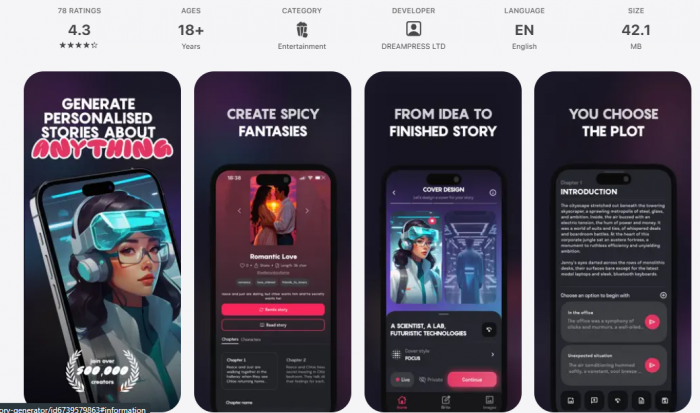
If you check the App Store page:
https://apps.apple.com/us/app/dreampress-ai-story-generator/id6739579863
…you’ll see the same messaging, but the app description is noticeably simplified, likely to appeal to mobile-first users.
In reality, DreamPress behaves like a blend of:
- a story starter
- a creative-writing assistant
- a roleplay chat
- a character-driven prompt expander
It’s not a “novel-writing” tool. It’s not a productivity tool.
It’s more like a place to play with ideas.
Feature Breakdown Based on Usage
Instead of repeating the features word-for-word, here’s how each one actually behaves when tested.
Story Generator
Creates short to medium scenes, not long-form chapters.
The style tends to be descriptive, sometimes overly poetic.
Good for:
Getting a mood, a vibe, or a starter paragraph
Weak for:
Maintaining continuity across long texts
AI Story Writer
This mode tries to extend your text more intelligently.
It’s decent at matching tone, and better at maintaining character names than some competitors.
But:
Sometimes the writing becomes loop-like or repetitive after several expansions.
Personalized Story Generator
This is the feature most people rave about.
You can feed it:
- character names
- settings
- relationships
- vibes
- triggers
…and it tries to “write in that universe.”
Realistically, it’s fun—but don’t expect deep story logic.
Prompt Generator
Actually more useful than expected.
Great for breaking writer’s block.
Plot Generator
A bit generic.
Most plots look like templates reshuffled with new nouns.
Audiobook Generator
Interesting concept, but limited.
It doesn’t narrate full stories, more like short previews.
Character / Roleplay Chat
This is by far the most used feature.
It’s basically a simplified, stylistic version of Character.AI.
People use it for:
- character interactions
- romantic chats
- NSFW scenarios
Tone-wise, it feels more flexible than ChatGPT but less “clever” than Character.AI.
The iOS App Experience
The iOS version:
Feels a lot more “game-like.”
Features missing from mobile:
- advanced customization menus
- longer story context windows
- some niche story categories
Mobile Pros:
- Easy to navigate
- Works offline for reading past stories
- Quick-prompt modes
Mobile Cons:
- Occasional crashes
- Stories sometimes cut off
- Device heating on long generations
It feels like a lightweight sibling of the web app, not a mirror of it.
Where DreamPress AI Honestly Performs Well
Style Mimicry
It captures emotional tone better than most generic AI tools.
Scene Descriptions
Highly visual writing; almost cinematic.
Roleplay responsiveness
It reacts quickly and keeps characters consistent for a few turns.
Casual storytelling
If you want something fun, light, or imaginative, it works.
Beginner-friendly creativity
People who aren't writers can still get satisfying output.
Limitations, Bugs, and User Complaints
You can check:
- Trustpilot reviews → https://www.trustpilot.com/review/dreampress.ai
- Tenereteam complaints → https://dreampress.tenereteam.com/
- Reddit feedback → https://www.reddit.com/r/artificial/comments/zspt7g/
- Smutfinder’s deep critique → https://www.smutfinder.com/blog/dreampress-review-strengths-weaknesses-and-smutfinder-as-the-best-alternative
Here are the recurring issues:
Story Memory Drops After a Few Paragraphs
DreamPress struggles with long-form continuity.
Billing & Subscription Confusion
Some users reported not understanding token consumption or cancellations.
NSFW Inconsistency
Sometimes it allows certain scenes, sometimes it censors abruptly.
Story Repetition
Multiple reviews mention predictable outputs.
Customer Support Delays
Several Trustpilot complaints focus on slow responses.
Limited Customization on Certain Modes
Some features look polished but lack actual depth.
Free Tier is Extremely Limited
Most meaningful functions quickly require payment.
User Sentiment: A More Honest Consolidation
Based on all sources combined:
What People Genuinely Like
- It’s fun
- It’s easy
- It’s aesthetically nice
- It writes in a “storybook” tone that many enjoy
- It handles emotional storytelling well
What People Complain About
- Lack of depth
- Inconsistent memory
- Subscription ambiguity
- Not ideal for professional writing
- NSFW limits come and go
- Some content feels “copy-paste rephrased”
The sentiment is not “bad,” but it’s not overwhelmingly positive either.
It’s more like:
“Good for entertainment. Not good for serious writing.”
DreamPress AI vs Alternatives
DreamPress AI vs NovelAI
NovelAI is better for long-form and lore consistency.
DreamPress is more casual and more visual.
DreamPress AI vs Sudowrite
Sudowrite is a professional writing tool.
DreamPress is a hobbyist tool.
DreamPress AI vs Character.AI
Character.AI offers deeper emotional intelligence.
DreamPress is easier, faster, more playful.
DreamPress AI vs Smutfinder
Smutfinder is more explicit and specialized.
DreamPress feels more “PG-13→R-rated” depending on prompts.
Pricing Reality: Fair or Confusing?
DreamPress doesn’t always clearly explain token usage, especially in the app version.
Problems noted include:
- inconsistent credit consumption
- unexpected pop-ups
- limited free tier
- unclear refund policies
It’s not “scammy,” but it is confusing, especially compared to tools like NovelAI which are transparent about pricing tiers.
Who DreamPress AI Is Actually Good For
If you’re someone who wants:
- casual stories
- short emotional scenes
- flirt/relationship chats
- fanfiction-style prompts
- stylish, vibey writing
- easy creativity without effort
DreamPress works really well.
It's basically an “AI toybox” for creativity.
And Who Should Probably Skip It
If you want:
- long-form novel writing
- stable memory
- structured plot logic
- professional output
- nonfiction quality
- research-grade writing
DreamPress isn’t going to satisfy you.
It’s not built for complexity, it’s built for play.
Conclusion
After digging through the website, reading user feedback across Reddit and Trustpilot, checking independent reviews like Smutfinder and Skywork, and spending time using DreamPress myself, the overall picture becomes clear. DreamPress AI isn’t pretending to be a professional writing suite or a serious publishing tool, and it doesn’t behave like one. What it does offer is a space for casual creativity: short scenes, emotional storytelling, character interactions, and the kind of writing people generate for fun rather than structure.
It delivers moments of surprisingly vivid writing, but it also falls into repetition, loses context quickly, and occasionally behaves unpredictably. Those issues don’t make it a bad tool, they just make it a tool with a very specific audience. If you enjoy experimenting with ideas, playing with characters, or generating imaginative snippets without worrying too much about perfect continuity, DreamPress will feel enjoyable. If you need tightly crafted long-form writing or professional-grade consistency, you’ll likely run into frustration.
In the end, DreamPress AI works best when treated as a creative sandbox, not a writing engine. The more you use it for light, exploratory storytelling, the more sense it makes—and the fewer expectations you place on it, the more you’ll appreciate what it actually does well.
Post Comment
Be the first to post comment!