In the rapidly evolving world of generative artificial intelligence, Civit AI has emerged as one of the most influential and talked-about platforms. Serving as a community-oriented hub for AI art generation and model sharing, it occupies a unique position between open-source collaboration and commercial AI services. This article explores Civit AI’s features, pricing, user sentiment, controversies, and alternatives offering a balanced view that reflects real-world feedback from users and observers.
A Platform Built by Creators, for Creators
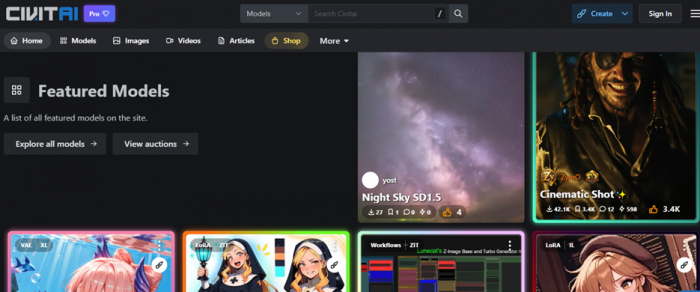
At its core, Civit AI is a model marketplace where artists, developers, and hobbyists share and explore generative AI assets like Stable Diffusion checkpoints, LoRAs (low-rank adaptation models), embeddings, and other tools for image and media creation. Its mission has been to democratize access to high-quality generative tools and foster community learning, discussion, and collaboration.
Unlike many commercial AI services that restrict model access behind locked APIs, Civit AI enables users to download and use thousands of models for free, allowing for deep customization and experimentation.
Pricing and How “Buzz” Works

One of Civit AI’s defining features is its hybrid pricing model based on a virtual currency called Buzz. At a glance:
- The Free tier costs nothing and allows browsing, downloading models, and limited generation.
- Paid plans Bronze (~$10/month), Silver (~$25/month), and Gold (~$50/month) grant monthly Buzz credits and additional perks such as priority support and expanded generation capacity.
Buzz credits are used to power on-site generation (text-to-image, image-to-image, or video), and users can earn some Buzz through platform engagement or purchase more as needed.
This structure positions Civit AI somewhere between a free community repository and a credit-based AI generation service, allowing flexibility but also introducing complexity that many users find confusing.
User Sentiment: Diverse and Divided
A Spectrum of Opinions: From Praise to Profound Frustration
Sentiment toward Civit AI is far from uniform. Instead of a single narrative, there are multiple overlapping communities of users, each with their own experiences and expectations. This fragmentation has produced strongly polarized opinions.
1) Positive Sentiment: Why Many Users Still Value Civit AI
Even among mixed feedback, there are consistent themes of appreciation:
- Unmatched Variety of Models: Still today, Civit AI hosts one of the broadest collections of generative models anywhere online from character-centric LoRAs to experimental SDXL variants. For creators who want diversity and experimentation, this breadth remains a major strength. (GeniusFirms)
- Free Access to Core Features: Many users point out that model downloads and browsing remain free, allowing newcomers and hobbyists to explore AI creativity without upfront expense.
- Community Support: Comment sections, ratings, prompt examples, and creator feedback help beginners learn and iterate. This dynamic built-in community is often cited as a reason to stick with the platform.
- Genuine Interactions: On social platforms like Reddit, some users report positive direct interactions, finding helpful, sincere communication especially around model sharing and collaborative support.
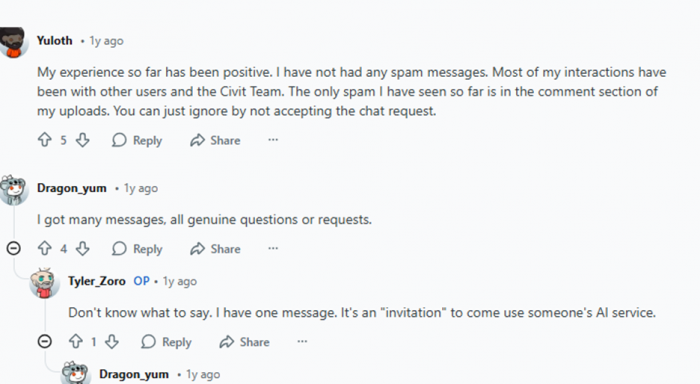
This blend of accessibility, variety, and social connectivity keeps a core group engaged even amid broader critiques.
2) Negative Sentiment: Frustrations That Fuel Outrage
At the opposite end of the spectrum, there is very strong negativity especially on public review sites like Trustpilot and in Reddit communities.
A. Trustpilot’s Strongly Negative Ratings
Civit AI’s Trustpilot profile shows a deeply skewed rating distribution:
- 78% of ratings are 1-star, with numerous accusations of poor support, bans without explanation, and paywall frustration.
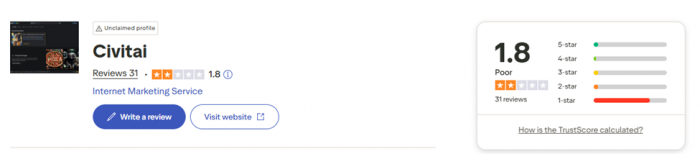
This level of negative review volume suggests that many users feel compelled to publicly express their dissatisfaction often forfeiting anonymity to do so.

B. Complaint Themes on Reddit & Social Platforms
Across multiple threads, the same points keep recurring:
Monetization & Buzz Frustration
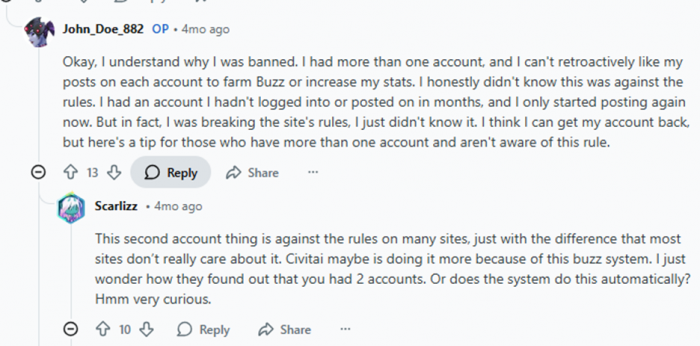
- Users frequently complain that the Buzz economy feels confusing or unfair, with costs increasing without clear notice and features being moved behind paywalls.
- Some report getting banned or throttled after spending Buzz, or being confused about Buzz spending mechanics.
Technical & UX Issues
- Instances of slow generation, inconsistency, or reduced image quality have been flagged repeatedly.
Quality Control & Platform Fairness
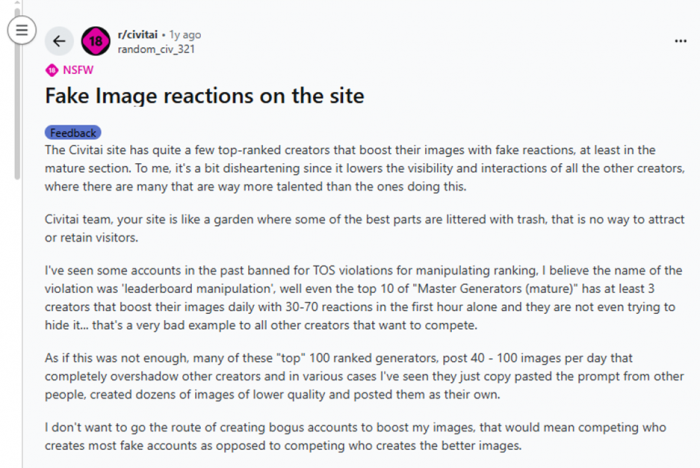
- Some users accuse others of gaming reaction counts to promote content unfairly, which undermines trust in the community ranking system.
- undermines trust in the community ranking system.
Together, these issues create persistent dissatisfaction among power users, creators seeking professionalism, and paying subscribers.
3) Controversy Over Content Policy Changes
A particularly charged dimension of Civit AI’s reception revolves around content moderation and evolving policies:
- In 2025, Civit AI introduced stricter content guidelines that limited categories like incest, self-harm themes, and required NSFW uploads to include specific metadata. These changes sparked significant backlash with over 950 adverse reactions compared to far fewer supportive ones.
This wasn’t just a technical change, it affected user identity and creative freedom. For users who relied on certain styles or communities (especially adult-oriented art), the perception was that their contributions were suddenly invalidated or censored, with minimal communication.
That, in turn, has led to comments like:
“Anyone else completely lost motivation to engage with Civitai and share models?”
and broader community sentiment framing the change as driven by external pressure (e.g., from payment processors like Visa/Mastercard).
4) Nuanced or Neutral Views:Some Users See Room for Both Good and Bad
Not all feedback is strictly positive or negative. Many users express mixed feelings:
- Some acknowledge the value of the platform’s resources, but feel the monetization path and UX haven’t matured well.
- Others recognize that the platform still has community value, even while critiquing specific policy decisions. (Trustpilot)
This group tends to be the largest informal cluster neither evangelists nor outright critics and is often absent from extreme review sites because they don’t feel strongly enough to post.
5) Overall: Why Sentiment Is So Polarized
Civit AI doesn’t occupy a middle ground in public perception. The platform’s features are simultaneously seen as:
- Empowering and open by many creators.
- Confusing, expensive, or unstable by others.
- Creative and collaborative, yet also unmoderated and chaotic.
This divergence arises because different segments of the user base have fundamentally different goals:
- Hobbyists appreciate access and variety.
- Professional creators expect stability and predictable value.
- Critics of content restrictions see policy changes as censorship.
- Casual users may be frustrated by cost mechanics or search/UX friction.
Each group interacts with Civit AI’s features through a very different lens and that’s why user sentiment remains so distributed and multifaceted, rather than converging on a single consensus.
The Debate Around Buzz and Monetization
If there’s one topic that consistently surfaces across Reddit threads and social discussions, it’s the Buzz economy. Users regularly discuss fluctuations in Buzz costs and how unpredictable pricing impacts their workflow. In some cases, generation prices have apparently increased without clear explanation, leading to community tension.
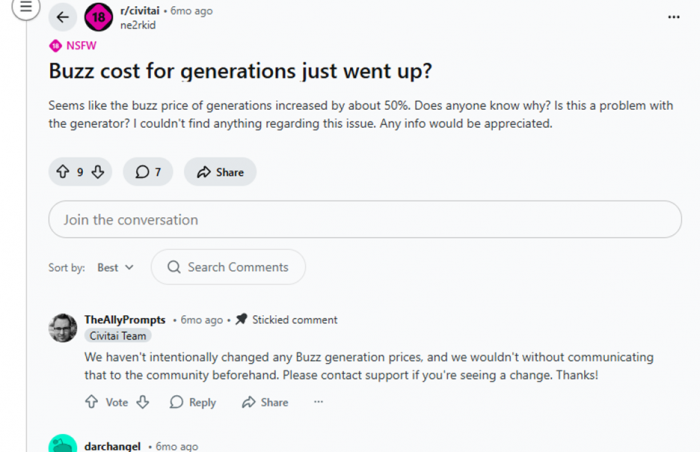
These tensions reflect a broader challenge for platforms that mix free community contributions with paid features: balancing sustainability with openness. Civit AI’s attempt to monetize access particularly as generation features and video capabilities become more expensive has tested user loyalty, even as many continue to value the deep model repository.
Controversies, Content Moderation, and Safety
Because Civit AI hosts models created by countless users, the platform faces governance and safety challenges typical of open communities. Independent academic research into generative AI platforms, including Civit AI, highlights concerns around harmful content generation, such as NSFW material and deepfakes, which can spread without adequate controls.
This underscores a tension: while open ecosystems encourage experimentation and creativity, they can also enable content that violates ethical or legal standards if governance doesn’t keep pace with innovation.
Alternatives: Where Users Go Next
| Platform | Best For | Free Tier | Model Marketplace | Generation Quality | Ease of Use | Key Strength |
| Civit AI | Model collectors & power users | Yes | Yes (largest) | High (varies by model) | Moderate | Huge open model library |
| Hugging Face | Developers & researchers | Yes | Yes | High (technical) | Low–Moderate | Open-source ecosystem |
| SeaArt.ai | Fast creators & beginners | Yes | No | Very High | High | Simple UI & fast results |
| Mage.space | Casual users | Yes (slow) | No | Medium–High | Very High | Unlimited free generations |
| Leonardo AI | Designers & professionals | Limited | No | Very High | High | Studio-quality outputs |
| PixAI.art | Anime & character art | Yes | Partial (LoRA tools) | Very High (niche) | High | Anime-focused tools |
| Tensor.art | Prompt engineers | Yes | Yes | High | Moderate | Strong workflow controls |
| RepublicLabs.ai | Budget creators | Yes | Partial | High | High | Transparent pricing |
Final Thoughts: A Hub with Heart and Headaches
Civit AI remains one of the most influential platforms in the generative AI ecosystem precisely because of its breadth of community content and model diversity. Enthusiasts and power users praise its technical depth and collaborative spirit, and many beginners find it an ideal place to learn and experiment with AI art.
At the same time, ongoing concerns around monetization, platform performance, and content policy underscore the challenges of scaling a community-driven project into a sustainable service for millions. The platform’s evolution and its ability to balance innovation with transparency will likely determine whether it retains its passionate core or continues to fragment.
For creators and readers alike, Civit AI remains a compelling case study in how community, creativity, and commerce intersect in the age of generative intelligence.
Post Comment
Be the first to post comment!