On This Page
- How I Start the Decision (Before Touching Any Dashboard)
- When I Choose GoDaddy (And Why That’s a Rational Choice)
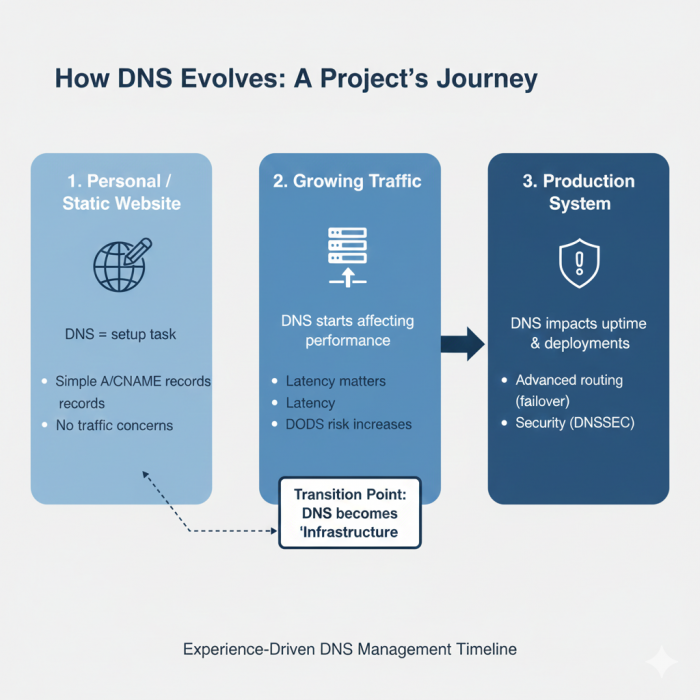
- The First Warning Signs That DNS Is Becoming Important
- Why I Move to Route 53 for Anything I Expect to Grow
- Performance: Why I Care More About Predictability Than Speed
- Reliability: How I Personally Define “Acceptable Downtime”
- Pricing: Why Route 53 Feels Fairer Over Time
- Automation: Where I Stop Compromising
- Security: What I Expect DNS to Do by Default Now
- UX Reality: Why “Harder” Isn’t Always Worse
- My Final Conclusion
I no longer treat DNS as a checkbox.
In 2025, DNS is one of those quiet components that either fades into the background or becomes the reason things break at the worst possible moment.
After working with small websites, growing platforms, and production systems, my approach to choosing between AWS Route 53 and GoDaddy has changed completely.
This isn’t a feature comparison.
This is how I personally evaluate DNS based on how a project behaves over time.
How I Start the Decision (Before Touching Any Dashboard)
Before pricing, before SLAs, before documentation, I ask myself:
What role will DNS play in this project six months from now?
Because DNS rarely fails on day one.
It fails during:
- traffic spikes
- migrations
- partial outages
- rushed deployments
If DNS is only meant to exist, my choice is simple.
If DNS needs to react, my choice changes.
That framing saves me from overengineering or underengineering, early on.
When I Choose GoDaddy (And Why That’s a Rational Choice)
If I’m building:
- a personal site
- a brochure website
- a local business presence
- a static project with predictable traffic
I don’t pretend it needs enterprise DNS.
I choose GoDaddy because:
- the domain purchase and DNS live together
- the interface doesn’t demand technical depth
- record changes are rare
- the risk profile is low
At this stage, DNS is administrative, not architectural.
I’m not planning failover.
I’m not routing by geography.
I’m not automating deployments.
And that’s okay.
Using Route 53 here would add:
- mental overhead
- AWS account management
- unnecessary complexity
For small, stable projects, GoDaddy feels appropriate, not inferior.
The First Warning Signs That DNS Is Becoming Important
The shift never happens all at once.
It creeps in.
I notice things like:
- users accessing the site from multiple countries
- deployments happening more frequently
- downtime causing real stress instead of mild annoyance
- infrastructure spreading across services instead of one server
This is when DNS stops being invisible.
With GoDaddy, I can still manage DNS, but now I’m working around it instead of with it.
That’s usually when I pause and reassess.
Why I Move to Route 53 for Anything I Expect to Grow
When I choose Route 53, it’s because I’ve accepted one truth:
- This project will not stay simple.
- Route 53 fits the way I already build systems:
- infrastructure as code
- automated scaling
- failure-aware design
- DNS becomes part of that system.
Instead of just pointing a domain, I can:
- route users to the nearest region
- shift traffic away from unhealthy endpoints
- control rollouts using weighted records
- make DNS changes through Terraform commits
At this point, DNS stops being configuration and becomes logic.
That’s a fundamental shift.
Performance: Why I Care More About Predictability Than Speed
I’ve learned not to obsess over headline latency numbers.
What matters to me is:
- consistency across regions
- predictable behavior during traffic spikes
- no sudden slowdowns I didn’t plan for
Route 53’s Anycast network gives me confidence that:
- DNS resolution behaves the same for users in Europe, Asia, or the US
- sudden popularity doesn’t degrade lookup performance
- With GoDaddy, performance is fine locally, but less predictable globally.
If all my users are in one country, this barely matters.
If my users are distributed, DNS becomes part of user experience whether I acknowledge it or not.
Reliability: How I Personally Define “Acceptable Downtime”
This is where my tolerance has changed over the years.
For some projects:
Downtime means a missed visit
For others:
Downtime means lost trust, broken integrations, or breached SLAs
Route 53 assumes failure will happen and builds around it:
- region-level redundancy
- automated failover
- health-check-driven routing
GoDaddy assumes failure is rare and humans will respond.
Neither approach is wrong, but only one matches how I build critical systems today.
Pricing: Why Route 53 Feels Fairer Over Time
GoDaddy pricing feels comfortable because it’s familiar:
- yearly renewals
- predictable invoices
- bundled features
- Route 53 pricing feels uncomfortable at first:
- hosted zones
- per-million query charges
- no “everything included” plan
But over time, I’ve realized something important:
DNS costs scaling usually mean the product is scaling.
I’d rather pay more because people are actually using my system than pay flat fees that hide limitations.
Route 53 pricing aligns cost with usage.
GoDaddy pricing aligns cost with ownership.
Both make sense, just for different stages.
Automation: Where I Stop Compromising
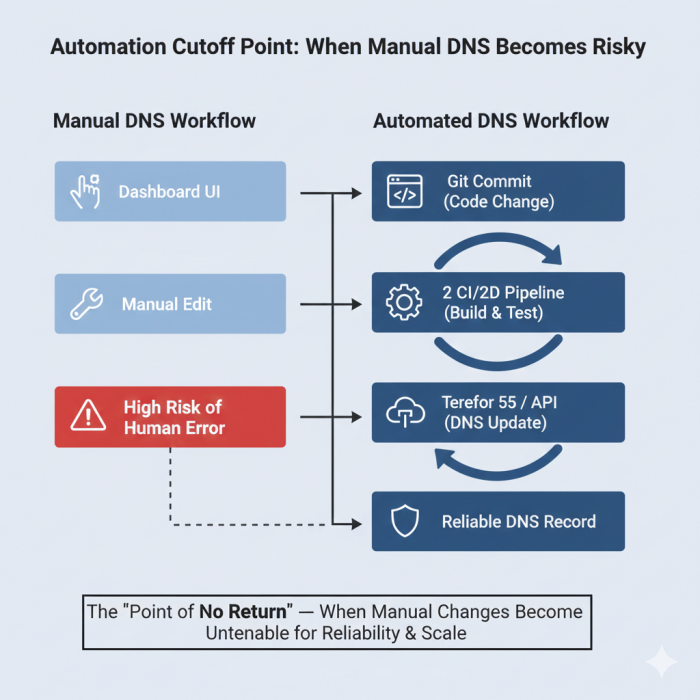
Once a project uses:
- CI/CD pipelines
- Terraform or CloudFormation
- auto-scaling infrastructure
- Manual DNS becomes a liability.
With Route 53:
- DNS lives in version control
- changes are reviewed
- rollbacks are instant
- humans aren’t racing dashboards during incidents
At this stage, click-based DNS feels unsafe to me, not simple.
That’s my personal cutoff point.
Security: What I Expect DNS to Do by Default Now
I no longer think of DNS as neutral.
DNS can be attacked, abused, or manipulated, and when it is, debugging is painful.
Route 53 gives me:
- built-in DDoS protection
- straightforward DNSSEC
- IAM-based access control
- audit trails
With GoDaddy, security exists—but often as an add-on or upgrade.
For low-risk sites, that’s acceptable.
For production systems, I want security baked in, not optional.
UX Reality: Why “Harder” Isn’t Always Worse
I won’t pretend Route 53 is friendly.
The AWS console assumes:
- technical literacy
- understanding of cloud concepts
- comfort with abstraction
GoDaddy assumes:
- you just want it to work
- That difference is intentional.
When I don’t need control, I don’t force complexity.
When I do need control, simplicity becomes a constraint.
My Final Conclusion
If I’m honest with myself:
GoDaddy is where I start projects.
Route 53 is where I take them when they matter.
Not because GoDaddy fails—but because projects evolve.
How I actually build in 2025:
I buy domains wherever it’s cheapest and convenient
I move DNS to Route 53 when performance, automation, or uptime becomes critical
That hybrid approach isn’t theoretical, it reflects real-world growth.
DNS isn’t just a setting anymore.
For me, it’s infrastructure, and I choose it accordingly.
Post Comment
Be the first to post comment!