Marketing measurement rarely fails because of a lack of data. It fails because the data is fragmented, inconsistent, or difficult to trust. Most platforms promise clarity, but few explain how that clarity is achieved or what assumptions are baked into the measurement.
AppsFlyer presents itself as a “Modern Marketing Cloud” on its official website, appsflyer.com, designed to unify attribution, deep linking, data collaboration, and AI-assisted workflows across mobile apps, web, CTV, and even PC/console environments. Rather than taking that positioning at face value, this article examines what AppsFlyer is actually used for, what data it tracks, and where its limits become visible in real-world usage.
To understand that, it helps to first look at why marketing measurement became so fragmented in the first place.
Why Marketing Attribution Became Difficult Before Platforms Like AppsFlyer
Before dedicated attribution platforms emerged, marketing teams typically relied on:
- Platform-reported last-click attribution
- App analytics tools limited to single environments
- Manual reconciliation between ad dashboards and internal BI tools
Peer feedback and internal reports often conflicted, while privacy changes such as Apple’s SKAdNetwork further reduced deterministic visibility. This created a gap between activity and confidence, teams could see signals, but struggled to defend decisions.
AppsFlyer’s existence is best understood as a response to this fragmentation, which leads naturally to the question of what the platform is actually used for today.
What AppsFlyer Is Used For in Practice
In real deployments, AppsFlyer is most commonly used for a set of tightly related functions rather than as a general marketing tool.
Attribution and ROI Measurement Across Channels
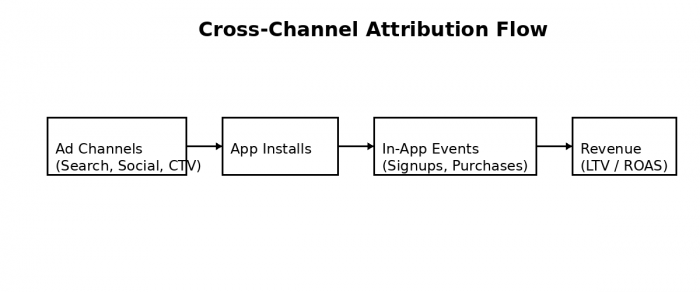
AppsFlyer’s Measurement Suite focuses on connecting installs, in-app events, and revenue back to marketing touchpoints. According to analysis published by Business of Apps, the platform is widely adopted by mobile-first businesses for attribution and ROI tracking rather than campaign creation.
Deep Linking and User Routing (OneLink)
AppsFlyer’s OneLink system handles journeys such as web-to-app, QR-to-app, email-to-app, and social-to-app routing. This capability is documented on AppsFlyer’s own product pages and is typically used to avoid sending users to generic landing screens instead of contextual in-app locations.
Fraud Detection and Traffic Quality
AppsFlyer claims to provide real-time fraud detection to block bots and fake installs. This is especially relevant in performance marketing, where invalid traffic can distort attribution without delivering real users.
Privacy-Safe Data Collaboration
AppsFlyer also promotes privacy-first data collaboration through clean-room-style environments, allowing brands and partners to analyze performance without exchanging raw user-level data.
Understanding these use cases leads directly to another common question: who owns AppsFlyer and how the company itself is structured.
Who Owns AppsFlyer and How the Company Is Structured
AppsFlyer is a privately held company, founded in 2011 by Oren Kaniel and Reshef Mann. This information is publicly documented on Wikipedia’s AppsFlyer page and corroborated by the company’s profile on LinkedIn.
Because AppsFlyer is not publicly listed, detailed financial disclosures are limited. As a result, most external evaluation relies on usage data, customer reviews, and ecosystem adoption rather than earnings reports.
That makes the next topic particularly important: what kind of data AppsFlyer actually tracks.
What Kind of Data AppsFlyer Tracks
AppsFlyer’s SDK documentation, available via its Help Center, explains that the platform automatically collects identifiers used for attribution. These include:
- AppsFlyer ID
- Google Advertising ID (GAID)
Additional documentation explains that other identifiers may be collected depending on SDK configuration, consent settings, and specific implementation choices. Technical references for these behaviors are outlined in AppsFlyer’s developer documentation and privacy materials.
In practical terms, AppsFlyer tracks event-level and identifier-based data to connect user actions with marketing sources. This is not unusual for attribution platforms, but it does place AppsFlyer at the center of ongoing privacy discussions—especially as regulations evolve.
That tension between accuracy and privacy helps explain why AppsFlyer now frames itself as more than an attribution tool.
The “Modern Marketing Cloud” Positioning: What It Adds, and What It Doesn’t
On its homepage, AppsFlyer groups its capabilities into four pillars:
- Measurement Suite – attribution, analytics, incrementality testing, fraud protection
- Deep Linking Suite (OneLink) – routing users into relevant in-app destinations
- Data Collaboration Suite – clean rooms and privacy-safe partner measurement
- Agentic AI Suite – including Agent Hub and Model Context Protocol (MCP) for AI-driven workflows
This structure suggests breadth, but it’s important to separate measurement enablement from decision-making.
AppsFlyer does not claim to:
- Design creative strategy
- Define campaign messaging
- Fix poor event instrumentation
It surfaces data and patterns. What teams do with that information remains a human and organizational challenge, which becomes especially visible when reviewing user feedback.
Why AppsFlyer’s Ratings Vary So Widely by Platform
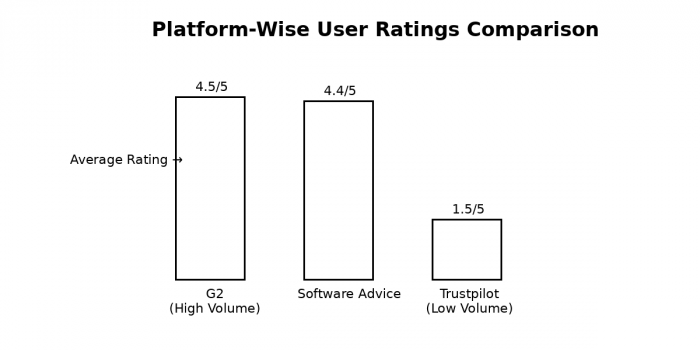
Third-party review sites paint a mixed but instructive picture.
On G2, AppsFlyer holds an average rating of 4.5/5 from over 680 verified reviews, suggesting strong satisfaction among enterprise and mid-market users who rely on the platform regularly.
Similarly, Software Advice reports a high average rating, with most reviewers awarding four or five stars for reliability and measurement depth.
However, on Trustpilot, the rating drops significantly (around 1.5/5 at the time of writing), with complaints often centered on billing, support responsiveness, or expectation mismatches rather than core attribution accuracy.
This divergence suggests that AppsFlyer performs best for teams with analytics maturity, while friction appears when onboarding, pricing, or support expectations are unclear.
That distinction becomes clearer when looking at AppsFlyer’s ecosystem and customer base.
Ecosystem, Partners, and Industry Adoption Signals
AppsFlyer claims integrations with over 10,000 partners and reports usage by more than 15,000 brands, including companies such as Netflix, Pepsi, Ubisoft, GAP, and Burger King. These claims are referenced across its website and reinforced by its visibility on platforms like YouTube, where the company publishes technical walkthroughs and educational sessions.
AppsFlyer also releases industry benchmarks such as the Performance Index, which are frequently cited in marketing analysis discussions.
While ecosystem size does not guarantee fit for every organization, it does indicate that AppsFlyer operates at a scale where governance, compliance, and reliability are critical concerns—bringing privacy back into focus.
Privacy, Regulation, and Ongoing Scrutiny
AppsFlyer publishes detailed privacy and compliance documentation outlining alignment with frameworks such as GDPR and SKAdNetwork. These materials are accessible through its official legal and privacy pages.
At the same time, AppsFlyer has been referenced in broader industry discussions and media coverage, including reporting by Reuters, in the context of regulatory complaints involving analytics vendors and data sharing practices. These mentions do not imply wrongdoing, but they do highlight why attribution platforms remain under scrutiny.
For buyers, this reinforces the importance of reviewing:
SDK configuration options
Consent management flows
Data retention and sharing controls
Which leads naturally to the question of who AppsFlyer is actually best suited for.
Who AppsFlyer Is Most Likely to Benefit From
Based on usage patterns and review data, AppsFlyer appears most suitable for:
- App-first businesses with significant paid acquisition
- Teams running campaigns across mobile, web, and CTV
- Organizations with mature analytics and event schemas
- Marketers who need defensible ROI and attribution reporting
It may be less suitable for:
- Very small teams without analytics resources
- Businesses expecting immediate clarity without setup effort
- Users looking for creative guidance rather than measurement
- Understanding this fit helps explain why opinions on AppsFlyer vary so widely.
Final Assessment
AppsFlyer does not position itself as a creative or growth-hacking platform. Its core value lies in measurement discipline—providing structured ways to observe what happened, where users came from, and how performance changes over time.
For teams willing to invest in proper instrumentation and governance, AppsFlyer can function as a reliable measurement layer. For others, it may feel complex or underwhelming. That gap between expectation and execution is where most criticism, and most praise, tends to originate.
Post Comment
Be the first to post comment!