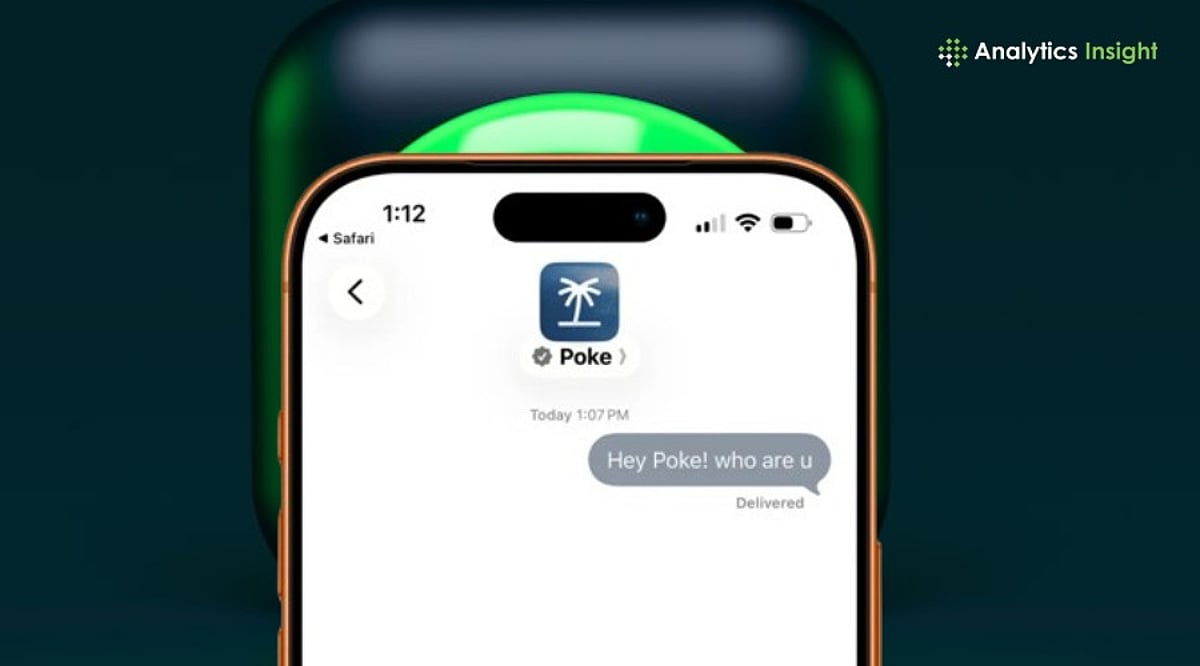
Apple has approved Poke as the first AI agent allowed to run on its Messages for Business platform, marking a notable shift in how third-party AI assistants may enter Apple’s tightly controlled messaging ecosystem.
The approval gives Poke, a Palo Alto-based startup behind a text-based AI assistant, a way to operate through Apple Messages. Until now, Messages for Business has mainly been used by airlines, retailers, hotels, banks, and service providers to communicate with customers through iMessage-style chats. It supported customer service, live agents, appointment scheduling, automated replies, and support workflows. It was not previously known as a channel for standalone consumer AI agents.
That makes Poke’s approval important beyond the startup itself. Apple is allowing an AI assistant to reach users inside a familiar messaging surface, but through a channel that already has review rules, verified business identities, interface standards, and support expectations. It is a cautious opening, not a free-for-all.
The timing is also significant. The approval came just days before Apple’s WWDC event, where the company is expected to put more attention on AI tools, Siri upgrades, and developer-facing AI features. Poke’s case suggests Apple may be willing to let AI agents into parts of its ecosystem, but only under strict platform controls.
What Poke does inside messaging
Poke is designed as a personal AI assistant that works through text. Instead of asking users to open a complex dashboard, manage workflows in a separate app, or use a developer-style interface, Poke lets them interact with an AI agent through normal messaging.
The assistant can help with daily planning, calendar management, reminders, personal workflows, fitness and health tracking, smart home control, and photo editing. It can also connect with outside services such as Notion, Oura, and Gmail, giving users a way to organize documents, search emails, draft messages, track sleep and activity insights, and manage inbox-related tasks.
The company says it works across familiar messaging platforms, including Apple Messages, WhatsApp, and Telegram, while also offering SMS support in some markets. With Apple’s approval, Poke can now offer an iMessage-style experience with rich actions and a verified Apple Messages interface.
That matters because messaging changes how an AI assistant feels. A standalone app asks users to remember to open it. A messaging-based assistant feels more like a contact. Users can ask for help in the same place where they already talk to friends, businesses, and service providers.
Apple’s controlled route into AI agents
The bigger story is not only that Poke can appear in Apple Messages. The bigger story is how Apple is allowing it.
Poke did not simply plug into the platform overnight. Apple required the startup to show that live support would be available when needed, that the assistant would be clearly identified as AI, and that the experience would follow Apple’s interface standards. Poke also had to submit testimony from messaging providers and adapt the product to Apple’s design requirements.
That included using Apple-style buttons and interface elements, along with link previews rather than standard inline links. The approval process reportedly took a couple of months, which suggests other AI companies should not expect instant access.
Those rules reflect Apple’s broader platform philosophy. The company is not opening Messages as a loosely controlled agent marketplace. It is testing AI assistants through a structured business messaging channel where identity, support, interface quality, and user expectations are easier to manage.
For users, that could mean a cleaner and more trusted experience. For startups, it creates both opportunity and friction. Getting into Apple Messages may offer valuable distribution, but only for companies that can meet Apple’s standards around support, presentation, and reliability.
Why this matters for Apple’s AI strategy
Apple has moved more slowly than some rivals in generative AI, but its ecosystem gives it a different kind of leverage. The iPhone is not just another device. It is where users manage messages, payments, calendars, photos, apps, and personal communication. If AI agents become part of daily life, the messaging layer could become one of the most valuable places to reach users.
Poke gives Apple a way to test that idea without fully opening iOS to autonomous agents that can act broadly across the device. Messages for Business is a safer path because it already has limits. Businesses are verified, conversations follow Apple’s interface standards, and support expectations are built into the system.
This could become a new distribution model if more AI agents are approved later. A user may not need to download a separate app for every assistant. Instead, some agents could operate through verified messaging channels, where Apple controls the experience and charges platform fees.
Poke co-founder Marvin von Hagen said the startup will pay Apple on a per-user basis, though the exact pricing has not been disclosed. If AI agents become common inside Messages for Business, that model could become a new revenue stream for Apple.
Messaging becomes the next AI battleground
Apple’s move arrives as other major platforms are also turning messaging into an AI distribution layer. Meta has been pushing AI business agents across WhatsApp, Messenger, and Instagram, with tools designed to answer customer questions, qualify leads, book appointments, recommend products, and close sales.
That competition matters because messaging is where users already spend time. AI agents do not need to convince people to adopt a new interface if they can appear inside the chats people already use. For businesses, that can reduce friction. For consumers, it can make AI assistance feel more natural.
Apple’s approach is different from Meta’s. Meta is moving aggressively across business messaging at massive scale. Apple appears to be moving more cautiously, using Messages for Business as a controlled entry point. That may slow adoption, but it also fits Apple’s emphasis on quality, privacy, and platform governance.
What this means for AI startups
For AI startups, Poke’s approval is encouraging but not simple. It shows that Apple may allow third-party agents into its messaging ecosystem, but also that the path will require more than a chatbot wrapper.
Companies will likely need live support, clear AI disclosure, trusted messaging providers, Apple-compliant design, privacy controls, and a product that fits the expectations of Messages for Business. That could separate more serious AI agent startups from lightweight assistants that are not prepared for platform review.
Poke’s own funding gives it some room to pursue that route. The startup, built by The Interaction Company of California, has around 10 people and has attracted backing from investors including Spark Capital and General Catalyst. It recently added $10 million in funding on top of a previous $15 million seed round, giving it a reported $300 million post-money valuation.
That valuation reflects the broader bet behind the company: AI assistants may become more useful when they live inside everyday communication channels rather than isolated apps.
A cautious opening for Apple’s AI future
Apple’s approval of Poke is a small product milestone with larger implications. It suggests Apple may be willing to let AI agents operate inside its ecosystem, but only through channels where it can preserve control over identity, interface quality, support standards, and monetization.
For users, the immediate change is simple: an AI assistant can now live inside Apple Messages. For developers, the message is more complex. Apple may be opening the door, but it is still holding the handle.
The next question is whether Poke remains a one-off approval or becomes the first sign of a broader AI-agent distribution model inside Messages. If Apple expands this path, the future of AI assistants on the iPhone may not begin as another app icon. It may begin as a verified chat.
Post Comment
Be the first to post comment!